Best Fertilizer for St. Augustine Grass in Texas (2026 Top Picks)
 Marcus GreenTurf Management Pro | 18 Years
As an Amazon Associate we earn from qualifying purchases.
If you have ever watched a lush green St. Augustine lawn go pale and patchy by mid-July in Texas, you already know the truth: feeding this grass here is not the same as feeding it anywhere else. Texas hands St. Augustine a brutal combination of triple-digit heat, swampy Gulf humidity, alkaline clay in some places and acidic sand in others, plus summer water restrictions that show up right when the lawn is hungriest. The fertilizer routine that keeps a yard thriving in Florida or coastal Georgia will get you chinch bug damage, gray leaf spot, and iron chlorosis if you run it blindly across Texas.
St. Augustine is the king of warm-season turf along the Gulf Coast for good reason. It loves heat, it shades out weeds with its broad blades, and it tolerates a little salt and humidity better than almost anything else. But it is a hungry grass, and "hungry" plus "Texas summer" is a tightrope. Feed it too little and it thins out and lets weeds and disease move in. Feed it too much nitrogen in July and you are basically fertilizing the fungus and the bugs instead of the lawn.
This guide is built specifically for Texas conditions. Not generic St. Augustine advice, but the real regional differences between the humid Houston coast, the sandy acidic soils of East Texas, and the alkaline Blackland clay around Austin and San Antonio. I will cover exactly how much nitrogen to put down, the best fertilizers for 2026, a feeding schedule broken out by region, and how to handle the problems Texas throws at this grass. If you are not even sure you are looking at St. Augustine versus another warm-season grass, run a photo through our free grass identifier first so you are feeding the right turf.
Why Texas St. Augustine Is Different
The first thing to understand is that Texas grows two main St. Augustine cultivars, and they behave differently. Raleigh is the workhorse across most of the state. It handles heavy clay well, it shrugs off cold snaps better than the Gulf types, and it has more tolerance to St. Augustine Decline (SDS), which is why so many sod farms and box stores push it. Floratam runs along the warm Gulf Coast where it gets bigger and more vigorous, but it is not cold hardy, so it tends to struggle north of the immediate coast. Knowing which one you have shapes how aggressively you can feed and when you stop for the year.
The second thing is soil, and Texas does not give you one soil. The humid Gulf Coast and East Texas lean acidic and sandy, which means nutrients (especially nitrogen) leach through faster and you feed in smaller, more frequent doses. Inland Central Texas is the opposite world: alkaline Blackland clay and caliche with a high pH that chemically locks up iron. That is why so many Austin and San Antonio St. Augustine lawns turn yellow even when they are getting plenty of nitrogen. The fix there is iron, not a heavier nitrogen bag. Below is the short list of products I reach for most across these conditions, and I will break down each one in the comparison section.
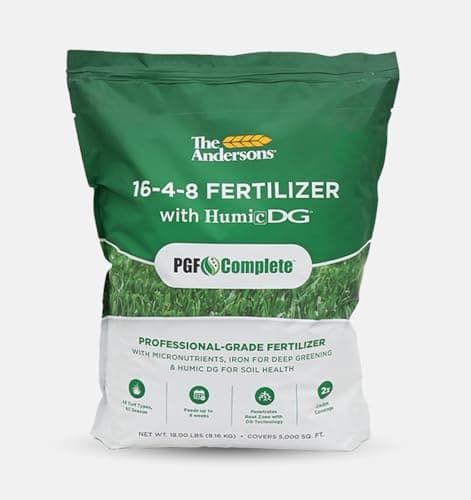
- Editor pick (balanced slow-release for most Texas lawns): The Andersons Professional PGF Complete 16-4-8 Fertilizer with 7% Humic DG
- Organic plus iron and slow nitrogen: Milorganite All-Purpose Slow-Release Nitrogen 6-4-0 Fertilizer
- Fast green-up with iron for tired summer turf: Dark Matter 21-0-0 Ammonium Sulfate Fertilizer
The third factor is climate stress. Texas summers bring extreme heat, drought, and water restrictions in Central Texas at exactly the time St. Augustine wants water and food. That combination is why the smart Texas approach favors lighter, slow-release feeding over big nitrogen pushes. A slow-release product feeds the grass steadily without forcing a flush of soft, disease-prone growth in the worst of the heat. For a deeper look at this grass beyond fertilizer, our St. Augustine grass pillar guide covers mowing, watering, and variety selection.
NPK Targets for Texas St. Augustine
St. Augustine is a heavy nitrogen feeder. The total annual target across a full season is 1 to 4 lbs of actual nitrogen per 1,000 square feet, per Texas A&M AgriLife guidance (EHT-144). Lean toward the lower end (around 1 to 2 lbs) on sandy East Texas soils where you want to avoid pushing soft growth, and toward the higher end (3 to 4 lbs) on a vigorous, well-watered long-season Gulf Coast lawn on heavier soil. One more adjustment from TAMU: St. Augustine growing in shade needs roughly half the nitrogen of lawns in full sun, so dial the rate down under trees. Note that this is "actual nitrogen," not bag weight. A 16-4-8 bag is 16 percent nitrogen, so a 20 lb bag delivers about 3.2 lbs of actual N.
The ratio matters as much as the total. A balanced slow-release blend in the neighborhood of 16-4-8 is the sweet spot for St. Augustine: enough nitrogen to drive color and density, a modest amount of phosphorus, and meaningful potassium for heat, drought, and disease tolerance. That potassium (the third number) is doing quiet, important work in Texas because it strengthens cell walls and improves stress resistance heading into the brutal stretch from June through August. Avoid high-phosphorus "starter" blends on established lawns; most Texas soils already hold plenty of phosphorus, and overdoing it does nothing good.
Here is the part that trips up Central Texas homeowners. If your alkaline Blackland or caliche soil is locking up iron, adding more nitrogen will not green the lawn back up. It will just push growth that stays yellow (a condition called iron chlorosis). The answer is supplemental iron, which I will detail in the products and problems sections below. Bottom line on targets:
- Annual nitrogen: 1 to 4 lbs N per 1,000 sq ft, split into 4 to 6 feedings.
- Ratio: balanced slow-release around 16-4-8 (high N, low to moderate P, real K).
- Per application: roughly 0.5 to 1 lb of actual N per 1,000 sq ft, never more than 1 lb at once.
- Shade: lawns growing in shade need about half the nitrogen of full-sun lawns.
- Iron, not nitrogen, for yellowing on high-pH Central Texas soil.
Soil Test Before You Pick a Bag
The single decision that separates a balanced 16-4-8, a high-nitrogen program, and an iron-first approach is your soil, and the only way to know your soil is to test it. A cheap mail-in test through the Texas A&M Soil, Water and Forage Testing Lab reports your pH, phosphorus, potassium, and micronutrient status for a modest fee, and that report tells you which of the three paths to take. In East Texas, where sandy soils run acidic and iron is already available, the test usually points you to a straightforward balanced 16-4-8 and, if phosphorus reads low, a touch more P. In the Hill Country and across Central Texas caliche, the same test almost always comes back high pH with locked-up iron, which is your signal to go iron-first and lean on chelated iron rather than piling on nitrogen the grass cannot turn green. Testing every 2 to 3 years keeps you from guessing and from wasting money on phosphorus or potassium your soil already holds.
Top Fertilizers for Texas St. Augustine (2026)
These are the products I recommend most for Texas St. Augustine in 2026, sorted by use case. The comparison table puts them side by side, and the notes below walk through when each one earns its spot in your shed. Every link goes to the current product so you can check the latest details before buying.
| Product | N-P-K | Type | Best For | Buy |
|---|---|---|---|---|
| The Andersons Professional PGF Complete 16-4-8 Fertilizer with 7% Humic DG | 16-4-8 | Granular slow-release + humic | Editor pick, all-around Texas feeding | Amazon |
| Milorganite All-Purpose Slow-Release Nitrogen 6-4-0 Fertilizer | 6-4-0 | Organic slow-release + iron | Gentle summer feeding, color, organic | Amazon |
| Dark Matter 21-0-0 Ammonium Sulfate Fertilizer | 21-0-0 | Granular fast-release + iron | Quick green-up, mild acidifying | Amazon |
| Scotts Southern Turf Builder Lawn Fertilizer | Southern blend | Granular | Big-box convenience, broad coverage | Amazon |
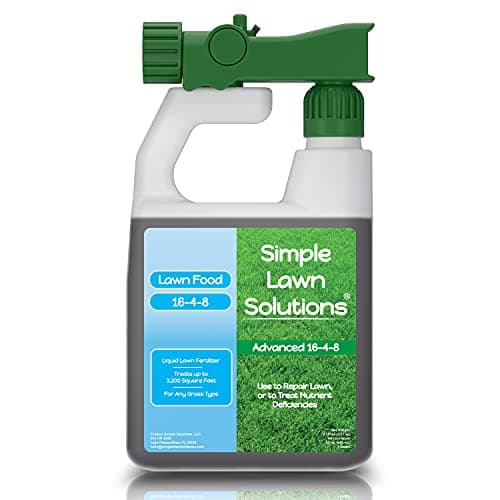
| Advanced 16-4-8 Balanced NPK Liquid Lawn Food | 16-4-8 | Liquid | Spot feeding, fast uptake, new lawns | Amazon |
| Ironite II by Pennington Mineral Lawn Supplement 1-0-0 | 1-0-0 | Granular iron supplement | Greening high-pH lawns without growth push | Amazon |
| Southern Ag Chelated Liquid Iron | Iron (chelated) | Liquid iron | Fast color fix for Central Texas chlorosis | Amazon |
| Espoma Organic All Season Lawn Food | Organic | Granular organic | Soil-building, pet-and-kid-friendly | Amazon |
| Pennington Full Season Lawn Fertilizer 32-0-5 | 32-0-5 | Granular extended-release | Budget, high-nitrogen coverage | Amazon |
The Andersons PGF Complete 16-4-8 (editor pick)
This is the one I put in most Texas St. Augustine yards. The 16-4-8 ratio is exactly what this grass wants, the prill is fine and dispersive (it works into the canopy and breaks down without leaving visible granules), and the 7% humic DG actually helps soil biology, which matters on tired Texas clay. It is slow-release enough to feed steadily through heat without a growth spike. Use it as your backbone product spring through early fall.
Milorganite 6-4-0
Milorganite is the gentle, organic, slow-release option that also delivers iron, so it greens up the lawn without forcing growth. That makes it ideal for a midsummer feeding when you want color but do not want to push soft tissue into chinch bug and gray leaf spot season. The low nitrogen number means you apply more product per pass, but it is nearly impossible to burn the lawn with it, even in July.
Dark Matter 21-0-0 Ammonium Sulfate
When a lawn looks tired and you want a fast, even green-up, ammonium sulfate with iron does it. The sulfate also has a mild acidifying effect, which is a small bonus on alkaline Central Texas soil. This is more fast-release, so keep applications light (no more than 1 lb of N per 1,000 sq ft) and water it in well, especially in heat.
Scotts Southern Turf Builder
The big-box, grab-it-on-the-way-home option. It is formulated for southern grasses including St. Augustine, it spreads easily, and it is widely available. It is not as agronomically tuned as the PGF, but it is a perfectly solid choice for a homeowner who wants one bag and simple instructions.
Advanced 16-4-8 Liquid
A liquid 16-4-8 is your spot-feeding and quick-uptake tool. It is great for new sod or plugs that have not rooted enough to handle granular, for evening out a thin area, or for a fast foliar pick-me-up. Liquids feed quickly but do not last as long as granular slow-release, so think of this as a supplement, not your main program.
Ironite II 1-0-0 and Southern Ag Chelated Liquid Iron
These two are the Central Texas color insurance. Ironite II is a granular iron supplement (1-0-0) that greens a high-pH lawn without dumping on nitrogen, and the Southern Ag chelated liquid iron is the fast-acting version you spray when a yard goes yellow and you need it green for the weekend. Chelated iron stays available in alkaline soil longer than plain iron sulfate, which is why it is the smart pick for Blackland clay.
Espoma Organic All Season and Pennington 32-0-5
Espoma is the choice for folks who want a fully organic, soil-building program and a product that is gentle around kids and pets. Pennington 32-0-5 sits at the budget end with a high nitrogen number, so it stretches further per bag. Just respect that high N: apply lightly, never in the worst of summer disease season, and water it in.
How Much of Each Bag to Apply
Because every bag carries a different nitrogen percentage, the amount of product you spread for the same 0.5 to 1 lb of nitrogen per 1,000 sq ft changes a lot between picks. The table below converts a target nitrogen rate into pounds of product for the granular options, so you are not eyeballing the spreader. Drop your lawn size and target rate into our fertilizer calculator to get the total bags you need.
| Product | N-P-K | For 0.5 lb N | For 0.75 lb N | For 1 lb N |
|---|---|---|---|---|
| The Andersons PGF Complete | 16-4-8 | 3.1 lb | 4.7 lb | 6.25 lb |
| Milorganite | 6-4-0 | 8.3 lb | 12.5 lb | 16.7 lb |
| Dark Matter Ammonium Sulfate | 21-0-0 | 2.4 lb | 3.6 lb | 4.8 lb |
| Pennington Full Season | 32-0-5 | 1.6 lb | 2.3 lb | 3.1 lb |
| Advanced 16-4-8 (liquid) | 16-4-8 | Liquid, applied by volume per gallon, so follow the label dilution rather than a dry weight |
All figures are pounds of product per 1,000 sq ft. Milorganite needs the most product per pass because its nitrogen number is low, which is also why it is nearly impossible to burn a lawn with it in July.
Application Schedule by Texas Region (2026)
Texas is big enough that one calendar does not fit it. The right move is to tie your first feeding to soil temperature, not the date on the wall. St. Augustine wakes up and starts taking up nutrients when soil temps at the root zone hold around 65°F. A good operational rule from Texas A&M: wait until you have mowed the lawn at least twice in spring before that first feeding, which confirms the grass is truly out of dormancy and actively growing. Check your local reading with our soil temperature tool before that first spring application so you are not feeding dormant grass (which just feeds weeds). Here is how the season shakes out by region.
Gulf Coast and Houston
This is the Texas St. Augustine heartland: warm, humid, long growing season, often Floratam near the coast and Raleigh inland. Soil usually hits 65°F by late March. For a deeper local breakdown, see our Houston lawn care guide.
- Late March / early April: First feeding once growth is steady. PGF Complete 16-4-8 at about 1 lb N per 1,000 sq ft.
- Mid to late May: Second feeding. PGF Complete again, or Pennington 32-0-5 if you want more reach.
- Early to mid July: Ease off nitrogen. Use Milorganite 6-4-0 for color without pushing disease-prone growth in peak humidity.
- Late August / early September: Final main feeding for the year. PGF Complete or a balanced slow-release.
- Stop feeding nitrogen by late September. Late-season nitrogen invites fall brown patch (large patch).
East Texas (Tyler, Lufkin)
East Texas soils run sandy and acidic, so nitrogen leaches faster and the lawn benefits from more frequent, lighter feedings. The acidity also means iron is generally more available, so chlorosis is less of an issue than out west.
- Early April: First feeding once soil holds 65°F. PGF Complete 16-4-8.
- Late May: Second feeding, light rate. Because sand leaches, lean toward the 1 to 2 lb annual end split across more passes.
- Early July: Light summer feeding with Milorganite 6-4-0 to hold color.
- Late August: Final feeding. Espoma Organic All Season is a good fit here if you are building sandy soil.
- Stop by late September to avoid feeding fall fungus.
Central Texas (Austin, San Antonio)
This is the alkaline clay and caliche country, plus the region most likely to be under summer water restrictions. Two rules dominate here: favor slow-release so the lawn does not depend on heavy watering, and plan on iron for color rather than chasing green with more nitrogen.
- Early to mid April: First feeding. PGF Complete 16-4-8.
- Late May: Second feeding, plus a chelated iron application if you are seeing yellowing. Southern Ag Chelated Liquid Iron or Ironite II.
- July: Skip or minimize nitrogen during water restrictions. Use iron alone (Ironite II) to keep color without forcing growth you cannot water.
- September: Final light feeding once the worst heat breaks. Slow-release only.
- Iron as needed all season whenever the lawn pales between feedings. It is the high-pH fix.
North Texas (Dallas, Fort Worth, Denton)
DFW sits at the cold edge of St. Augustine's range, so the season is shorter and you start later than the coast. It is also the region with real winterkill risk: St. Augustine north of DFW can thin badly or die back after a hard freeze, which is why you feed to build a strong, well-rooted lawn heading into fall rather than pushing late growth. Alkaline Blackland clay here means iron chlorosis is common, same as Central Texas.
- Mid to late April: First feeding once soil holds 65°F and you have mowed the lawn twice. PGF Complete 16-4-8 at about 1 lb N per 1,000 sq ft.
- Late May / early June: Second feeding, plus chelated iron if the lawn is yellowing on high-pH clay.
- July: Light summer feeding with Milorganite 6-4-0 to hold color without forcing soft growth in the heat.
- Late August: Final feeding to build density before dormancy.
- Stop nitrogen by early September. Late-season nitrogen raises winterkill and brown patch risk in a region that already stresses this grass.
Common Texas St. Augustine Problems
Problem: Chinch bugs (the Houston-area scourge)
Chinch bugs are the number one pest of Gulf Coast St. Augustine. They thrive in hot, dry, sunny spots and suck the juice out of the grass, leaving expanding yellow-to-brown patches that look like drought damage but do not recover with water. The big mistake is dumping nitrogen on it: lush, soft growth from over-fertilizing is exactly what chinch bugs love. Solution: keep nitrogen moderate in summer, lean on slow-release like Milorganite, water properly, and treat with an appropriate lawn insecticide if you confirm the bugs. Do the "tin can flotation" test or part the grass at the patch edge to spot them before reaching for chemicals.
Problem: Gray leaf spot
Gray leaf spot flares in hot, humid weather and is made dramatically worse by summer nitrogen. You will see small gray or tan lesions on the blades, and in bad cases the lawn looks scorched. Solution: back off nitrogen in the peak of summer (this is the single biggest lever), water in the early morning so blades dry fast, and avoid the fast-release high-N products in July and August. This is exactly why our schedule swaps to gentle Milorganite mid-summer.
Problem: Brown patch / large patch (fall)
As nights cool in fall, brown patch (large patch) shows up as roughly circular patches of thinning, off-color grass. Late-season nitrogen is the accelerant. Solution: stop nitrogen feeding by late September, water in the morning rather than the evening, and improve drainage in low spots. If you feed late to "get one more green push," you are usually feeding the fungus.
Problem: Iron chlorosis (yellowing on alkaline soil)
Classic Central Texas issue. The lawn yellows, especially newer growth, even though it is getting nitrogen, because the high-pH Blackland clay or caliche locks iron up where roots cannot get it. Solution: apply chelated iron, not more nitrogen. Southern Ag Chelated Liquid Iron greens it up fast, and Ironite II gives a longer granular feed. Chelated forms stay available in alkaline soil far better than cheap iron sulfate.
Problem: Take-all root rot
Take-all root rot attacks stressed St. Augustine, thinning the lawn in irregular patches and weakening the roots so the grass pulls up easily. It is worse on high-pH soil and where the lawn is overwatered. Solution: avoid pushing the pH higher, do not overwater, keep the grass healthy with steady slow-release feeding rather than feast-or-famine nitrogen, and consider a top-dressing of peat moss over affected areas to lower surface pH around the roots.
Application Tips for Texas Conditions
Getting the product right is half the job. The other half is how you put it down in Texas heat. A few rules keep you from burning the lawn or wasting fertilizer.
- Never exceed 1 lb of actual nitrogen per 1,000 sq ft in a single application. Split the annual total across the season instead of front-loading it.
- Water the fertilizer in with about a quarter inch of irrigation after applying granular products, unless rain is on the way. This moves nutrients to the roots and prevents leaf burn in heat.
- Do not fertilize a dry, stressed, or dormant lawn. Feeding grass that is sitting in drought stress can scorch it. Make sure the lawn is actively growing and reasonably watered first.
- Feed in the cooler part of the day, early morning or evening, especially mid-summer. Avoid spreading granular onto wet blades in full mid-day heat.
- Use a calibrated spreader and follow the product's setting. Guessing leads to stripes (over and under-applied rows) that show up for weeks.
- Respect water restrictions. In Central Texas summers, lean harder on slow-release and iron so the lawn is not dependent on water you may not be allowed to apply.
- Sweep granules off hardscape back onto the lawn. Fertilizer left on driveways and sidewalks washes into storm drains and does nothing for your grass.
One more Texas-specific note: if you laid new sod or plugs this season, go easy. Wait until new sod has knit down and started actively growing (usually a few weeks) before the first real feeding, and consider a gentle liquid like the Advanced 16-4-8 to feed without burning tender roots. New St. Augustine wants water and time more than it wants a heavy nitrogen hit.
Conclusion
Feeding St. Augustine in Texas comes down to a few durable principles: hit 1 to 4 lbs of nitrogen per 1,000 sq ft a year with a balanced slow-release around 16-4-8, split it into several feedings, ease off the nitrogen during the hot, humid, disease-prone heart of summer, and fix yellowing on alkaline Central Texas soil with iron instead of more nitrogen. Tie your first feeding to soil temperature, adjust the cadence to your region (more frequent and lighter on sandy East Texas, iron-forward on Central Texas clay, generous on the Gulf Coast), and you will keep that thick green carpet through the worst the state can throw at it.
For the national-level breakdown of products, rates, and timing across all climates, see our complete best fertilizer for St. Augustine grass 2026 guide. And if you are still not 100 percent sure your lawn is St. Augustine versus a look-alike like centipede or coarse Bermuda, snap a photo and run it through our free grass identifier before you buy a single bag. Feeding the right grass the right way is how you win the Texas summer.
Top Picks
 The Andersons PGF Complete 16-4-8 (5,000 sq ft)Check price on Amazon
 Simple Lawn Solutions Advanced 16-4-8 Liquid Fertilizer (32 oz)Check price on Amazon
As an Amazon Associate we earn from qualifying purchases.
Free Lawn Care Tools
Start your first feeding in spring once soil temperatures hold around 65°F, which is typically late March on the Gulf Coast and early to mid April further inland. Feed every 6 to 8 weeks through early fall, then stop applying nitrogen by late September to avoid triggering fall brown patch. Use a soil thermometer rather than the calendar so you do not feed dormant grass.
A balanced slow-release fertilizer around 16-4-8 is the sweet spot for Texas St. Augustine. The high nitrogen drives the color and density this hungry grass needs, the moderate phosphorus is enough for established lawns, and the potassium builds heat and drought tolerance for Texas summers. Aim for 1 to 4 lbs of actual nitrogen per 1,000 square feet across the whole season, per Texas A&M AgriLife guidance (EHT-144).
That is almost always iron chlorosis from high-pH Blackland clay or caliche soil, which chemically locks up iron where the roots cannot reach it. Adding more nitrogen will not fix it and can make growth worse. Apply a chelated iron product like Southern Ag Chelated Liquid Iron for a fast green-up, or Ironite II for a longer granular feed.
Be careful. Many weed and feed products contain herbicides that can injure St. Augustine, especially in heat, and the timing for weed control rarely matches the timing for feeding. It is usually better to fertilize and treat weeds separately so you can control rate and timing on each. Always confirm the herbicide is labeled safe for St. Augustine before applying.
Target 1 to 4 lbs of actual nitrogen per 1,000 square feet per year, per Texas A&M AgriLife guidance (EHT-144), split into 4 to 6 feedings. Lean toward the lower end on sandy East Texas soils that leach faster, and toward the higher end on vigorous, well-watered long-season Gulf Coast lawns. St. Augustine growing in shade needs roughly half the nitrogen of full-sun lawns. Never apply more than 1 lb of actual nitrogen per 1,000 square feet in a single application.
Go gentle on brand-new sod or plugs. Wait until the sod has knit down and started actively growing, usually a few weeks, before the first real feeding. A mild liquid like a 16-4-8 liquid lawn food feeds without burning tender new roots, and consistent watering matters more than a heavy nitrogen hit at this stage.
Roughly half the nitrogen of a full-sun lawn, per Texas A&M AgriLife. Shaded St. Augustine gets less light for photosynthesis, so it cannot use as much nitrogen, and pushing a full rate under trees produces weak, stretched, disease-prone growth instead of density. If your sunny turf is on a 1 lb of nitrogen per 1,000 square feet program, drop the shaded zones to about 0.5 lb per application and mow those areas a little higher to give the grass more leaf surface.
Yes. Atrazine is the active ingredient in the weed-and-feed products that are labeled safe for St. Augustine, which is why it is the common choice for this grass where other broadleaf herbicides can injure it. Follow the label closely: apply within the temperature range it specifies (generally below about 90°F), do not exceed the labeled rate, and time it to actively growing turf rather than dormant or heat-stressed grass. Always confirm the specific product lists St. Augustine on the label before you spread it.
Stop nitrogen earlier the farther north and inland you are. In Dallas and North Texas, make your last nitrogen feeding by early September so the lawn hardens off before the first freeze and you do not raise winterkill or brown patch risk. On the Houston and Gulf Coast, where the season runs longer, you can push the final feeding to early or mid October. The rule of thumb is to stop nitrogen about 6 to 8 weeks before your area's typical first frost.
It is a box-store staple in Texas, but for an established St. Augustine lawn it is usually the wrong shape: equal phosphorus and potassium to nitrogen rarely matches what Texas soils need. Save 13-13-13 for a soil test that documents phosphorus and potassium deficiency or for new sod, and otherwise feed a nitrogen-forward product with iron on alkaline clay.
Mow at 3.5 to 4 inches, feed 0.5 to 1 lb of nitrogen per 1,000 sq ft once the lawn needs mowing regularly, and treat summer yellowing on high-pH clay with chelated iron rather than more nitrogen. Deep, infrequent morning watering finishes the job; a taller, evenly fed lawn thickens itself.
No. Daily shallow watering builds shallow roots, invites gray leaf spot, and makes chinch bug damage worse. Aim for about an inch a week including rain, delivered deeply once or twice, and water in the early morning so the blades dry fast.

Your lawn plan, in your pocket all season
Grass ID, a season plan, soil-timed reminders, and a lawn journal that remembers what you did. Free on iPhone.