Is a Reel Mower Worth It? Who It's For, Who Should Skip It, and the Picks

As an Amazon Associate we earn from qualifying purchases.
Quiet. No gas. No battery. No pull cord. A manual push reel mower sounds like the answer to every Saturday complaint. For some lawns it is. For a lot of lawns it's a garage ornament by July. The difference comes down to three things you can check today: your grass type, your mowing height, and how big the yard is.
Fast Answer: A reel mower is worth it if you have a small, smooth lawn of Bermuda or zoysia that you mow at 2 inches or lower and can cut at least weekly. Clemson Extension says reel mowers are used at 2 inches or less. It says Bermuda and zoysia are best cut with one. Most rotary mowers can't give a quality cut below 1 inch.
Skip it for tall fescue or St. Augustine kept at 3 to 4 inches. The push reels below top out under 3 inches. Skip it for bumpy ground or a yard full of sticks, too. Same if you miss mowings. The UC IPM lawn guide says reel mowers aren't useful for overgrown grass or uneven ground.
How a reel mower cuts
A rotary mower spins one blade flat and fast. It hits the grass. UF/IFAS puts it plainly: rotary mowers cut on impact.
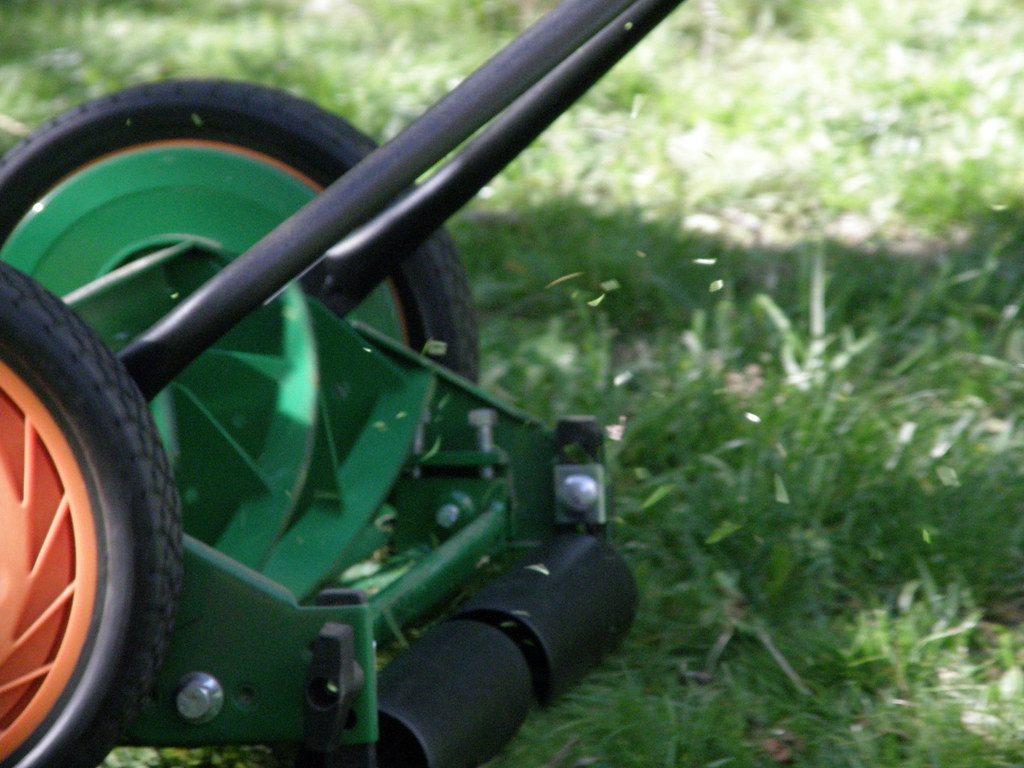
A reel mower works like shears. A cylinder of curved blades spins past a fixed blade at the bottom, called the bed knife. Each blade of grass gets pinched and snipped. Clemson calls it a scissor-like action that produces a very clean, even cut.
The push version has no motor. The wheels turn the reel. Push faster, the reel spins faster. Stop pushing, it stops cutting. That's the whole machine.
Clean cut matters. A torn tip browns. Clemson says a dull blade tears the grass and leaves the lawn looking brown. A sharp reel leaves a clean tip.
Grass type decides it
Start here. Everything else is secondary. If you don't know what's growing out there, a free photo ID settles it in about thirty seconds.
These are the heights we publish in our mowing height chart, next to what a push reel handles. Clemson's line is 2 inches or less for reel work.
| Grass | Our published height | Push reel fit |
|---|---|---|
| Hybrid Bermuda | 0.5 to 1 in | Best fit. Most rotaries can't cut this low cleanly, per Clemson. |
| Common Bermuda | 1 to 1.5 in | Good fit. |
| Zoysia | 1 to 2 in | Good fit. Clemson says rotary struggles below 2 in on zoysia. |
| Centipede | 1.5 to 2 in | Works if the reel reaches 2 in. UF/IFAS prefers a rotary. |
| Perennial ryegrass | 2 to 3 in | Borderline. Low end only. |
| Kentucky bluegrass, fine fescue | 2.5 to 3.5 in | Poor fit for most push reels. |
| Tall fescue, St. Augustine | 3 to 4 in | Skip. Outside reel territory. |
Warm-season, low-cut grass is the reel's home turf. Clemson says it straight: Bermuda and zoysia are best cut with a reel mower. UF/IFAS adds that most rotary mowers can't mow lower than 1 inch and do their best work above 2 inches.
Cool-season lawns are the problem. Tall fescue wants 3 to 4 inches on our chart. Clemson lists 3 to 3.5 inches in summer. All three reels below with a published height range top out under 3 inches. The Mowing Height Calculator gives your number by grass and season. Check it against the mower's height range at the store. That's the number.
Lawn size: small and flat
No extension office publishes a square-foot cutoff for push reels. So measure your own. The Lawn Size Calculator does it from a map, and it flags a reel mower as an option under 5,000 square feet.
Surface matters as much as size. Clemson says reel mowers need a relatively smooth surface, and extremely uneven ground gets scalped. Ruts, roots, and mole ridges all count. Walk the yard. If your ankle finds the dips, the reel will too.
Shop math: how far you walk per mow
Givens, all scenario inputs: a 3,000-square-foot lawn, roughly the typical yard in our measured-lawn study. Two mowers. Three inches of overlap on every pass so you don't leave strips.
- 18-inch reel, minus 3 inches of overlap: 15 inches of new cut per pass. That's 1.25 feet.
- 3,000 square feet divided by 1.25 feet: 2,400 feet of walking. About 0.45 mile.
- 14-inch reel, minus 3 inches of overlap: 11 inches per pass, about 0.92 feet.
- 3,000 divided by 0.92: about 3,270 feet. Roughly 0.62 mile.
Four inches of width saves you about a sixth of a mile every mow. Double the lawn and double the walk. Run it with your own square footage before you pick a width.
Mowing frequency: the part nobody likes
A reel mower doesn't forgive a skipped week. UC IPM says reel mowers aren't useful for tall grasses.
The one-third rule sets the schedule. UF/IFAS: mow often enough that no more than a third of the blade comes off per mowing. Treat one-third like the redline on a tach.
Run it for Bermuda at 1 inch. One-third of 1.5 inches is half an inch. So you mow when it hits 1.5 inches. In peak summer growth that comes around fast. How fast depends on your lawn, your water, and your feeding. Put a ruler in the grass for two weeks. That tells you your interval.
Can't keep that pace? Skip the reel. Or keep a rotary for catch-up cuts. Feast-or-famine cutting is on our list of bad lawn mower habits for a reason.
- Clemson HGIC 1205 puts reel mowers at 2 inches or less and lists tall fescue at 3 to 3.5 inches in summer.
- UF/IFAS LH028 lists reel or rotary for Bermuda and rotary for centipede, coarse zoysia, and St. Augustine.
- Your county extension office can confirm the right height for your grass and region.
Sticks, pinecones, and bumps
UF/IFAS says to pick up sticks, stones, and debris before mowing to avoid damaging the mower. On a reel, a twig wedges between the reel and the bed knife and stops it cold.
Under an oak or a pine? You'll be picking up the lawn before you mow it. Every time. Skip it unless you already do that walk for other reasons.
Sharpening and backlapping
The blades are the wear part. When the cut gets ragged, check the gap between the reel and the bed knife. The manual shows how yours adjusts.
Most home kits work by backlapping. You coat the blades with lapping compound, a gritty paste, and spin the reel backward against the bed knife until the edges hone. Kits exist for it. Great States sells its 16-inch mower with a sharpening kit in the box.
Full sharpening is a shop job. Clemson says sharpening reel mowers is difficult and can be left to a mower repair service. Budget a trip to the shop every so often. Call your local shop for their rate. No published number exists.
Cost of ownership against gas and battery
The push reel's running cost is close to zero. No fuel. No oil. No battery to replace. No charger. Your legs are the engine. The tradeoff is the sharpening trip and your time.
Gas and battery mowers carry their own upkeep: blades, batteries, fuel, tune-ups. If you want quiet without the pushing, look at our battery mower picks by yard size. Better fit for a lawn mowed at 3 inches and up.
Clippings stay on the lawn with a push reel unless you add a catcher. That's fine. Clemson says clippings from regular mowing are small and break down fast. Our post on the benefits of a mulching lawn mower covers why leaving them works.
Buy it or skip it
| Situation | Verdict | Buy it if / Skip it unless | Source |
|---|---|---|---|
| Bermuda or zoysia, mowed at 2 in or lower | Buy | Lawn is smooth and you mow weekly or more | Clemson HGIC 1205 |
| Hybrid Bermuda under 1 in | Buy | You want a clean cut a rotary can't give | UF/IFAS, Clemson |
| Centipede at 1.5 to 2 in | Buy | The mower's top setting reaches 2 in and you accept UF/IFAS lists rotary as preferred | UF/IFAS LH028, our height chart |
| Tall fescue or St. Augustine at 3 to 4 in | Skip | Almost never; the reels below top out under 3 in | Clemson HGIC 1205, our height chart, maker height ranges |
| Bumpy lawn, roots, ruts | Skip | You level it first | Clemson, UC IPM |
| You mow every two weeks or less often | Skip | Never; tall grass stalls the reel | UC IPM, UF/IFAS |
The picks, by lawn
Specs below come from each manufacturer's own product page. Each pick is matched to a grass and a height. For a lawn held at 3 inches or more, none of them fit. Buy a rotary.
Low-cut Bermuda or zoysia: American Lawn Mower 1815-18
18-inch cut. Five blades. Adjusts from 1/2 to 2-3/4 inches, per American Lawn Mower Co. That covers every warm-season height on our chart except St. Augustine. The width keeps the walk down on a mid-size yard. Buy it if you mow Bermuda, zoysia, or centipede.
Tiny low-cut strip: American Lawn Mower 1204-14
14-inch cut. 19 pounds. The maker markets it for bluegrass, fescue, and rye. Read the height range, though. The product page lists 1/2 to 1-3/4 inches in one spot and 1/2 to 1-1/2 in another. Either way, under 2 inches. That's well below the 2.5 to 4 inches we publish for bluegrass and tall fescue. Buy it for a small, low-cut warm-season lawn or a tiny side strip. Skip it for a tall-mowed fescue yard.
Budget pick with a sharpening kit: Great States 415-16SK
16-inch cut. Adjusts from 1/2 to 2-1/2 inches, per the manufacturer. Ships with a sharpening kit, so backlapping is covered from day one. The 2-1/2-inch top setting reaches the low end of ryegrass and every warm-season height but St. Augustine. Buy it if you want to do your own blade upkeep.
Want the clippings bagged: Scotts 2010-20SG
20-inch cut with a grass catcher included, per American Lawn Mower Co., which builds it. The widest cut here. The product page doesn't list the height range, so check the manual for your grass before you order. Buy it if you want clippings off the lawn.
What other guides get wrong
Most reel mower roundups rank by push effort and build. Grass type barely gets a line. That's backwards. A great reel on the wrong grass does a bad job every week.
Here's the gap. Our chart puts tall fescue at 3 to 4 inches. Clemson says reels are for 2 inches or less. UC IPM does list tall fescue as a reel grass. The catch is the height. The push reels we checked stop under 3 inches. Some push reels are even marketed for cool-season grass with a top setting under 2 inches. Set that mower at its max and you're still cutting fescue lower than we recommend.
The fix costs nothing. Know your grass. Know your height. Read the height range on the box. If they don't overlap, leave it on the shelf.
Mowing on schedule is half the battle. The other half is knowing when the lawn needs feeding, water, or a raise in the deck as the season turns. WGIS Premium builds a 12-month care plan around your grass and ZIP code, with seasonal reminders, so the height changes and the feedings land in the right week.
The reel mower punch list
- Confirm your grass. A free photo diagnosis takes about thirty seconds.
- Get your target height from the Mowing Height Calculator. Over 2 inches? A rotary does the job.
- Measure the lawn with the Lawn Size Calculator and run the shop math above.
- Walk the yard for bumps, roots, and sticks. Fix or skip.
- Match the mower's height range to your target. Width to your yard size.
- Mow before the grass gains a third of its height. Ruler in the lawn if you're not sure.
- Adjust the reel-to-bed-knife gap when the cut gets ragged. Backlap or take it to the shop.
Right grass, right height, small flat yard. Buy the reel. Anything else, leave it on the shelf.
Free Lawn Care Tools
A reel mower is worth it for a small, smooth lawn of Bermuda or zoysia (centipede works at 2 inches) mowed at 2 inches or lower, cut at least weekly. Clemson Extension says reel mowers are used at 2 inches or less and that Bermuda and zoysia are best cut with one. For tall fescue or St. Augustine at 3 to 4 inches, a rotary does the job.
The pros are a clean, scissor-like cut, no fuel or battery, and almost no noise. The cons are a low height range, trouble with tall grass, sticks, and bumpy ground, and blades that need occasional adjustment and sharpening. UC IPM says reel mowers work well on smooth, even ground and aren't useful for tall grasses.
A push reel mower is a poor fit for tall fescue kept at the recommended height. We publish 3 to 4 inches for tall fescue, and Clemson Extension says reel mowers are used at 2 inches or less. A rotary mower set at 3 to 4 inches is the better tool.
You mow often enough that no more than one-third of the blade comes off per mowing, which is the UF/IFAS rule. For Bermuda at 1 inch, that means mowing when it reaches 1.5 inches. Growth rate varies by lawn, so a ruler in the grass for two weeks gives you your interval.
Home sharpening is done by backlapping: coating the blades with lapping compound and spinning the reel backward against the bed knife. Clemson Extension says sharpening reel mowers is difficult and can be left to a professional mower repair service. Some mowers, like the Great States 415-16SK, ship with a sharpening kit.
No extension office publishes a size cutoff, but reel mowers suit small, flat lawns. Our Lawn Size Calculator flags a reel mower as an option under 5,000 square feet. On a 3,000-square-foot lawn, an 18-inch reel means roughly 0.45 mile of walking per mow with 3 inches of overlap.

Your lawn plan, in your pocket all season
Grass ID, a season plan, soil-timed reminders, and a lawn journal that remembers what you did. Free on iPhone.