Large Patch in Zoysia and St. Augustine: Fall Identification and Treatment

As an Amazon Associate we earn from qualifying purchases.
You mowed all summer and the lawn looked great. Then the nights turned cool, and one morning in early fall there it is: a big yellow-orange ring sitting in the middle of an otherwise healthy zoysia or St. Augustine lawn. Four feet across, maybe six. The edge looks almost drawn on with a highlighter. A week later it is wider, and there are two more of them by the driveway. That is large patch, and here is the part most people do not realize until it is too late: by the time you can see it, the infection already happened.
Large patch is a fall and spring disease of warm-season grasses caused by the soil fungus Rhizoctonia solani. It becomes active as soil temperatures drop out of summer heat and into the mild range, which is exactly when zoysia and St. Augustine are slowing down and losing their ability to outgrow damage. You get large, roughly circular patches with a yellow, orange or bronze halo at the advancing edge, and blades near that edge pull free easily because the fungus rots the leaf sheath right at the base.
The fix is mostly timing, not chemistry. Stop fall nitrogen, cut irrigation back hard, water only in the early morning, and if your lawn has a history of it, put down a preventive fungicide before symptoms show rather than after. Large patch is one of the very few lawn diseases where preventive treatment genuinely pays, because the window is predictable and the damage is already underway by the time the rings appear.
What Large Patch Actually Looks Like
The name is doing honest work here. These are big. A single patch commonly runs several feet across, and on a lawn that has had the disease for a few seasons you can get patches that merge into shapes the size of a parking space.
The giveaway is the edge. A healthy-looking lawn does not just stop at a brown area; with large patch you get a distinct band of yellow, orange or bronze grass where the fungus is actively working through the turf. NC State Extension describes that expanding margin of discolored turf as the classic diagnostic feature, and it is the thing to photograph if you want a second opinion.
Now go kneel at that edge and pull on a few blades. If it is large patch, they come away with almost no effort, and the base of the blade where it wrapped the stem looks dark, water-soaked, slimy or rotted. The fungus is not attacking the leaf tip or the root first, it is rotting the leaf sheath at the base. UF/IFAS puts that basal rot at the center of how they identify the disease in Florida lawns, and once you have felt how easily an infected blade releases, you will never confuse it with drought again.
The last odd detail catches people off guard: the middle of the patch often greens back up while the ring keeps marching outward. You end up with a donut of good grass inside a halo of dying grass. That is not the disease healing. It is the fungus having already moved past the center to fresh tissue at the perimeter.
Why This Is a Fall Disease, Not a Summer One
If you have ever read about brown patch on fescue or ryegrass, the pathogen will sound familiar, because it is the same genus. Rhizoctonia solani hammers cool-season lawns in the heat and humidity of midsummer, and turf pathologists call that brown patch. On warm-season lawns the same fungus does its damage in the shoulder seasons instead, and that version gets called large patch. Clemson HGIC covers both under one fact sheet for exactly that reason.
The reason for the flip is the grass, not the fungus. Cool-season grass is stressed by summer heat, so summer is when it cannot defend itself. Warm-season grass is stressed by cooling soil, so fall is its weak point. As soil temperatures fall out of the summer range and into the mild range, zoysia and St. Augustine start shutting down growth and moving resources into storage, and the fungus becomes active in that same window. Disease pressure goes up at the exact moment your lawn loses its ability to grow out of an injury. Then the whole thing repeats in reverse each spring as soil temperatures climb back through that same mild band before the grass has fully woken up.
How It Shows Up Differently by Grass Type
Zoysia
Zoysia tends to get hit hardest and show the textbook symptoms. The rings are sharply defined, the orange halo is unmistakable, and the patches can be enormous. The extra insult is spring: areas that were infected in fall green up noticeably later than the rest of the lawn, sometimes weeks later, which makes a lot of homeowners assume they have a new spring problem when they are actually looking at last fall's scar. If zoysia is your grass, the zoysia disease guide walks through the rest of what shows up on it.
St. Augustine
St. Augustine gives you a messier picture. The patches are usually broader and more diffuse, the halo can be subtle, and the edges are less geometric. That vagueness is why St. Augustine large patch gets confused with take-all root rot constantly, and the two call for different responses. Our St. Augustine disease guide has the side-by-side, and if you are already shopping chemistry, the fungicide breakdown for St. Augustine covers which active ingredients actually apply.
Bermuda
Bermuda generally gets off easy. It can host large patch, but symptoms tend to be less severe and recovery is faster because bermuda is aggressive and spreads hard once soil warms. You will still see thin, off-color areas, just rarely the dramatic rings. The bermuda disease guide has the details, and spring dead spot is usually the bigger worry there anyway.
What Else It Could Be
Before you spend money, rule these out. Take-all root rot also hits St. Augustine and also produces yellowing irregular areas, but it attacks roots and stolons rather than leaf sheaths, so blades do not slip out cleanly at the base and the roots look short, dark and rotted. Chinch bugs produce expanding dead areas too, usually in the hottest, sunniest, driest part of the lawn, and you can find the insects in the transition zone if you part the grass and look. Dollar spot makes spots the size of a silver dollar with bleached hourglass lesions on individual blades, not multi-foot rings. Drought stress follows irrigation patterns and high spots, not circles. And plain uneven dormancy fools a lot of people every fall, because shaded and low-lying areas cool first and start browning first.
If you are not sure which of those you are looking at, photograph the boundary between good and bad grass rather than the dead middle, and run it through our free AI lawn diagnosis. The advancing edge carries nearly all the diagnostic information.
Cultural Controls That Actually Move the Needle
Every extension source agrees on this part, and it is free. Large patch runs on leaf wetness and lush, nitrogen-fed tissue going into cool weather.
- Stop fall nitrogen. Late nitrogen pushes soft growth right when the fungus is waking up. This is the single most common self-inflicted cause of a bad large patch year.
- Cut irrigation back hard. Cooling soil plus shorter days means the lawn needs far less water than it did in August, and most people never adjust. Use the watering planner to reset the fall schedule instead of guessing.
- Water at dawn only. Evening watering leaves blades wet all night, which is exactly the condition the fungus wants. Early morning lets the canopy dry fast.
- Fix drainage and reduce thatch. Low spots that stay soggy become the permanent home base for next year's rings. Heavy thatch holds moisture at the crown.
- Raise mowing height and improve airflow. A taller canopy on a stressed warm-season lawn going into fall handles disease better. Set yours with the mowing height calculator, and prune back shrubs crowding the affected area so air can move.
The Fall Preventive Window: This Is the Whole Game
Here is why this section matters more than the rest. I am generally skeptical of preventive fungicide on home lawns, because for most diseases you are spending money against a maybe. Large patch is the exception, and it is an exception for two specific reasons.
First, the window is predictable. The disease activates as soil temperatures drop through the mild range in fall, and that happens on roughly the same calendar schedule in your area every year. Second, and this is the one that changes behavior, symptoms show up well after infection starts. The fungus is already into the leaf sheaths before the first ring becomes visible. So when you spray after seeing rings, you are not preventing anything. You are running a rescue operation on tissue that is already infected, on a lawn that has largely stopped growing and cannot replace what it lost until spring.
If your lawn had large patch last fall or last spring, it will very likely have it again, because the fungus survives in the soil and thatch. Those lawns are the ones where a preventive application earns its cost. A lawn with no history does not need one.
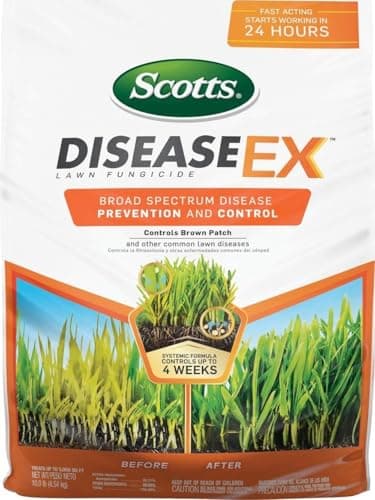
For homeowners, azoxystrobin is the standard chemistry for this disease, and the easiest way to buy it is granular. Scotts DiseaseEx Lawn Fungicide is a 10 lb granular azoxystrobin bag that runs around $21. Coverage depends entirely on which rate you use, so confirm the rate and the coverage on your own bag before you spread it, since label rates differ between preventive and curative use. Granular products like this have to be watered in to move the active ingredient off the granule and down to where the fungus lives, and skipping that step is the most common reason a treatment does nothing. There is a full walkthrough in our DiseaseEx application guide, and if you are trying to work out timing more broadly, when to apply fungicide to a lawn covers the logic across seasons. No fungicide cures large patch, and none of them bring back grass that is already gone. What they do is protect the tissue that is still healthy.
- Soil temperature trigger: The specific soil temperature and depth used to time the fall application varies by source and by region. Get the number your state extension turf program publishes rather than a figure from a national article.
- Application timing for your area: Fall treatment dates in coastal Georgia, north Texas and central Florida are not the same week. Your county extension office or state turf program publishes a local calendar.
- Rates and reapplication intervals: Product labels list different rates for preventive versus curative use, and whether a second application is warranted depends on the product and your conditions. Follow the label and your state's recommendation, not a rate you read online.
- Nitrogen rates and cutoff dates: How much nitrogen your grass type should get and the date to stop applying it in fall are both regional. Confirm both with your extension service before you fertilize this fall.
What to Expect Next Spring
Areas infected this fall will green up late. Sometimes very late, to the point where you are convinced they are dead. On zoysia especially, a patch that was damaged in October can still look bare in April while the rest of the lawn has filled in. That is usually slow recovery rather than mortality, because the crowns and stolons often survive even when the leaf tissue was destroyed.
The reflex is to spray again the moment those areas look bad in spring. Resist it. What you are seeing in early spring is frequently last fall's damage, not a new infection, and a fungicide does nothing for damage that already happened. Spring does bring a second real activity period as soil temperatures climb back through the same mild band, so a spring application can be justified on a lawn with a genuine history. Just make that call on soil temperature and history, not on how the scars look.
The faster route to recovery is boring: correct watering, correct mowing height, and nitrogen only once the grass is actively growing in warm soil. Push fertilizer at cold, half-awake turf and you feed the fungus before you feed the lawn.
What Other Guides Miss
Almost every article on this disease treats it as a fungus problem. It is really a calendar problem, and the two call for completely different behavior.
If it is a fungus problem, the job is picking the right product, and you do that after you see symptoms. If it is a calendar problem, the product barely matters and the date is everything, because the only application that changes your outcome happens on a lawn that still looks perfect. That is a genuinely hard thing to ask of anyone. You are spending twenty-odd dollars and an hour on a lawn with nothing visibly wrong with it, based on a soil temperature you cannot see, to prevent damage you will otherwise not notice for another two or three weeks.
The second thing guides skip: the damage you see in fall sets your spring. Warm-season grass that loses leaf tissue in October does not rebuild it until soil warms again. So the real cost of a missed fall window is not the ugly ring in November, it is the thin, late-greening lawn you stare at the following April while your neighbors are already mowing. Judge this disease on a twelve-month clock, not a two-week one.
That timing problem is exactly what our paid personalized 12-month care plan is built for. It tells you the specific week your large patch preventive window opens for your zip code and your grass type, and puts it on a schedule with the rest of your year, which on a disease this timing-dependent is the entire ballgame.
Your Fall Action Plan
- Confirm what you have. Photograph the boundary between healthy and discolored grass, tug a few blades at that edge to check for basal rot, and run the photo through the free AI diagnosis if you want a second read before you spend anything.
- Stop nitrogen now. If you have a late fall fertilizer application on the calendar for a zoysia or St. Augustine lawn with any disease history, take it off.
- Reset irrigation for fall. Cut run times, move every start time to early morning, and shut off any evening cycles entirely.
- Raise the mower and keep mowing. Stay on schedule at a taller height until growth genuinely slows, and keep the blade sharp so you are cutting rather than tearing.
- Decide on prevention based on history. Lawn had large patch before? Plan a preventive granular application timed to your local soil temperature guidance, and water it in. No history? Skip it and rely on the cultural fixes.
- Fix the site problems before winter. Address the low spot that stays wet, dethatch if the layer is heavy, and open up airflow around the affected area.
- Write down where the patches were. Next fall's preventive application goes on those areas first, and next spring you will want to know whether a slow-greening spot is old damage or something new.
Free Lawn Care Tools
They are caused by the same fungus genus, Rhizoctonia solani, but the names refer to different situations. Brown patch describes the disease on cool-season grasses like fescue and ryegrass during hot, humid summer weather. Large patch describes it on warm-season grasses like zoysia and St. Augustine in fall and spring as soil temperatures pass through the mild range. Clemson HGIC covers both under a single fact sheet for that reason.
It comes down to when the grass is vulnerable rather than when the fungus is active. Warm-season grasses are stressed by cooling soil, so as temperatures drop out of the summer range the grass slows down and loses the ability to outgrow injury. The fungus becomes active in that same window, so disease pressure peaks exactly when the lawn cannot recover. The pattern repeats in spring as soil warms back through the same range.
Check where the rot is. Large patch rots the leaf sheath at the base of the blade, so blades at the edge of the patch pull free with almost no resistance and look dark and water-soaked where they wrapped the stem. Take-all root rot attacks roots and stolons instead, leaving short, dark, rotted roots while blades stay more firmly attached. St. Augustine patches from large patch also tend to be broader and more diffuse than the sharp rings you see in zoysia.
No. By the time rings are visible the fungus has already infected that tissue, so an application at that point is a rescue that protects remaining healthy grass rather than a cure. Grass that has already been killed will not come back from a spray, and on a warm-season lawn in fall it will not regrow until soil warms in spring. That is why the preventive window before symptoms appear matters so much on this particular disease.
Not with nitrogen in fall. Late nitrogen pushes soft new growth right as the fungus becomes active and is one of the most common ways homeowners make a large patch year worse. Wait until the grass is actively growing in warm soil in spring before applying nitrogen. Your state extension office publishes both the appropriate rates and the fall cutoff date for your region and grass type.
That donut pattern is normal for large patch and it is not a sign of recovery. The fungus works outward from where it started, so it has already moved past the center to fresh tissue at the perimeter while the center begins to fill back in. The active disease is in the yellow or orange halo at the advancing edge, which is also the best place to photograph or sample if you want a confident identification.

Your lawn plan, in your pocket all season
Grass ID, a season plan, soil-timed reminders, and a lawn journal that remembers what you did. Free on iPhone.