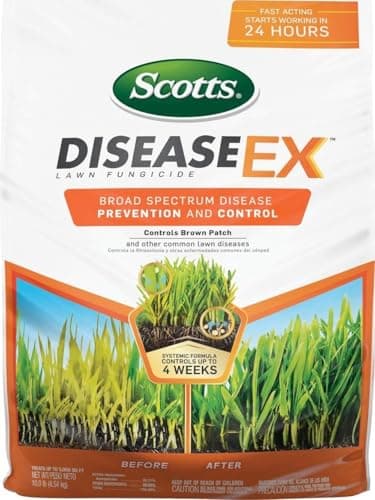
Scotts DiseaseEx Instructions: Rates, Spreader Settings, and Timing

As an Amazon Associate we earn from qualifying purchases.
Quick answer: Scotts DiseaseEx Lawn Fungicide is a granular product whose active ingredient is azoxystrobin. You spread it dry with a broadcast or drop spreader, then water it in lightly so the granules dissolve and the fungicide moves into the soil and up into the plant. It works far better as a preventive than as a rescue, so the best application is the one you make before the disease shows up. The most important detail most people miss: the label carries a preventive rate and a separate, higher curative rate, and they are different numbers. Decide which job you are doing before you fill the spreader, then read the rate off your own bag.
Fungicide is the one lawn product where guessing costs you twice: you lose the money and you lose the window. A 10 lb bag runs about $21, cheap enough that people buy it on a hunch and spread it on brown patches that turn out to be drought stress, dull mower blades, chinch bugs, or grubs. None of those respond to azoxystrobin.
So before you open the bag, confirm you are looking at a fungal disease. Snap a photo and get a free AI diagnosis in about thirty seconds, no account required. That is the difference between a $21 bag that fixes something and a $21 bag that sits in the garage.
DiseaseEx is granular azoxystrobin, a systemic strobilurin fungicide. Measure your lawn, find the rate on your bag for the job you are doing (preventive or curative, they are not the same rate), set the spreader using the settings Scotts prints on the bag for your spreader model, apply to dry grass, walk a crisscross pattern, then water it in right away with light irrigation. Keep everyone off the lawn until it dries.
The part that decides your result is timing, not technique. Azoxystrobin protects plant tissue that is still healthy. It does not raise dead grass. If large patch or brown patch is already running through your lawn, expect the application to stop the spread rather than green up the damage, and expect recovery to come from the grass growing out of it. Apply ahead of the disease window for your grass type and your results change completely.
What is the active ingredient in Scotts DiseaseEx?
The active ingredient in Scotts DiseaseEx Lawn Fungicide is azoxystrobin. The percentage is printed on the bag, and Scotts reformulates from time to time, so read your own label rather than trusting a number you found online.
Azoxystrobin belongs to a chemistry class called strobilurins, sometimes written as QoI fungicides. Strobilurins interrupt energy production inside the fungal cell, so the fungus cannot grow, spread, or germinate new spores. That is a different mechanism from contact fungicides, which coat the leaf surface and sit there until they wash off.
Azoxystrobin is also systemic. Once the granule dissolves and the material reaches the root zone, the plant takes it up and moves it through the tissue. The protection travels with the grass instead of sitting on top of it, which is why rain does not immediately wipe out your application the way it can with a purely contact product.
Here is the catch, and it is the whole reason this product gets bad reviews from people who used it wrong. Systemic protection protects living tissue. It stops the fungus from colonizing healthy plants. It cannot restore leaf tissue the fungus already destroyed. That is what makes azoxystrobin a preventive-first product. Golf course superintendents use this same chemistry class on large patch and brown patch, and they almost never wait for symptoms. They apply on a calendar built around soil temperature, before the pathogen becomes active.
The consumer version of that chemistry is easy to buy: Scotts DiseaseEx Lawn Fungicide, 10 lbs. runs about $21 for the 10 lb bag. Coverage depends entirely on which rate you use, so work out your square footage first and check the bag before deciding how many bags you need.
Preventive vs curative: two different rates, two different jobs
This is the table to read twice. Most DiseaseEx complaints come from someone applying the preventive rate to an active outbreak, or applying at all after the disease had already taken the turf down.
| Preventive application | Curative application | |
|---|---|---|
| When you apply | Before symptoms appear, as the disease window opens for your grass type and region | At the first sign of disease, while damage is still limited and spreading |
| Label rate | The lower rate on the label | The higher rate on the label |
| What to expect | Disease never establishes; the lawn simply does not get sick | Spread slows or stops; existing damage stays damaged until the grass grows out of it |
| How long protection runs | The label states the protection interval and the shortest allowed reapplication interval; follow those, not a number you read in a forum | Same label interval applies, and a follow-up application is usually part of the plan |
| If you get it wrong | Applying the preventive rate to an active outbreak often underdoses the problem and looks like product failure | Applying the curative rate when nothing is wrong wastes product and burns a rotation slot you may want later |
Look at your own bag before you set the spreader. Scotts prints both rates, and they are not close. Also check the label for the maximum azoxystrobin allowed per season on a given area, because that ceiling limits how many times you can go back out.
What diseases does Scotts DiseaseEx control?
The label lists a broad set of turf diseases, including brown patch, large patch, dollar spot, gray leaf spot, rust, anthracnose, and several leaf spot and blight organisms. Azoxystrobin is wide-spectrum, which is part of why it shows up in a consumer bag at all.
What it does not do is just as important. DiseaseEx is a fungicide, not an insecticide. It will do nothing for chinch bugs, armyworms, sod webworms, or grubs. It will do nothing for drought stress, dog urine spots, scalping from a low mower, or fertilizer burn. Every one of those produces brown patches that look like disease to an untrained eye.
Misdiagnosis is the number one reason this product "does not work." If the real problem is grubs, you want a soil insecticide instead, and the companion walkthrough for that job is our BioAdvanced grub killer instructions. If the real problem is a warm-season lawn with large patch, the identification details are in our large patch guide for zoysia and St. Augustine. And if you are not sure a fungicide is even the right category of answer, read whether a fungicide can actually help your lawn before you spend anything.
The free route is faster. Confirm it is fungus before you spend $21 on a bag: upload a photo for a free AI ID and you will at least know which aisle you belong in.
When to apply Scotts DiseaseEx
Soil temperature drives the disease window, not the calendar. The same week in May means something completely different in Ohio and in Georgia, and a cool wet spring can push a window two or three weeks off its usual date. Track your own conditions with our soil temperature tool and treat published date ranges as a rough starting point.
Brown patch on cool-season grass
Tall fescue, ryegrass, and bluegrass get hit by brown patch in warm, humid summer weather, especially when nighttime temperatures stay high and the canopy stays wet overnight. The preventive application goes down as that warm humid stretch begins, not after the circles show up. NC State Extension's Brown Patch in Turf publication walks through the conditions that open that window.
Large patch on warm-season grass
Zoysia, St. Augustine, and centipede get large patch in the shoulder seasons. The classic program is a fall application as soil temperatures drop out of the summer range, then a second the following spring as they climb back through it. Summer is generally not the large patch window. NC State Extension covers the pattern and the seasonal biology in Large Patch in Turf.
Dollar spot
Dollar spot runs through much of the growing season, often on lawns underfed on nitrogen, and flares with heavy dew and mild nights. NC State Extension's Dollar Spot in Turf factsheet explains why underfed lawns get hit hardest.
For a broader look at fungicide timing across grass types, see our guide on when to apply fungicide to your lawn. If you are on St. Augustine specifically, the product comparison is in best fungicide for St. Augustine grass.
If you would rather not track this yourself every season, that is exactly what our paid personalized 12-month care plan does: it tells you the exact week your preventive fungicide window opens for your zip code and your grass type, alongside the rest of your year.
How to apply Scotts DiseaseEx step by step
- Measure the lawn. Get an actual square footage, not an estimate. Break the yard into rectangles, measure each one, add them up, and subtract the driveway, beds, and house footprint. Every rate decision downstream depends on this number being right.
- Find the right rate on your bag. Locate the preventive rate and the curative rate on the label, then pick the one that matches the job you decided on. Write the number down before you go outside. Do not use a rate from a video or an old bag.
- Set the spreader. Scotts publishes spreader settings on the bag for its own spreader models. If you own one of those, use the printed setting. If you own something else, find the closest equivalent in that manufacturer's chart, then verify by calibration: weigh out enough product for a measured test area, spread it, and see whether you run out early or have material left over. Adjust and repeat until output matches the rate.
- Apply to a dry lawn. Granules need to fall through the canopy and reach the soil surface. On wet grass they stick to the blades, which means uneven coverage and a lot of product that never gets where it is doing any good.
- Walk a crisscross pattern. Make one pass in one direction at half your rate, then a second pass perpendicular to the first. Two overlapping half-rate passes even out the edges of the spread pattern and eliminate the striping you get from single-direction application. Keep a steady pace and shut the hopper at the ends of each pass.
- Water it in immediately. Light irrigation dissolves the granule and carries the active ingredient down into the root zone where the plant can take it up. Unwatered granules sitting on the surface are not doing anything. Your bag states how much water and how soon; if you need help building a repeatable schedule, use our watering tool.
- Stay off until dry. Keep people and pets off the treated area until the lawn has dried after watering in, per the label's reentry statement.
- Exact application rates for preventive and curative use come from the label on the bag in your hands, not from a general article. Confirm the rate for your specific formulation before you calibrate.
- Reapplication intervals and the maximum seasonal amount of azoxystrobin per treated area are label requirements. Your state extension turf program can help you read them against your grass type.
- Fungicide resistance is real with strobilurins. Extension turf pathologists generally recommend rotating to a different mode of action rather than making back-to-back applications of the same chemistry all season.
- Which fungicides are cleared for residential turf varies by state. Check with your state extension office before assuming a product or a rate you read about elsewhere is legal where you live.
Troubleshooting: why your DiseaseEx application did not work
Work down this list in order. The first two account for most failures.
It was not fungus. Grubs, chinch bugs, drought, scalping, and dog spots all make brown patches. Azoxystrobin does nothing for any of them.
You applied curatively, late. The disease had already taken the turf down. A systemic fungicide stops spread; it does not resurrect dead leaf tissue. Judge a curative application by whether the edges of the affected area stopped advancing, not by whether the middle turned green.
You never watered it in. Granules that sit dry on the canopy release nothing. This is the single most common technique error.
You applied to wet grass. Granules stuck to blades instead of reaching soil, so coverage was patchy even though the spreader was set correctly.
The spreader was never calibrated. Too little means no protection; too much wastes product and can push you past the seasonal limit.
Nothing changed culturally. If you are mowing too short, watering at night, and pushing nitrogen into a summer brown patch window, you are recreating the conditions the fungus wants. Fungicide buys you time; the cultural fix is what keeps the disease from coming back every year.
Common mistakes
Buying before diagnosing
The $21 bag is cheap enough to buy on a guess, and that is exactly the trap. Diagnose first, then buy.
Using one rate for every situation
The preventive rate and the curative rate exist because they do different jobs. Picking whichever you remember is how you underdose an outbreak.
Treating the calendar as the trigger
Last year's date is not this year's window. Soil temperature and humidity decide when the pathogen turns on.
Running the same chemistry all season
Repeated strobilurin applications with no rotation is how resistance develops. Rotate modes of action.
Watering at night
Extended leaf wetness overnight is the main driver for most turf diseases. Shifting irrigation to early morning is free and it changes your disease pressure more than any product will.
Conclusion
DiseaseEx is a good consumer product built on serious chemistry, and it will do what the label says if you use it the way the label intends: preventively, at the correct rate, on a dry lawn, watered in, with the cultural problems fixed alongside it. The failures almost always trace back to a diagnosis that was never made or a rate that was never read.
Your closing checklist:
- Confirm it is fungus before you spend anything. Get a free AI ID from a photo, no account needed.
- Measure the lawn and write down the square footage.
- Decide preventive or curative, then read that rate off your own bag.
- Set the spreader from the bag's chart and verify by calibration.
- Apply dry, crisscross, water in immediately, stay off until dry.
- Track soil temperature so next year's application lands before the disease does.
Free Lawn Care Tools
The active ingredient is azoxystrobin, a systemic fungicide in the strobilurin (QoI) class. It moves into the plant rather than sitting on the leaf surface, which is why it holds up better through rain than a purely contact product. The exact percentage is printed on your bag, and Scotts reformulates occasionally, so read the label rather than a number you found online.
Because azoxystrobin is preventive-first, the honest answer is that it starts protecting healthy tissue as soon as it is watered in and taken up by the plant. What you will not see is dead grass turning green again, since a fungicide stops the fungus but does not repair tissue it already destroyed. Judge a curative application by whether the affected area stops spreading, then wait for the grass to grow out of the damage.
The label states the protection interval and the shortest allowed reapplication interval for your formulation, and those numbers are the ones to follow. Real-world duration also depends on disease pressure, mowing frequency, and how fast the grass is growing, since new leaf tissue is unprotected. Check the bag before planning a follow-up application, and note the maximum amount allowed per area per season.
Yes. Granules sitting dry on the leaf canopy release almost nothing, so the application does not do its job until irrigation dissolves them and carries the active ingredient into the root zone. Water in right after you finish spreading, using the amount and timing your bag specifies. Skipping this step is the single most common reason a DiseaseEx application appears to fail.
You should apply to a dry lawn. Granules need to fall through the canopy and land on the soil surface, and on wet grass they stick to the blades instead, which gives you uneven coverage and wasted product. Wait until the dew has burned off or the lawn has dried, spread the product, then water it in on purpose.
Measure your lawn in square feet first, breaking the yard into rectangles and subtracting driveway, beds, and the house footprint. Then read the rate off your own bag for the job you are doing, because the preventive rate and the curative rate are different and coverage changes with them. Multiply the rate by your square footage to get the number of bags, and do not rely on a coverage figure from a video or an older bag.
DiseaseEx is a standalone fungicide, not a fertilizer, so the two are separate applications. Check both labels before applying them close together, and be careful about pushing nitrogen into a summer brown patch window on cool-season grass, since heavy feeding in that window can make disease pressure worse. If in doubt, space the applications out and prioritize the fungicide timing.
Follow the reentry statement on your bag, which is the binding instruction. The general practice with granular lawn products is to keep people and pets off the treated area until the product has been watered in and the lawn has dried. Store the remaining product sealed and out of reach, and never guess at a shorter interval than the label allows.
It will slow or stop the spread if you catch the outbreak early and use the higher curative rate from the label, but it will not restore grass the fungus has already killed. Azoxystrobin protects living tissue; recovery of damaged areas comes from the grass growing back. This is why the preventive application, made before symptoms appear, produces dramatically better results than a rescue attempt.
Scotts publishes spreader settings on the bag for its own spreader models, so use the printed setting if you own one of those. For any other spreader, find the closest equivalent in that manufacturer's chart and then verify it by calibrating: weigh out enough product for a measured test area, spread it, and adjust until the output matches the label rate. Do not use a setting someone else reported for a different bag or formulation.

Your lawn plan, in your pocket all season
Grass ID, a season plan, soil-timed reminders, and a lawn journal that remembers what you did. Free on iPhone.
Related Articles
- Lawn Care Tips
St. Augustine Grass Diseases: Identification and Treatment
Jun 15, 2026•12 min read - Lawn Care Tips
Bermuda Grass Fungus & Diseases: Identification and Treatment
Jun 15, 2026•12 min read - Lawn Care Tips
Large Patch in Zoysia and St. Augustine: Fall Identification and Treatment
Sep 13, 2026•6 min read