The Best Fungicide for St. Augustine Grass: How to Pick by Disease

As an Amazon Associate we earn from qualifying purchases.
You came here wanting one bottle name, and I will give you product picks. But the honest answer comes first, because it is the part that saves you money: there is no single best fungicide for St. Augustine grass. The right product depends entirely on which disease you have, and a big share of people buying lawn fungicide right now do not have a fungus at all. They have chinch bugs, drought stress, or fertilizer burn. Spraying a systemic on any of those is twenty dollars gone and two more weeks of watching the lawn get worse.
For the two diseases that hit St. Augustine most often, gray leaf spot and brown patch (called large patch in warm-season turf), azoxystrobin is the most accessible homeowner active ingredient. It is a systemic strobilurin, it works best applied preventively, and it comes in granular form that spreads with an ordinary broadcast spreader. One caveat before you lean on it for gray leaf spot specifically: that fungus has a documented history of developing resistance to strobilurins, so do not use azoxystrobin alone for it season after season. If you have visible, actively spreading disease and need something that works on infection already inside the plant, a DMI triazole like propiconazole is the better tool, and hose-end ready-to-spray bottles are the easiest route to it. Myclobutanil products such as Spectracide Immunox are sold everywhere and are also a DMI, but that line is better known as an ornamental and fruit-tree fungicide, and its lawn-disease coverage is narrower than its ornamental coverage. Check the label for lawn use before you buy.
Take-all root rot is the exception. It is a root disease driven by drainage, soil pH and nitrogen management, and no spray substitutes for fixing those conditions. And before you buy anything, confirm you actually have a disease: chinch bug damage and drought stress both look close enough to fungus to fool most homeowners.
Diagnose first, then buy
Five things account for almost every "my St. Augustine has a fungus" call, and only four are actually fungal.
Gray leaf spot. Small tan to gray lesions on the leaf blades, usually with a darker border and often a faint yellow halo. It loves hot, humid weather and lawns pushed with nitrogen. Heavily hit turf looks scorched from a distance, but the diagnostic sign is on the individual blade. Distinct spots on the leaves means a foliar disease, not a root problem.
Brown patch and large patch. Roughly circular patches from a foot across to several feet, often with a darker smoky ring at the advancing edge in the morning. Pull a blade at the edge and it slips out of the sheath easily with a rotted, dark base. In warm-season grass this one is cool, wet weather driven, which means fall and spring, not July. Clemson HGIC covers identification in Brown Patch and Large Patch Diseases of Lawns, and NC State Extension has a warm-season write-up in Large Patch in Turf. We walk through it in our large patch guide for zoysia and St. Augustine.
Take-all root rot. Irregular yellow, thinning areas with soft edges instead of clean circles, and no lesions on the blades at all. The damage is underground: short, dark, brittle roots and stolons that lift off the soil with almost no pull. Read NC State Extension's Take-All Root Rot in Turf, and our take-all root rot guide.
Dollar spot. Small bleached spots about the size of a silver dollar, sometimes merging, with hourglass-shaped lesions banding across individual blades. It favors underfed, low-nitrogen turf, which makes it the odd one out here.
The impostors. Chinch bugs, drought stress and fertilizer burn all produce dead patches in St. Augustine, all three get misdiagnosed as fungus, and none respond to a fungicide. There is a side-by-side breakdown in our St. Augustine disease identification guide, and to settle it in half a minute, run a photo through the free AI diagnosis tool before you drive to the store.
The fungicide chemistries that matter for St. Augustine
Ignore the brand on the front of the jug. What a product does is set by the active ingredient on the back label. Four are worth knowing for this grass.
Azoxystrobin
Azoxystrobin is a systemic strobilurin, so the plant takes it up and moves it instead of it sitting on the leaf surface. It is the broadest homeowner-available option for warm-season turf diseases and the standard pick for brown patch and large patch. It also appears in extension guidance for take-all root rot, where it must be watered in to reach the root zone.
Its weakness is timing. Strobilurins are preventive-first chemistry, best applied before or at the first symptoms, and they lose value once a disease is running hard. The upside is the form factor: azoxystrobin is widely sold as a granular that goes down with the same broadcast spreader you use for fertilizer, which removes the biggest failure point in homeowner fungicide use, uneven spray coverage.
Propiconazole
Propiconazole is a DMI triazole, also systemic, and it is the one to reach for when you are already behind. DMIs have meaningfully better curative activity than strobilurins, meaning they can knock down infection already established inside the plant rather than only protecting clean tissue. That makes propiconazole the pick for an active, visibly spreading outbreak.
The easiest homeowner route is a liquid hose-end ready-to-spray bottle. You screw it on and walk, which is more forgiving than mixing concentrate in a pump sprayer. One caution: DMIs can have a plant growth regulator effect on turf. That is normal and label-anticipated, and a reason to follow the label rather than improvise.
Myclobutanil
Myclobutanil is the active ingredient in the Spectracide Immunox line, another DMI, stocked in nearly every big-box garden department. That availability is why it ends up in so many lawn fungicide searches. The problem: Immunox is fundamentally an ornamental, rose and fruit-tree fungicide, and its listed lawn-disease coverage is narrower than its ornamental coverage. Some products in the line are labeled for turf and some are not.
That does not make it a bad product. It makes it one you have to read before you buy. Turn the bottle over, find the turf section of the label, and confirm your disease and St. Augustine grass are both named. If they are not, put it back. I am not linking a specific product because the right one depends on which label version is on your local shelf.
Chlorothalonil
Chlorothalonil is a contact fungicide: protectant only, no movement into the plant. It coats leaf tissue so spores landing there cannot establish. With no systemic movement, coverage has to be thorough, anything the spray missed is unprotected, and new growth after application is unprotected too.
I mention it for completeness because it fills older turf-disease literature and makes a useful rotation partner. But residential availability varies by state, and some states have restricted homeowner-use products containing it. Check what is sold to homeowners where you live before planning around it.
Why rotating chemistry matters
Fungicides are grouped by mode of action, which is what the FRAC group number on the label tells you. Fungal populations adapt to a mode of action they meet repeatedly, and strobilurins like azoxystrobin have a well-documented resistance history when used alone. In plain language: do not spray the same chemistry back to back all season. Alternate a strobilurin with a DMI, or a systemic with a contact. How many applications each group allows per season is a label and extension question.
Comparing the options
Here is the whole decision in one table. Prices and formulations change, so treat each product as the current homeowner-accessible example of that chemistry.
| Active ingredient | Best for | Preventive or curative | Form | Notes |
|---|---|---|---|---|
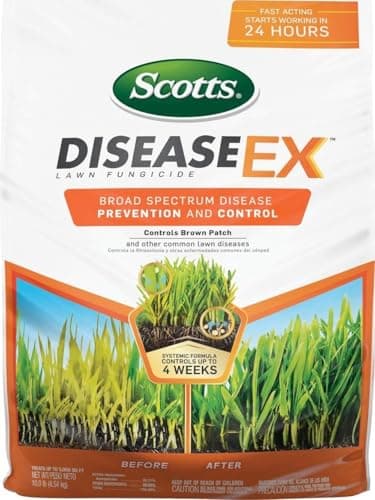
| Azoxystrobin Scotts DiseaseEx Lawn Fungicide, 10 lbs. (about $21) | Brown patch and large patch, gray leaf spot, dollar spot; supporting role on take-all root rot | Preventive first, weak once disease is running | Granular, broadcast spreader | Broadest homeowner coverage here. Easiest to apply evenly. Water in for root diseases. Strobilurin, so rotate it. Gray leaf spot has documented strobilurin resistance, so do not rely on azoxystrobin alone for that one. |
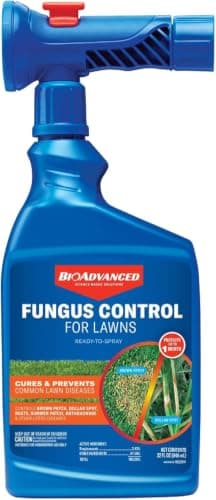
| Propiconazole BioAdvanced Fungus Control for Lawns (32 fl oz hose-end, about $17) | Active, visibly spreading brown patch, large patch, gray leaf spot and dollar spot | Systemic with real curative activity | Liquid hose-end ready-to-spray | The pick when you are already behind. DMI triazole, so it rotates well against azoxystrobin. |
| Myclobutanil (Spectracide Immunox line, no link) | Depends entirely on the label version; ornamental coverage is broader than turf coverage | Systemic DMI | Liquid concentrate and ready-to-spray | Widely stocked and often bought by mistake for lawn disease. Confirm turf use and your disease on the label first. |
| Chlorothalonil (chemistry only, no link) | Protecting healthy turf, rotation partner | Contact protectant only, no curative action | Liquid concentrate | No systemic movement, so coverage must be complete and new growth is unprotected. Residential availability varies by state. |
Matching the fungicide to the disease
Chemistry is half of it. Each of these diseases is driven by a cultural condition, and if you fix the chemistry and not the condition you will buy fungicide again next year.
Gray leaf spot
Azoxystrobin preventively if you have a history of it, propiconazole if lesions are already spreading. The cultural fix is nitrogen. Gray leaf spot is strongly associated with lush, nitrogen-pushed growth in hot humid weather, so back off feeding during peak summer instead of trying to grow through it. Watering late in the day keeps blades wet overnight and makes it worse, so move irrigation to early morning and use our watering tool to set a schedule you will stick to.
Brown patch and large patch
This is azoxystrobin's home turf, and preventive timing separates a lawn that shrugs it off from one that scars. The disease activates when soil temperatures drop into the range that favors it, which in warm-season lawns means fall as the grass slows and again in spring. Soil temperature, not the calendar, is the trigger, so watch soil temperature heading into fall. Cultural fixes: drainage, no late-season nitrogen, no evening watering. For application mechanics on the granular, see our how-to-apply companion for Scotts DiseaseEx, and for season timing, when to apply fungicide to a lawn.
Take-all root rot
Be realistic here. Azoxystrobin appears in extension guidance for this disease, applied in fall and watered in so it reaches the root zone, but it is never the whole plan. Take-all is driven by poor drainage, high soil pH and stress, and lawns that only spray tend to relapse the next summer. Get a soil test, move pH toward the range your extension office recommends, fix the wet spots, raise mowing height and feed lightly. Recovery is measured in a growing season, not weeks.
Dollar spot
Both azoxystrobin and propiconazole are active against it. The unusual part is the cultural fix, because dollar spot is a low-nitrogen disease. A starved lawn keeps producing it no matter what you spray, so an adequate, balanced feeding program does as much work as the fungicide.
- Application rates and retreatment intervals are label instructions and differ by product, formulation and concentration. Read the label on the jug you bought and follow it exactly. Nothing here replaces it.
- Which active ingredients are registered for residential use on St. Augustine grass varies by state. Your state extension office can tell you what is cleared where you live.
- Season-long resistance rotation programs, including how many applications of a FRAC group are appropriate per year, should come from your state extension turf recommendations.
- Preventive timing depends on local soil temperature and disease pressure, which shift by region and year. Ask your county extension office when your preventive window opens, and get a soil test before changing pH or fertility.
When NOT to spray
This is the section that pays for itself. Every one of these gets mistaken for lawn disease, and fungicide does nothing for any of them.
Chinch bugs. The most expensive misdiagnosis in St. Augustine. Damage shows up in the hottest, sunniest, most drought-stressed parts of the lawn, often along driveways, and turns the turf straw brown. Part the grass at the green edge of a damaged area and look for small black and white insects at the soil line. If you find them you need an insecticide.
Drought stress. Grass short on water folds its blades, takes a blue-gray cast and holds footprints. It shows first on slopes, near pavement and anywhere irrigation does not reach evenly. The fix is water, and an irrigation audit on that zone usually finds the real problem.
Fertilizer burn. Sharp-edged yellow or brown streaks following the exact path of a spreader. The giveaway is geometry: disease does not travel in straight parallel lines. Water it in heavily and wait.
Dormancy. St. Augustine browns off in cold weather, unevenly, because shaded and exposed areas cool at different rates. Browning heading into winter with no blade lesions is a lawn going to sleep.
Slime mold. Gray, black or yellow powdery masses coating blades after humid weather, usually in the same spot every year. It looks alarming and is harmless. It is not feeding on the grass, just standing on it. Hose it off and move on.
What Other Guides Miss
Most "best fungicide for St. Augustine" articles are built as a product ranking, and that structure is the problem. Ranking implies a single winner, and a single winner only exists if every reader has the same disease. The person with gray leaf spot in August and the person with large patch in November need different chemistry at different times, and the person with chinch bugs should not be on that page at all.
Those guides also skip that fungicide timing on warm-season grass is driven by soil temperature and moisture, not by a date. Brown patch and large patch fire when soil temperatures drop into their range, which is why a preventive application made too early or too late accomplishes nothing while costing exactly the same.
Third: the strongest chemistry here, applied perfectly, still loses to a lawn watered at nine at night. Extended leaf wetness is the input every one of these foliar diseases needs. Fix irrigation timing and you cut your fungicide spend more than any product choice will.
That is where the paid side of this site earns its keep. Our personalized 12-month care plan tells you the exact week each disease's preventive window opens for your zip code and your grass type, so you apply azoxystrobin when it can actually do something instead of guessing off a national average. That is the difference between a preventive program and an expensive habit.
Your buying plan, in order
- Confirm it is a disease at all. Rule out chinch bugs, drought and fertilizer burn. Snap a photo and run it through the free AI diagnosis before you spend a dollar on chemistry. A wrong diagnosis makes every step below useless.
- Name the specific disease. Blade lesions mean foliar. No lesions plus rotten roots means take-all. Cross-check against the identification guide and the St. Augustine grass guide.
- Pick preventive or curative. No visible disease but a known history means azoxystrobin granular before the window opens. Active, spreading damage means a propiconazole hose-end spray.
- Read the label before you pay. Confirm St. Augustine grass is listed, your disease is listed, and the product is cleared for residential turf use in your state. This step catches the Immunox mistake.
- Fix the cultural cause the same week. Morning irrigation, less nitrogen in summer heat, higher mowing, drier low spots. Chemistry buys time; conditions decide whether the disease returns.
- Plan the rotation before you need it. If a second application is warranted, switch modes of action, and get per-season limits from the label and your extension office.
Free Lawn Care Tools
There is no single best one, because the right product depends on which disease you have. For brown patch, large patch and gray leaf spot, azoxystrobin is the broadest and most accessible homeowner active ingredient, and it comes as a granular you can spread evenly. If the disease is already spreading visibly, a systemic DMI like propiconazole in a hose-end spray has better curative activity. Confirm the disease first, because chinch bugs and drought stress get mistaken for fungus constantly.
Scotts DiseaseEx is an azoxystrobin granular, and azoxystrobin is the standard homeowner active ingredient for brown patch, large patch and gray leaf spot in warm-season turf. It is preventive-first chemistry, so it performs best applied before or at the first symptoms rather than partway into an outbreak. For root diseases it has to be watered in so it reaches the root zone. Check the label to confirm St. Augustine grass and your specific disease are both listed.
Immunox contains myclobutanil, which is a systemic DMI, but the line is primarily an ornamental, rose and fruit-tree fungicide. Its listed lawn-disease coverage is narrower than its ornamental coverage, and some products in the family are not labeled for turf at all. That makes it a product you have to read before you buy rather than one you can grab on brand recognition. Turn the bottle over, find the turf section, and confirm your disease and your grass type are named.
Preventive products protect tissue that is not infected yet, which is why strobilurins like azoxystrobin work best applied before symptoms show or right as they start. Curative products have enough systemic activity to act on infection already established inside the plant, which is where DMI triazoles like propiconazole are stronger. Most homeowners buy after the damage is visible, which is exactly when a curative product makes more sense. Once the outbreak is stopped, preventive timing is what keeps it from returning.
No, and this is the most expensive mistake in St. Augustine lawn care. Chinch bug damage appears in the hottest, sunniest, most drought-stressed parts of the lawn and turns the turf straw brown, which looks close enough to disease to fool most people. Part the grass at the green edge of a damaged area and look for small black and white insects at the soil line. If you find them you need an insecticide, and a fungicide will do nothing at all.
Yes, if you are making more than one application in a season. Fungicides are grouped by mode of action, shown as the FRAC group number on the label, and fungal populations adapt to a mode of action they meet repeatedly. Strobilurins like azoxystrobin have a well-documented resistance history when used alone application after application. Alternate a strobilurin with a DMI, or a systemic with a contact, and get the per-season limits from the label and your state extension office.
Not on its own. Azoxystrobin appears in extension guidance for take-all root rot, applied in fall and watered in so it reaches the root zone, but the disease is driven by poor drainage, high soil pH and stress. Lawns that only spray it tend to relapse the following summer. Get a soil test, fix the wet spots, raise your mowing height and feed lightly, and expect recovery to take most of a growing season.
Timing is driven by soil temperature and moisture rather than by a calendar date. Brown patch and large patch activate when soil temperatures fall into the range that favors them, which in warm-season lawns means fall as the grass slows and again in spring. Gray leaf spot is a hot, humid weather disease and tracks summer nitrogen and overnight leaf wetness. Your county extension office can tell you when the preventive window typically opens where you live.

Your lawn plan, in your pocket all season
Grass ID, a season plan, soil-timed reminders, and a lawn journal that remembers what you did. Free on iPhone.
Related Articles
- Lawn Care Tips
Large Patch in Zoysia and St. Augustine: Fall Identification and Treatment
Sep 13, 2026•6 min read - Lawn Care Tips
Take-All Root Rot in St. Augustine Grass: How to Identify and Treat It
Sep 13, 2026•6 min read - Lawn Care Tips
St. Augustine Grass Diseases: Identification and Treatment
Jun 15, 2026•12 min read