Types of Grass in Florida: The Common Lawn Grasses
 Marcus GreenTurf Management Pro | 18 Years
As an Amazon Associate we earn from qualifying purchases.
Florida is warm-season grass country. St. Augustine is the default lawn statewide, with bahia, zoysia, bermuda, and centipede filling in, plus seashore paspalum and carpetgrass as specialty grasses. There is no tall fescue or bluegrass lawn here. Every common Florida grass spreads by runners, so blade width, color, and seed heads do the sorting.
St. Augustine is broad and coarse with thick surface runners; bahia carries a Y-shaped seed head on a tall stalk. UF/IFAS sets pre-emergent at February 1 in South Florida, February 15 in Central Florida, and March 1 in North Florida.
Every grass that makes a real Florida lawn is warm-season, built for the heat and humidity. UF/IFAS Extension recommends seven species, but most yards come down to five, with St. Augustine well out in front. This guide covers each common type and how to tell which one is already in your yard.
The types of grass that grow in Florida
St. Augustinegrass
St. Augustinegrass is the default Florida lawn, the most commonly used lawn grass in the state and the dense blue-green turf you see on most home sites. It handles Florida heat and humidity, tolerates more shade than the other warm-season options, and takes some salt near the coast. The trade-off is pests: UF/IFAS calls the southern chinch bug its major insect problem, and it needs steady water and an eye for disease.
Bahiagrass
Bahiagrass is Florida's low-input workhorse, a good choice for large lots or anywhere without irrigation. It persists in the state's infertile sandy soils on little water or fertilizer and sends down deep roots, but it has an open, coarse canopy and tall Y-shaped seed heads that need frequent mowing. It is function over looks, not a manicured lawn.
Zoysiagrass
Zoysiagrass is the dense, fine-to-medium premium turf used statewide for high-quality Florida lawns. Properly managed, it produces a very dense ground cover that resists weed invasion and feels great underfoot. It is slow to establish and the priciest to install, which is the price of that density.
Bermudagrass
Bermudagrass is Florida's full-sun performance grass, among the most widely used warm-season grasses on athletic fields, golf courses, and high-profile lawns. It is fine-textured, wear- and drought-tolerant, and recovers fast, but it demands full sun and the most mowing and feeding of any Florida lawn grass.
Centipedegrass
Centipedegrass is the slow-growing lazy man's grass, best suited to the acidic sandy soils of North and Central Florida and the Panhandle. UF/IFAS notes its low fertility requirements compared to other Florida lawn grasses, and it asks for little mowing, but it does not take heavy traffic or high pH and can decline if pushed.
Two specialty grasses round out the Florida list. Seashore paspalum has the best salt tolerance of any warm-season turf, so it grows well where recycled or saline water is used, at a higher maintenance cost. Carpetgrass is a minor low-maintenance option for wet, low-fertility, acidic sites in North Florida. Both are niche choices rather than a typical home lawn.
Florida grass types compared at a glance
| Grass | Season | Best role | Sun / shade | Water need | Maintenance |
|---|---|---|---|---|---|
| St. Augustinegrass | Warm | Florida default, statewide | Best shade tolerance | Higher | Medium-high |
| Bahiagrass | Warm | Low-input, large or dry lots | Full sun, poor shade | Very low | Very low |
| Zoysiagrass | Warm | Dense premium, statewide | Sun to light shade | Moderate | Low-medium |
| Bermudagrass | Warm | Full-sun performance turf | Full sun, poor shade | Low once established | High |
| Centipedegrass | Warm | Acidic sandy North/Central FL | Sun to light shade | Low | Very low |
How to tell which type you already have
Start with one question: does the grass spread by runners, or grow in clumps? Every common Florida grass spreads by runners, so here blade width, color, texture, and the seed head do the sorting.
| Grass | Blade | Growth habit | Standout tell |
|---|---|---|---|
| St. Augustinegrass | Broad, flat, coarse | Thick surface runners | Runners you can lift and trace; planted from sod |
| Bahiagrass | Coarse, open | Short stout runners | Two-pronged, Y-shaped seed head on a tall stalk |
| Zoysiagrass | Fine to medium, stiff | Slow, very dense | Springy carpet feel; crunches when dry |
| Bermudagrass | Fine, wiry | Runners above and below ground | Bird's-foot seed head, even in mowed lawns |
| Centipedegrass | Medium, blunt-tipped | Low, slow creeping | Apple to yellow-green color; hugs the ground |
Still not certain? Our free AI grass identifier reads a close-up photo, names the grass, and builds a 12-month care plan tuned to your ZIP.
Which types grow in your part of Florida
UF/IFAS splits Florida into three lawn zones, North, Central, and South, and the mix shifts as you move down the peninsula. Florida soils are mostly sandy with little nutrient- or water-holding capacity, and coastal ground trends sandy and high-pH. See how Florida compares to the rest of the country in our roundup of lawn grasses across every state we cover.
- North Florida and the Panhandle: The coolest zone. St. Augustine, bahia, zoysia, and bermuda all grow, and centipede and carpetgrass are especially at home on the acidic sandy soils. Cool-season grasses survive here only fall through early spring and will not make it through the summer.
- Central Florida: Transitional and the heart of the state. St. Augustine is the most common lawn, with zoysia, bahia, bermuda, and centipede all viable.
- South Florida: The warmest and nearly frost-free. St. Augustine dominates, with bahia, zoysia, bermuda, and coastal seashore paspalum filling in. Grass grows almost year-round.
Florida grass timing that matters
Soil temperature and day length run a Florida lawn more than the calendar, and South Florida barely has a winter:
- Last spring frost: on average late February to mid-March in North Florida and the Panhandle, mid-to-late February in Central Florida, and essentially none in South Florida.
- Pre-emergent window: UF/IFAS sets it at February 1 in South Florida, February 15 in Central Florida, and March 1 in North Florida, or before daytime temperatures hit 65 to 70F for four or five days straight. It lines up with azaleas and dogwoods starting to bloom.
- Peak growth: late spring through summer, roughly April to September, and longest in South Florida.
- Dormancy: North and Central Florida grasses brown out and go semi-dormant over winter; South Florida stays green nearly year-round.
Our herbicide timing tool pins the exact pre-emergent date for your ZIP.
Next steps
Once you know your grass type, the care gets specific. Dig into the full guides for St. Augustinegrass, Bahiagrass, Zoysiagrass, Bermudagrass, or Centipedegrass, or line any two up in our grass comparison tool.
And if you are not sure what is growing out there, start with a quick photo on our free grass identifier.
Top Picks
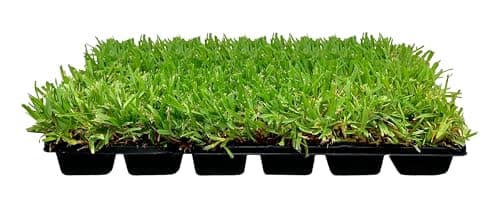
 St. Augustine Palmetto Grass Plugs (18 Extra-Large Live Plugs)Check price on Amazon
 Scotts Turf Builder Southern Lawn FoodCheck price on Amazon
As an Amazon Associate we earn from qualifying purchases.
Free Lawn Care Tools
St. Augustinegrass, by a wide margin. UF/IFAS calls it the most commonly used lawn grass in the state, valued for its shade tolerance and dense blue-green look. Bahia is the common low-input alternative on large or un-irrigated lots.
UF/IFAS recommends seven for Florida lawns: St. Augustine, bahia, zoysia, bermuda, and centipede, plus seashore paspalum and carpetgrass as specialty grasses. Florida is warm-season only, so there is no tall fescue or bluegrass lawn here.
Not as a lawn. Cool-season grasses only survive North Florida from fall through early spring and will not make it through the hot, humid summer. Every recommended Florida lawn grass is warm-season.
Bahiagrass for large or un-irrigated lots, since it survives on little water or fertilizer, and centipedegrass for acidic sandy North and Central Florida yards. Both trade a manicured look for very low input.
The two usual Florida culprits are southern chinch bugs, the grass's major insect pest, and take-all root rot, which flares in high summer rainfall and stress. Overwatering makes both worse, so the fix is usually less frequent, deeper watering plus the right diagnosis, not more water.
Sources (3)
- UF/IFAS Extension, Turfgrass Species Selection for Florida Lawns (ENH04/LH005).
- UF/IFAS Extension per-species: St. Augustinegrass (LH010), Bahiagrass (LH006), Zoysiagrass (LH011), Bermudagrass (LH007), and Centipedegrass (LH009).
- UF/IFAS Extension, Weed Management Guide for Florida Lawns (ENH884/EP141).
Photos: kcthetc1 / iNaturalist · CC0, Brandon Corder / iNaturalist · CC BY 4.0, Kevin Faccenda / iNaturalist · CC BY 4.0, Kaden Slone / iNaturalist · CC BY 4.0, Sterling Herron / iNaturalist · CC0

Beat weeds and brown spots from your phone
Snap a photo, get the fix, and follow a plan timed to your soil and weather. Free on iPhone.