Scotts Southern Weed and Feed (Bonus S): Instructions and Timing
 Marcus GreenTurf Management Pro | 18 Years
As an Amazon Associate we earn from qualifying purchases.
You bought a bag of Scotts Southern Weed and Feed, also called Bonus S, because your St. Augustine or centipede lawn is getting choked out by weeds and you want to feed the grass at the same time. Then you flipped the bag over, read the warnings about temperature, grass type, and timing, and now you are not sure when or even whether to put it down. I get this question constantly, and getting it wrong can brown out a perfectly good lawn.
Apply Scotts Southern Weed and Feed (Bonus S) only on established Southern grasses that tolerate atrazine, mainly St. Augustine and centipede, and to a lesser degree zoysia and dormant-to-greening bermuda where the label allows. The best windows are early spring as weeds green up and again in early fall, when daytime highs sit roughly in the 60s to mid-80s Fahrenheit. Mow, water the lawn so the blades are damp, then spread the granules so they stick to weed leaves, and do not water it in for 24 hours.
Skip it when highs climb past the upper 80s, on drought-stressed or freshly seeded or sodded turf, and on bermuda, bahia, or any cool-season grass where the label warns of injury. Atrazine is the active ingredient, so it kills and suppresses broadleaf weeds plus some young grassy weeds while the fertilizer greens up the lawn. When in doubt, confirm your grass type and the label rate before you open the bag.
What Bonus S Actually Is (and Is Not)
Let me clear up the confusion first, because Scotts sells three things that sound almost identical and homeowners mix them up every spring. Bonus S is a combination product: a granular fertilizer carrying the herbicide atrazine. That herbicide is the whole reason it gets a different timing and tolerance story than plain lawn food.
If you only want to feed the grass with no weed killer, that is plain Scotts Southern Turf Builder, and the broader weed and feed lineup is covered here. And if you run a bermuda lawn, atrazine is generally the wrong call, so read up on the weed-control products that will not torch bermuda before you reach for Bonus S. This post is strictly about the atrazine version for Southern lawns. I am going to keep us in that lane so you do not end up applying the wrong bag to the wrong grass.
Grass Tolerance and Timing at a Glance
This is the table I wish every homeowner saw before they bought a bag. Atrazine tolerance is everything here, and it varies a lot by species. Lead with this, then we will get into the how.
| Grass Type | Atrazine Tolerance | Best Application Window | Notes |
|---|---|---|---|
| St. Augustine | Good | Early spring and early fall | The classic candidate; tolerates atrazine well when established |
| Centipede | Good | Early spring and early fall | Tolerant, but it is a low-feed grass, so do not over-apply nitrogen |
| Zoysia | Fair to good | Spring green-up and early fall | Generally tolerant; follow the label and avoid hot weather |
| Bermuda | Poor to fair | Only if the label explicitly allows, dormant or early green-up | Often injured; usually a better fit for a bermuda-safe program instead |
| Bahia | Poor | Not recommended | Atrazine commonly injures bahia; choose a different product |
| Cool-season (fescue, rye, bluegrass) | None | Never | This is a Southern, warm-season product; it can damage cool-season turf |
The big takeaway: St. Augustine and centipede are the two grasses Bonus S was really built for. If you are growing something else, slow down and verify the label before you commit. Not sure which grass is yours? A quick photo diagnosis settles it in seconds, and it pulls in the weeds and conditions active in your area so the recommendation actually fits your yard.
What It Kills and What It Does Not
Atrazine is a pre-emergent and early post-emergent herbicide, which means it works on weeds that are small and actively growing, and it lays down a little residual control in the soil. In a Southern lawn that translates to decent control of a range of broadleaf weeds and a handful of young grassy weeds.
Weeds it tends to handle well
- Common broadleaf weeds like chickweed, henbit, and lawn burweed when they are still young
- Some clover and spurge, again best when the weeds are small
- Early annual bluegrass and certain young grassy weeds, with better results from a pre-emergent timing
Weeds it struggles with
- Mature, hardened-off weeds that have already set seed
- Tough perennials and well-established sedges, which usually need a targeted product
- Crabgrass that has already germinated and tillered out
The pattern in my years on Southern turf is simple: atrazine rewards early timing. Hit weeds while they are seedlings and you get real control. Wait until they are knee-high and seeding, and you are mostly just feeding the lawn while the weeds shrug it off.
When to Apply Scotts Bonus S by Season and Temperature
Timing is where most people go wrong, so let me be specific about the windows. There are two main shots per year, and temperature is the guardrail on both.
Early spring
As your Southern lawn starts to green up and winter weeds are still small, that is your first window. You want the warm-season grass actively growing, not fully dormant, and you want the weeds young. Daytime highs sitting in the 60s to low 80s Fahrenheit are the sweet spot. This shot catches lingering winter annuals and lays down some residual ahead of summer weeds.
Early fall
The second window opens as the brutal summer heat breaks and cool-season winter weeds are just germinating. Knocking out henbit, chickweed, and annual bluegrass at the seedling stage in fall saves you a miserable late-winter weed problem. Again you are looking for moderate temperatures, not the lingering 90s of late summer.
The temperature ceiling
This is the rule people ignore and regret. Atrazine plus high heat plus a stressed Southern lawn is how you brown out turf. As a general guide, once daytime highs are pushing past the upper 80s, hold off. Summer is not Bonus S season. The label gives the exact ceiling for your product, and I want you to follow it rather than my round number.
- Atrazine application rates, the maximum temperature cutoff, and the number of applications allowed per year are printed on the label and regulated, and they vary by state. Treat the bag as the law and follow it exactly rather than any figure you read in an article.
- Atrazine is a restricted or watched product in some areas because of groundwater concerns, and a few jurisdictions limit or ban it. Your county cooperative extension office can confirm what is allowed where you live.
- Typical guidance limits you to a small number of atrazine applications per lawn per year with a minimum interval between them. For the exact rate per thousand square feet, the spreader setting, and the re-treatment interval for your grass and region, contact your local cooperative extension office.
- If your lawn is newly seeded, sprigged, or sodded, there is usually a waiting period of several weeks to months before any atrazine product is safe. Your extension office can give the window for your grass type.
How to Apply Scotts Southern Weed and Feed
Application technique matters more with a weed and feed than with plain fertilizer, because the herbicide has to physically stick to weed leaves to work. Here is the sequence I use and recommend.
1. Mow a couple of days ahead and leave some leaf
Mow two or three days before you apply, and do not scalp it. You want weed leaves present and exposed so the granules have a target to land on. Mowing right before or right after application defeats the purpose.
2. Apply to a damp lawn
This is the trick most people miss. The granules need to stick to wet weed foliage. Apply in the early morning when there is dew, or lightly wet the lawn first with a sprinkler. Dry granules bouncing off dry leaves do almost nothing for weed control.
3. Spread evenly with the labeled setting
Use a broadcast or drop spreader set to the rate printed on the bag for your model. Even coverage prevents striping, where some passes get a double dose and burn while others get nothing. Walk a steady pace and slightly overlap your wheel tracks rather than your spread pattern.
4. Do not water it in
Unlike plain fertilizer, you do not want to immediately irrigate a weed and feed. The product needs to sit on the weed leaves to be absorbed, usually for 24 hours or so. Watering it in right away washes the herbicide off the leaves and into the soil before it can work. Check your bag, but the standard rule is wait at least a day, ideally with no rain in the forecast.
5. Then resume normal watering and mowing
After that 24-hour window, water and mow as usual. Give the product a few weeks to show results. Weeds yellow and curl before they die, so do not panic if they are still standing on day three.
Safety and Common Mistakes
A few hard-earned cautions, because Bonus S is forgiving on the right grass and unforgiving everywhere else.
- Tree and shrub roots: Atrazine can be taken up by the roots of ornamentals and trees. Be careful applying it inside the root zone of valued shrubs and trees, and keep it off garden beds entirely.
- Drought stress: Never apply to a lawn that is wilting or browning from drought. A stressed lawn plus a herbicide is asking for injury. Water it back to health first, then treat in good conditions.
- Wrong grass: I will say it again because it is the number one mistake. Do not put this on bermuda, bahia, or any cool-season grass unless the label specifically clears it. If you are not certain what you have, find out before you spread.
- Runoff and water: Do not apply before heavy rain, near storm drains, ponds, or wells. Atrazine and water do not mix well, which is exactly why it is regulated.
- Pets and kids: Keep everyone off until the product has been applied and the lawn has dried, and follow the re-entry guidance on the label.
What Other Guides Miss
Most articles about Bonus S stop at when to apply it. What they skip is the strategic question: weed and feed is almost always a compromise product, and understanding that compromise is what separates a good-looking lawn from a frustrated one.
Here is the thing the bag will never tell you. The ideal time to feed your grass and the ideal time to kill your weeds are usually not the same date. Your warm-season lawn wants nitrogen when it is actively growing in late spring and summer. But atrazine wants cooler temperatures and young weeds, which pushes you toward early spring and fall. By combining the two into one bag, you are forced to compromise on one of them. Most of the time you compromise on the feeding, applying nitrogen earlier or later than the grass truly wants it.
That is fine for many homeowners who want simplicity, and I am not talking anyone out of Bonus S. But if your real problem is weeds, the smarter play is often to treat weeds with the right herbicide at the right time, and feed separately on the grass's schedule. Centipede in particular is a low-nitrogen grass that resents heavy feeding, so a weed and feed can actually push it harder than it wants. This is the nuance that gets lost when a guide treats every Southern lawn the same.
The other thing guides gloss over is diagnosis. Half the lawns I have seen treated with Bonus S did not have a weed problem that atrazine solves. They had thin turf from a disease, an insect, or a mowing-height mistake, and the weeds were just moving into the bare spots. Spraying herbicide at the symptom does nothing for the cause. That is exactly why I push diagnosis first. A free photo diagnosis tells you whether you are actually fighting weeds or chasing a thinning problem that needs a completely different fix, and the premium plan goes a step further by building a personalized 12-month care plan that tells you the exact week to fertilize for your zip code and grass type, so your feeding and your weed timing finally line up instead of fighting each other.
The Bottom Line
Bonus S is a solid tool when it is matched to the right grass, the right weeds, and the right weather. Used carelessly, it browns out lawns and disappoints people. Use it deliberately and it earns its place. For a deeper dig into the two grasses it suits best, my St. Augustine grass guide and centipede grass guide walk through everything from mowing height to feeding schedules so you can fit Bonus S into a full-season plan.
Your Bonus S Action Plan
- Confirm your grass type first. St. Augustine and centipede are the prime candidates; zoysia is usually fine; bermuda, bahia, and cool-season grasses are mostly off the table unless the label says otherwise. Not sure, get a photo diagnosis before you buy.
- Identify your actual weed problem. Make sure weeds, not disease or insects, are why the lawn is thinning. Atrazine only fixes a weed problem.
- Pick the right window. Early spring as the lawn greens up, or early fall as winter weeds germinate, with daytime highs roughly in the 60s to mid-80s Fahrenheit and never in summer heat.
- Read your specific label. Confirm the rate, spreader setting, temperature ceiling, and applications allowed per year, and check with your cooperative extension office on any local atrazine restrictions.
- Mow two or three days ahead and leave weed leaves exposed.
- Apply to a damp lawn so the granules stick, spreading evenly at the labeled setting.
- Do not water it in for 24 hours, and pick a stretch with no rain in the forecast.
- Wait a few weeks for results, then feed and water on your grass's normal schedule, and consider separating weed control from feeding next season if you want each done at its ideal time.
Do that and Bonus S will do exactly what you bought it for, without taking your lawn down with the weeds.
Top Picks
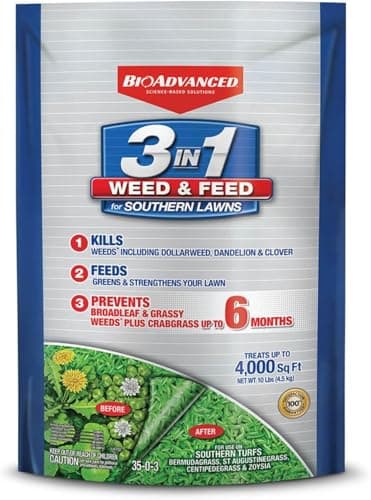
 BioAdvanced 3-in-1 Weed and Feed for Southern Lawns (10 lb)Check price on Amazon
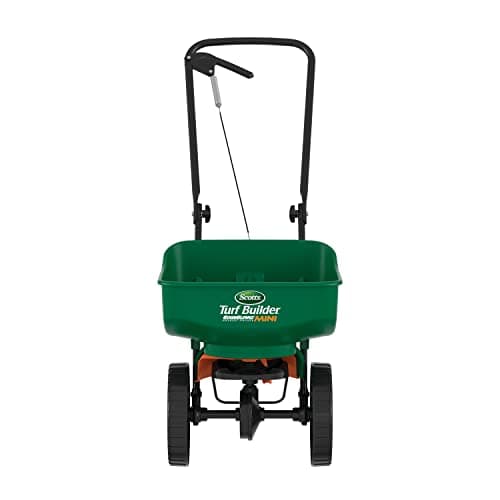
 Scotts Turf Builder EdgeGuard Mini Broadcast SpreaderCheck price on Amazon
As an Amazon Associate we earn from qualifying purchases.
Free Lawn Care Tools
The two best windows are early spring, as your Southern lawn greens up and winter weeds are still small, and early fall, as cool-season winter weeds begin to germinate. In both windows you want daytime highs roughly in the 60s to mid-80s Fahrenheit and the lawn actively growing, not dormant or drought-stressed. Avoid applying in summer heat once highs push past the upper 80s, since atrazine plus high heat can injure the turf.
It is built mainly for St. Augustine and centipede, which tolerate the atrazine well when established. Zoysia is generally fine, while bermuda and bahia are often injured and should only be treated if the label specifically allows it. Never use it on cool-season grasses like fescue, ryegrass, or bluegrass, since it is a warm-season product that can damage them.
Mow two or three days ahead and leave some leaf so weeds are exposed, then apply to a damp lawn in early morning dew or after lightly watering, because the granules must stick to wet weed leaves to work. Spread evenly with the labeled spreader setting, then do not water it in for about 24 hours so the herbicide has time to absorb. Give it a few weeks to show results before judging it.
Unlike plain fertilizer, a weed and feed needs the herbicide granules to sit on the weed foliage and be absorbed, which usually takes around 24 hours. Watering it in immediately washes the atrazine off the leaves and into the soil before it can control the weeds. The standard rule is to wait at least a day after applying and to avoid times when rain is in the forecast.
Atrazine works best on young, actively growing weeds and lays down some residual control. It tends to handle common broadleaf weeds like chickweed, henbit, and burweed, plus some clover, spurge, and early annual bluegrass when they are small. It struggles with mature, seeded-out weeds, tough perennials, established sedges, and crabgrass that has already tillered, so early timing is key.
No. Bonus S is a weed and feed, meaning it combines fertilizer with the herbicide atrazine, while Scotts Southern Turf Builder is plain lawn food with no weed killer. Use Turf Builder when you only want to feed the grass and Bonus S when you also need to control weeds on a tolerant Southern grass. Because Bonus S contains a herbicide, it has stricter timing, temperature, and grass-tolerance rules than plain fertilizer.

Your lawn plan, in your pocket all season
Grass ID, a season plan, soil-timed reminders, and a lawn journal that remembers what you did. Free on iPhone.
Related Articles
 Fertilizing
Scotts Liquid Weed and Feed Instructions: Hose-End Sprayer Guide
Jul 18, 2026•11 min read Fertilizing
Scotts Fall Weed and Feed: When to Apply, Settings and Which Bag to Buy
Sep 12, 2026•10 min read Fertilizing
Slow-Release Lawn Fertilizer: How It Works and When to Use It
Sep 23, 2026•6 min read