Types of Grass in Georgia: The Common Lawn Grasses
 Marcus GreenTurf Management Pro | 18 Years
As an Amazon Associate we earn from qualifying purchases.
Most Georgia lawns are warm-season grass. Bermuda, zoysia, centipede, and St. Augustine cover the middle and lower parts of the state, while tall fescue is the cool-season lawn for North Georgia's Piedmont and mountains. Where you sit on the map, and how much shade you have, decides which one belongs in your yard.
Put crabgrass pre-emergent down before soil at half-inch depth reaches about 52 to 55F, around March 1 for Atlanta and a couple of weeks earlier in South Georgia. Warm-season grasses peak June through August; tall fescue peaks in spring and fall and thins in summer heat.
Georgia straddles the line between the warm South and the cooler mountains, so it grows more lawn grasses than most states. University of Georgia Extension draws the key boundary at roughly Griffin: north of it, tall fescue is the classic cool-season lawn; south of it, warm-season grasses rule. This guide covers every common type and how to tell which one is already in your yard.
The types of grass that grow in Georgia
Bermudagrass
Bermudagrass is Georgia's go-to full-sun lawn, the grass under most athletic fields and full-sun front yards from the mountains to the coast. It takes Georgia summers in stride, recovers fast from traffic, and needs less water than most once established. The catch is shade: UGA notes bermuda performs poorly in it, so a tree-heavy yard will thin out. Expect frequent mowing and a tan, dormant look after the first hard frost.
Zoysiagrass
Zoysiagrass is the fine-textured, low-mow upgrade that UGA says is adapted to the entire state. It forms a dense, cushiony carpet that crowds out weeds and takes light shade better than bermuda. It grows slowly, which means less mowing but also slow recovery from damage and a higher install cost. Its popularity in Georgia is rising fast for exactly these reasons.
Centipedegrass
Centipedegrass is the low-input lawn for middle and lower Georgia, nicknamed the lazy man's grass for its very low nitrogen appetite. It is light apple-green, slow-growing, and happiest in the acidic, sandy soils of the Coastal Plain. Overfeed it or plant it in heavy alkaline ground and it declines, but given the right spot it asks for very little mowing or fertilizer.
St. Augustinegrass
St. Augustinegrass is the most shade-tolerant of Georgia's warm-season grasses, best suited to the middle and lower part of the state. You will find it in some shaded Atlanta yards too, though that far north it carries real winter-injury risk. It has broad, coarse blades and thick surface runners and likes the humidity. It is planted from sod or plugs, drinks more water than bermuda, and is frost-sensitive up north.
Tall Fescue
Tall Fescue is the cool-season lawn for North Georgia's Piedmont and mountains, staying green through fall, winter, and early spring when warm-season grasses go tan. UGA calls it best adapted to Georgia's Piedmont and puts its southern limit generally around Griffin, below which it hangs on mostly in shade. Its weakness is Georgia's hot, humid summer, which brings brown patch disease and thinning, so North Georgia fescue lawns are usually renovated or overseeded in fall to fill the summer losses.
Bahiagrass
Bahiagrass is the honest outlier here. UGA considers it a weed in most lawns, with an open canopy and tall Y-shaped seed heads, and lists it as a low-maintenance grass for roadsides, soil stabilization, and general-use areas rather than an ornamental lawn. It earns a mention because it is tough and drought-hardy on poor sandy ground, but it is not the choice for a showcase yard.
Kentucky Bluegrass
Kentucky Bluegrass is a niche option for the North Georgia mountains, the coldest corner of the state. UGA is clear that it does not perform as well as tall fescue there, so it shows up mainly in the highest, coolest parts of North Georgia, usually mixed into cool-season seed rather than standing as a lawn on its own. Everywhere else in Georgia the summers are simply too hot for it.
Georgia grass types compared at a glance
| Grass | Season | Best role | Sun / shade | Water need | Maintenance |
|---|---|---|---|---|---|
| Bermudagrass | Warm | Full-sun default statewide | Full sun, poor shade | Low once established | High |
| Zoysiagrass | Warm | Dense, low-mow, statewide | Sun to light shade | Moderate | Low-medium |
| Centipedegrass | Warm | Low-input, middle and south GA | Sun to light shade | Low | Very low |
| St. Augustinegrass | Warm | Shade, middle and south GA | Best shade tolerance | Higher | Medium-high |
| Tall Fescue | Cool | North Georgia lawns | Shade to part sun | Moderate to high | Medium |
| Bahiagrass | Warm | Utility and roadside, not lawns | Full sun, poor shade | Low | Very low |
| Kentucky Bluegrass | Cool | North GA mountains, in blends | Sun to light shade | High | Medium-high |
How to tell which type you already have
Start with one question: does the grass spread by runners, or grow in clumps? The warm-season grasses and Kentucky bluegrass spread; tall fescue grows in bunches with no runners. From there, blade width, color, and the seed head sort the rest.
| Grass | Blade | Growth habit | Standout tell |
|---|---|---|---|
| Bermudagrass | Fine, wiry | Runners above and below ground | Bird's-foot seed head, even in mowed lawns |
| Zoysiagrass | Fine to medium, stiff | Slow, very dense | Springy carpet feel; crunches when dry |
| Centipedegrass | Medium, blunt-tipped | Low, slow creeping | Apple to yellow-green color; hugs the ground |
| St. Augustinegrass | Broad, flat, coarse | Thick surface runners | Runners you can lift and trace; planted from sod |
| Tall Fescue | Wide, coarse, rough edges | Bunching, no runners | Grows in clumps, not a spreading mat |
| Bahiagrass | Coarse, open | Short stout runners | Two-pronged, Y-shaped seed head on a tall stalk |
| Kentucky Bluegrass | Fine, soft | Spreads by rhizomes, dense sod | Boat-shaped blade tip; open seed-head panicle |
Still not certain? Our free AI grass identifier reads a close-up photo, names the grass, and builds a 12-month care plan tuned to your ZIP.
Which types grow in your part of Georgia
Georgia sits in the warm-season South with a real cool-season pocket up north, so the common grasses shift as you move from the coast to the mountains.
- Blue Ridge and North Georgia mountains: The coolest corner. Tall fescue is the dominant lawn, Kentucky bluegrass shows up blended in, and Bermuda or Zoysia hold the full-sun sites. Latest frosts and the shortest warm-season window.
- Piedmont (Atlanta, Athens, Griffin): The transition heart. Tall fescue is the classic lawn around and north of Griffin, while Bermuda and Zoysia thrive in full sun and some St. Augustine covers shaded Atlanta yards. This is Georgia red clay country: acidic, compacted, and slow to drain.
- Coastal Plain and South Georgia (Macon, Savannah): The warmest, with sandy soils and the longest growing season. All warm-season here: Centipede, St. Augustine, Bermuda, and Zoysia, with Bahia on utility ground. Tall fescue is generally not a persistent lawn this far south.
Georgia grass timing that matters
Soil temperature, not the calendar, runs a Georgia lawn, and the numbers shift a lot from the mountains to the coast:
- Last spring frost: on average mid-April in the Piedmont, late April into early May in the mountains, and mid-February to early March along the coast.
- Pre-emergent window: put crabgrass pre-emergent down before soil at half-inch depth reaches about 52 to 55F. That is around March 1 for the Atlanta area, a couple of weeks earlier in South Georgia, and early-to-mid March up north. The old rule is to finish before the forsythia does.
- First fall frost: mid-October across northeast Georgia to mid-November across central Georgia, later on the coast.
- Peak growth: warm-season grasses peak June through August; tall fescue peaks in spring and fall and struggles in the summer heat.
- Dormancy: warm-season grasses brown out after the first hard frost until spring green-up; North Georgia fescue stays green year-round but thins in summer.
Our herbicide timing tool pins the exact pre-emergent date for your ZIP.
Next steps
Once you know your grass type, the care gets specific. Dig into the full guides for Bermudagrass, Zoysiagrass, Centipedegrass, St. Augustinegrass, or Tall Fescue, or line any two up in our grass comparison tool. For the wider picture, see how every state compares.
And if you are not sure what is growing out there, start with a quick photo on our free grass identifier.
Top Picks
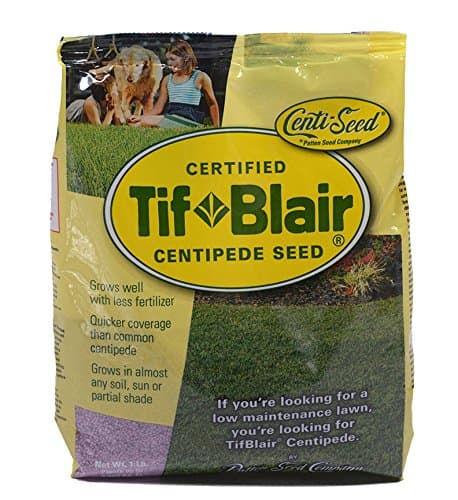
 TifBlair Centipede Grass Seed (1 lb, covers up to ~4,000 sq ft)Check price on Amazon
 Ferti-Lome Centipede Lawn Fertilizer 15-0-15 (20 lb)Check price on Amazon
As an Amazon Associate we earn from qualifying purchases.
Free Lawn Care Tools
Bermudagrass in full sun across most of the state, and tall fescue in North Georgia's cooler Piedmont and mountains. St. Augustine is the common pick for shade in middle and lower Georgia.
Four warm-season grasses make up most Georgia lawns (Bermuda, Zoysia, Centipede, and St. Augustine), plus tall fescue as the North Georgia cool-season lawn. Bahiagrass and Kentucky bluegrass round out the list as a utility grass and a mountain niche.
Yes, in North Georgia. UGA puts its southern limit around Griffin; north of there it is the standard cool-season lawn, though hot, humid summers bring brown patch and it needs fall overseeding. South of Griffin it fades out except in shade.
Centipedegrass in the acidic, sandy soils of middle and South Georgia, for its very low fertilizer and mowing needs. Zoysia is the low-mow premium option statewide.
Bermuda for full sun, heavy traffic, and the lowest water bill. Zoysia for a denser, lower-mow lawn that takes light shade better, at a higher install cost and slower recovery.
Sources (3)
- University of Georgia Extension, Lawns in Georgia: Selection and Species (Bulletin 1533-1).
- UGA Extension, Crabgrass control depends on soil temperatures.
- NOAA National Weather Service, Peachtree City, Georgia frost and freeze information.
Photos: Jesse Rorabaugh / iNaturalist · CC BY 4.0, Kevin Faccenda / iNaturalist · CC BY 4.0, bat (Maria Vorontsova) / iNaturalist · CC0, Josiah Londerée / iNaturalist · CC BY 4.0, Russell P. Rai / iNaturalist · CC BY 4.0, Nonbinary-Naturalist / iNaturalist · CC0, Bill Sheehan / iNaturalist · CC BY-SA 4.0

Beat weeds and brown spots from your phone
Snap a photo, get the fix, and follow a plan timed to your soil and weather. Free on iPhone.
Related Articles
 Climate & Regional Tips
Types of Grass in Arkansas: The Common Lawn Grasses
Jul 22, 2026•7 min read Climate & Regional Tips
5 Types of Grass in Hawaii and How to Tell Which You Have
Aug 30, 2026•7 min read Climate & Regional Tips
8 Types of Grass in Nevada and How to Tell Which You Have
Sep 2, 2026•9 min read