Types of Grass in Texas: Identify the 7 Common Lawn Grasses
 Marcus GreenTurf Management Pro | 18 Years
As an Amazon Associate we earn from qualifying purchases.
Almost every Texas lawn is a warm-season grass. Six cover most of the state: bermuda, St. Augustine, zoysia, buffalo, bahia, and centipede, with cool-season tall fescue holding on in the cooler Panhandle and in shade. Which one belongs in your yard depends on where in Texas you are.
For most of the state, the last spring frost lands February 1 to March 1, and that is also the pre-emergent window, before soil crosses 55F. Peak growth runs May through September with summer soil at 85 to 95F, and dormancy runs November through March. Tan is not dead.
Most of Texas is warm-season grass country. From the Gulf Coast up through the Metroplex, summer soil heat rules out cool-season lawns like Kentucky bluegrass and fine fescue almost everywhere. The exception is the High Plains and Panhandle around Amarillo and Lubbock, which sit in the transition zone and get cold enough that tall fescue can hold a full lawn. If you already know you are replacing your lawn and just want the top pick for your area, our guide to the best grass for Texas by region makes that call. This page is the fuller field guide: every common type, and how to tell which one you already have.
The types of grass that grow in Texas
Bermudagrass
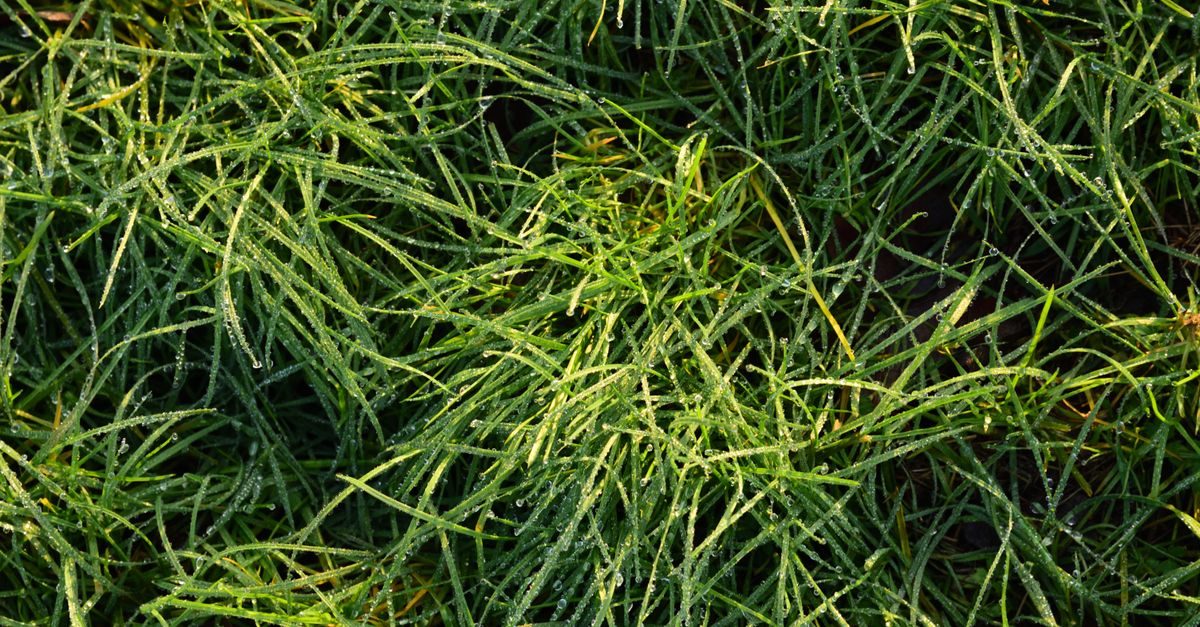
Bermudagrass is the grass you see most in full-sun Texas yards. It takes heat, drought, and foot traffic in stride, needs less water than most once its deep roots are established, and repairs itself through aggressive runners. The trade-offs: it needs sun, thins out badly in shade, and grows fast enough to demand regular mowing and feeding. Look for fine wiry blades and a seedhead shaped like a bird's foot, with three to seven slender spikes from a single point.
St. Augustinegrass
St. Augustinegrass is the go-to on the humid Gulf Coast and the best shade grass in the state. It has broad, coarse dark-green blades and thick spongy runners you can trace by hand. If tree canopy shades a good part of your yard, this is usually your grass. It is planted from sod or plugs rather than seed, drinks more water than Bermuda, and is the grass most prone to chinch bugs and brown patch in humid stretches, so plan to watch for both.
Zoysiagrass
Zoysiagrass is the dense, low-mow option that sits between Bermuda and St. Augustine. It forms a tight carpet that crowds out most weeds and is one of the most cold-tolerant warm-season grasses, so it holds up well in North Texas. The catch is that it is slow to establish and slow to heal, and it is the priciest of the group to put down.
Buffalograss
Buffalograss is a Texas native and the lowest-water grass on this list. Its soft blue-green blades sit on roots that reach several feet down, so it gets by on very little irrigation once established. It wants full sun, light traffic, and clay or alkaline soil, and it asks for only about one or two feedings a year. It is the natural pick for the drier central and western parts of the state, though it looks thinner than a lush Bermuda or St. Augustine lawn.
Bahiagrass
Bahiagrass is the tough, low-input choice for large sandy lots, mostly an East Texas play. It has a coarse, open texture, a distinctive Y-shaped seed head, and very deep roots that let it handle poor, sandy, acidic soil. It has poor shade tolerance, will never be a plush formal lawn, and those seed heads need frequent mowing, but for a big unirrigated yard it survives on almost nothing.
Centipedegrass
Centipedegrass is the low-effort lawn, and it is at its best in one part of Texas: the acidic, sandy soils of East Texas. It is light yellow-green, slow-growing, and happiest on low fertility and low pH. Give it the alkaline clay of North or Central Texas and it struggles, but in the right soil it earns its lazy-lawn reputation with very little feeding or mowing.
Tall Fescue
Tall Fescue is the one cool-season grass here. Texas A&M AgriLife adapts it to North Texas and the cooler High Plains, where warm-season grasses risk winter injury, and it holds up well in shade. It is usually grown as part of a cool-season seed mix rather than as a standalone lawn, and across the hotter rest of the state it works best as a shade patch, since South and Central Texas summers stress it.
Not sure which of these is already in your yard? Upload a photo to our free grass identifier and get the species, a confidence score, and a starter care plan in about fifteen seconds.
Texas grass types compared at a glance
| Grass | Season | Best Texas role | Sun / shade | Water need | Maintenance |
|---|---|---|---|---|---|
| Bermudagrass | Warm | Full-sun default | Full sun, poor in shade | Low once established | High |
| St. Augustinegrass | Warm | Shade and humid coast | Best shade tolerance | Higher | Medium-high |
| Zoysiagrass | Warm | Dense, low-mow lawn | Sun to moderate shade | Moderate | Low-medium |
| Buffalograss | Warm | Native, lowest water | Full sun only | Very low | Very low |
| Bahiagrass | Warm | Tough sandy lots | Full sun, poor shade | Low | Low |
| Centipedegrass | Warm | Acidic East Texas | Sun to light shade | Low to moderate | Very low |
| Tall Fescue | Cool | Panhandle and shade | Shade to part sun | Moderate to high | Medium |
How to tell which type you already have
Start with one question: does the grass spread by runners, or grow in clumps? Almost every common Texas grass spreads by runners. Tall fescue is the odd one out, growing in bunches with no runners at all. If a coarse clump stands well above the lawn with a white stripe down each blade, it is not tall fescue but a weed called Johnson grass. From there, blade width, color, and the seed head sort the rest. Here is the quick key.
| Grass | Blade | Growth habit | Standout tell |
|---|---|---|---|
| Bermudagrass | Fine, wiry | Runners above and below ground | Bird's-foot seed head, even in mowed lawns |
| St. Augustinegrass | Broad, flat, coarse | Thick surface runners | Runners you can lift and trace by hand; planted from sod |
| Zoysiagrass | Fine to medium, stiff | Slow, very dense | Springy carpet feel; crunches underfoot when dry |
| Buffalograss | Fine, soft, blue-green | Sparse surface runners | Curls over as it cures; thin, open stand |
| Bahiagrass | Coarse, open | Short stout runners | Two-pronged, Y-shaped seed head on a tall stalk |
| Centipedegrass | Medium, blunt-tipped | Low, slow creeping | Apple to yellow-green color; hugs the ground |
| Tall Fescue | Wide, coarse, rough edges | Bunching, no runners | Grows in clumps, not a spreading mat |
Still not certain? Our free AI grass identifier reads a close-up photo, names the grass, and builds a 12-month care plan tuned to your ZIP.
Which types grow in your part of Texas
Texas spans several lawn climates, and the common grasses shift as you move from the humid Gulf coast to the arid west to the cold High Plains. All of them grow somewhere in the state. See how Texas compares to the rest of the country in our roundup of lawn grasses across every state we cover.
- East Texas (Tyler, Lufkin, the Piney Woods): St. Augustine, Centipede, and Bahia thrive in the acidic sandy soil and humidity, with Bermuda in the open sun. The one corner of Texas where Centipede and Bahia truly shine.
- South Texas (Rio Grande Valley, Corpus Christi, Laredo): St. Augustine leads on the humid, near frost-free coast, with Bermuda and Zoysia close behind. Bahia fits the sandy coastal spots. Grass barely goes dormant here.
- Central Texas (Austin, San Antonio, the Hill Country): Bermuda and Zoysia over alkaline clay and caliche, with native Buffalograss the smart pick where summer watering is limited.
- North Texas (Dallas, Fort Worth): Bermuda and Zoysia on heavy Blackland clay, St. Augustine in tree shade, Buffalo for low-water yards. Colder winters than the south, so a later spring green-up.
- West Texas (El Paso, Midland, Odessa): Arid and alkaline, so native Buffalograss and irrigated Bermuda are the sensible defaults.
- Panhandle and High Plains (Amarillo, Lubbock): The coldest corner of the state and true transition-zone territory. Buffalograss and Bermuda handle the sunny yards, and this is the one part of Texas where cool-season grasses like tall fescue become genuinely viable. Expect a much later spring and earlier fall than the rest of Texas.
For a deeper regional breakdown with our top pick in each area, see our guide to the best grass for Texas by region.
Texas grass timing that matters
Soil temperature, not the calendar, drives a Texas lawn. These windows fit most of the state, the South Central zone from the coast up through the Metroplex:
- Last spring frost: February 1 to March 1, when warm-season grasses start to green up.
- Pre-emergent window: February 1 to March 1, before soil crosses 55F and crabgrass germinates. This is the date most Texans miss.
- Peak growth: May through September, with summer soil at 85 to 95F.
- First fall frost: November 15 to December 15, with a fall pre-emergent in October.
- Dormancy: November through March. Warm-season grasses go tan, not dead.
Adjust by region: run a week or two earlier toward the coast, and shift everything much later on the High Plains, where the last frost can hold into April and the growing season is noticeably shorter. Our herbicide timing tool pins the exact pre-emergent date for your ZIP.
Next steps
Once you know your grass type, the care gets specific. Dig into the full guides for Bermudagrass, St. Augustinegrass, Zoysiagrass, or Buffalograss, or line any two up in our grass comparison tool.
And if you are still not sure what is growing out there, start with a quick photo on our free grass identifier so you know exactly what you are working with before you spend a dime on seed or sod.
Top Picks
 Scotts Turf Builder Grass Seed Bermudagrass (4 lb)Check price on Amazon
 Scotts Turf Builder Southern Lawn FoodCheck price on Amazon
As an Amazon Associate we earn from qualifying purchases.
Free Lawn Care Tools
Bermudagrass, by a wide margin. It handles full sun, heat, drought, and traffic, which fits most Texas yards. St. Augustine is the most common grass where there is tree shade or coastal humidity.
Six warm-season grasses cover nearly every Texas lawn: Bermuda, St. Augustine, Zoysia, Buffalo, Bahia, and Centipede. Cool-season Tall Fescue adds a seventh common option, mainly for the Panhandle and for shade. Other grasses grow here, but these are the ones that make real lawns.
It comes down to sun. Choose Bermuda for full sun, heavy use, and the lower water bill of the two. Choose St. Augustine if you have meaningful tree shade or a humid coastal lot, where Bermuda thins out and dies. Many Texas yards run both, Bermuda in the open and St. Augustine under the trees.
Buffalograss for sunny, low-traffic yards, since it is native and needs little water or feeding. In the acidic, sandy soil of East Texas, Centipedegrass is the low-effort choice for the same reason.
In most of Texas, only as a shade patch, because summer heat stresses it. The exception is North Texas and the cooler High Plains, where Texas AM lists tall fescue as adapted, though it is usually grown as part of a cool-season seed mix rather than alone. Everywhere else, a warm-season grass is the durable, water-smart choice.
Sources (3)
- Texas A&M AgriLife Extension (AggieTurf), Texas Turfgrasses: Bermudagrass, St. Augustinegrass, Zoysiagrass, Buffalograss, Centipedegrass, and Tall Fescue.
- Texas A&M AgriLife Extension, Turfgrass Selection for Texas.
- Clemson Cooperative Extension HGIC 2316, Bahiagrass.
Photos: jeanhm / iNaturalist · CC0, Linda Jo Conn / iNaturalist · CC BY 4.0, Kevin Faccenda / iNaturalist · CC BY 4.0, Sam Kieschnick / iNaturalist · CC BY 4.0, Athena Philips / iNaturalist · CC BY 4.0, Vince Hale / iNaturalist · CC0

Beat weeds and brown spots from your phone
Snap a photo, get the fix, and follow a plan timed to your soil and weather. Free on iPhone.
Related Articles
 Climate & Regional Tips
5 Types of Grass in Hawaii and How to Tell Which You Have
Aug 30, 2026•7 min read Climate & Regional Tips
Types of Grass in Arkansas: The Common Lawn Grasses
Jul 22, 2026•7 min read Climate & Regional Tips
7 Types of Grass in New Mexico and How to Tell Them Apart
Sep 2, 2026•8 min read