

Fall Lawn Renovation: The Cool-Season Reset, Step by Step
 Marcus GreenTurf Management Pro | 18 Years
As an Amazon Associate we earn from qualifying purchases.
There is a point where throwing seed at a thin lawn stops working. You aerate, you overseed, you water for three weeks, and by the following June the same weeds are back and the same bare patches are open. That is not a seeding problem. That is a stand that has lost the argument, and the fix is a reset rather than a top up.
A fall renovation is that reset. You kill what is there, strip the debris, open the soil, and seed from close to bare ground at new-seeding rates. Done in the right six week window, a cool-season lawn goes from majority weeds to a closed, uniform stand before the ground freezes. Done in May, the same work usually dies in July.
This guide is the fall counterpart to Lawn Renovation 101: Transform Your Lawn This Spring. That one covers the spring calendar, warm-season sodding and plugging, and the assessment and grading work that spring is genuinely good for. This one is narrower and colder: cool-season grasses only, the late summer to early fall kill-and-reseed sequence, the seed rates, and the date after which you should stop and wait for next year.
Renovate instead of overseed when less than 30 percent of your stand is desirable grass, or when perennial grassy weeds have taken over. Do it in late summer to early fall: kill, wait 10 to 14 days, scalp to 3/4 inch, dethatch, aerate, then seed at full new-seeding rates. Finish seeding at least 45 days before your first hard frost.
The sequence matters more than the calendar. A non-selective kill needs 10 to 14 days to translocate before you disturb anything, and seedlings need roughly six weeks of growing weather to build enough root and crown to survive winter. Add those together and you get the real deadline, which is usually mid-August in the far north and mid to late September in the transition zone.
Seed at new-lawn rates, not overseed rates. Turf-type tall fescue goes down at 6 to 8 pounds per 1,000 square feet, Kentucky bluegrass at 2 to 3, perennial ryegrass at 4 to 5. Halving those because it looked like a lot is the most common way a fall renovation ends up thin.
Should You Renovate or Just Overseed?
Rutgers gives the cleanest threshold I have seen: if less than 30 percent of the stand is desirable grass, you are in kill-and-reseed territory. Above 30 percent, you can improve what is there with aeration and overseeding and expect it to close in.
The percentage is easier to judge than it sounds. Walk the yard and drop a 1 foot square anywhere that looks representative, five or six times. In each square, estimate how much of the green is grass you actually want versus weeds, coarse pasture grass, and bare soil. If most squares come back under a third good grass, stop planning an overseed.
Two other findings push you toward renovation regardless of the percentage:
- Perennial grassy weeds. Quackgrass, tall fescue clumps in a bluegrass lawn, nimblewill, or creeping bentgrass patches cannot be removed selectively in a home lawn. Seeding around them just gives them a thicker neighbor to spread into.
- Thatch over 1 inch. Rutgers uses 1 inch as the line where the renovation procedure gets heavier. Below that, dethatching folds into the normal prep. Above it, you are removing a physical barrier that has been blocking water and seed for years.
If you land above 30 percent desirable grass, you want overseeding best practices instead, which is a shorter, cheaper project with far less risk. Renovation is the option you take when the cheaper option has already failed once.
One more check before you commit. NC State notes that bare spots larger than 4 inches across need replanting rather than waiting for the surrounding turf to creep in. A lawn with a dozen of those is a patching job. A lawn where they have merged is a renovation.
Why Is Fall the Only Good Window for This?
Spring renovation of a cool-season lawn is not impossible. It is just a worse version of the same project, and the reason is what happens to the seedlings after they germinate.
Seed in September and the young grass gets two to three months of cool air, warm soil, reliable moisture, and almost no weed competition, because the summer annuals are done and the winter annuals have not established yet. It hardens off, builds roots through October and into November, and comes out of winter as real turf.
Seed the same lawn in May and the seedlings get maybe six weeks before summer arrives. They hit July with a shallow root system, in full crabgrass season, and you cannot use a crabgrass pre-emergent because it would have killed your seed. Rutgers puts it plainly: late summer to early fall is the most appropriate season, early spring is the next best choice, and spring brings an increased weed problem, particularly crabgrass.
Soil temperature is the other half of it. Cool-season species germinate best when soil sits between 50 and 65 degrees Fahrenheit. In fall, soil is falling through that range from above while air temperatures are already comfortable, which is close to ideal. In spring, soil is climbing through it from below and lags the air by weeks, so the calendar lies to you.
Nebraska Extension adds the cost of hesitating: each week of delay in fall seeding translates into 2 to 4 additional weeks required for the grass to mature. A week of procrastination in August is not a week. It is most of a month.
The Week by Week Fall Renovation Schedule
Work backward from your seeding date, not forward from today. Week 0 below is your target seeding week, and everything before it is negative time.
| Timing | Task | Detail |
|---|---|---|
| Week -6 | Soil test | Sample 3 to 4 inches deep, 10 to 15 cores mixed. Lime and phosphorus decisions take weeks to come back, so this is the first move. |
| Week -3 | Non-selective kill | Spray glyphosate on actively growing, unstressed weeds. Water the lawn a few days first if it is drought stressed, because dormant plants do not translocate well. |
| Week -2 to -1 | Wait, then retreat | Allow 10 to 14 days. Rutgers says retreat anything not fully dead at day 10. Do not mow, dethatch, or disturb the area during the wait. |
| Week -1 | Scalp | Drop the mower to 3/4 to 1 inch and bag everything. You are removing the dead canopy so seed can reach soil. |
| Week -1 | Dethatch | Vertical mower blades 1-1/2 to 2 inches apart, set at least 1/2 inch into the soil. Rake off and remove the debris, which is usually more than people expect. |
| Week 0 | Aerate | Core aerate 1 to 3 inches deep with holes no more than 3 inches apart, two passes in different directions. Leave the cores to break down. |
| Week 0 | Seed | Full new-seeding rates, in two perpendicular passes, worked into the top 1/8 inch of soil. |
| Week 0 | Starter fertilizer | 1 pound of nitrogen per 1,000 square feet at renovation, phosphorus per the soil test and your state rules. |
| Week 0 to +3 | Water light and often | Keep the top half inch damp. Two to four short cycles a day rather than one long one. |
| Week +3 to +6 | Transition and mow | Stretch the intervals and increase run time. After the third mowing, water to a depth of 6 inches. |
Two notes on the middle of that table. The dethatching pass is the step people skip, and it is the one that decides whether your seed reaches soil or sits in a mat of dead material. If you have never done it, how to dethatch a lawn walks through the machine settings and the debris volume to plan for. For aeration, size the job first with the aeration calculator so you rent the right machine for the right number of hours.
If you would rather combine the seeding and the seed-to-soil contact into one pass, a slit seeder does both and is the standard tool for renovation work. Slit seeder rental: the complete guide covers what the rental costs and how to set depth so you are cutting into soil rather than skating over it.
How Much Seed Does a Renovation Need?
This is where fall renovations quietly fail. Overseeding rates and new-seeding rates are different numbers, and a renovation is a new seeding even though there is an old lawn under it. Nebraska Extension is direct about the relationship: for overseeding into existing turf, cut the seeding rate in half. Which means if you are renovating, you use the full rate, not the halved one.
| Species | New seeding or renovation (lb per 1,000 sq ft) | Overseeding (lb per 1,000 sq ft) | Share of a blend |
|---|---|---|---|
| Turf-type tall fescue | 6 to 8 | 3 to 4 | Often seeded alone or above 90 percent |
| Non-turf-type tall fescue | 8 to 10 | 4 to 5 | Avoid for quality lawns |
| Kentucky bluegrass | 2 to 3 pure, 3 to 4 in a mix | 1 to 1.5 | 40 to 90 percent |
| Perennial ryegrass | 4 to 5 pure, 3 to 4 in a mix | 2 to 5 | 10 to 20 percent |
| Fine fescue | 4 to 5 pure, 4 in a mix | 2 to 2.5 | 30 to 50 percent |
Rates from Penn State Extension, with the overseed column following the half-rate rule.
Keep perennial ryegrass under 20 percent of a bluegrass blend. It germinates in five to seven days against bluegrass at fourteen to twenty-one, so a heavy rye fraction wins the space and you end up with a ryegrass lawn you did not order. A little of it is useful as a nurse grass on slopes. A lot of it is a different lawn.
Convert the rate into an actual bag count with the seeding calculator before you shop, because renovation quantities are large enough that guessing costs real money in either direction.
What Is the Last Day You Can Seed?
The working rule is to finish seeding at least 45 days before your first expected hard frost. That is the establishment time a seedling needs to germinate, tiller, and harden off. Seed later and you get germination without maturity, and a percentage of it does not come back in spring.
Apply the 45 days to your own frost date. The table below does the arithmetic for typical regional frost windows, but your local date is the one that counts.
| Region | Typical first hard frost | Finish seeding by | Ideal renovation seeding window |
|---|---|---|---|
| Upper Midwest, northern New England, high elevation | Sept 20 to Oct 1 | Aug 10 to Aug 15 | Aug 1 to Aug 15 |
| Great Lakes and inland Northeast | Oct 1 to Oct 10 | Aug 20 to Aug 25 | Aug 10 to Aug 25 |
| Lower Midwest and Mid-Atlantic | Oct 15 to Oct 25 | Sept 1 to Sept 10 | Aug 20 to Sept 10 |
| Transition zone, including Kentucky, Tennessee, Virginia, Missouri and the North Carolina piedmont | Oct 25 to Nov 10 | Sept 10 to Sept 25 | Sept 1 to Sept 25 |
| Pacific Northwest west of the Cascades | Nov 1 to Nov 15 | Sept 15 to Oct 1 | Sept 1 to Oct 1 |
Two regional cautions. Nebraska Extension calls the fall window August 15 to September 15 and says tall fescue specifically should go down no later than mid-September, because it needs longer than bluegrass or ryegrass to build cold hardiness. Wisconsin Extension recommends starting a complete renovation in mid-August and seeding in early September after the soil prep is finished.
Now subtract the kill and the wait. If your seeding deadline is September 10, your glyphosate goes down around August 25, and the decision to renovate at all has to be made in early August. Missing the spray date by a week does not cost you a week of seeding. It costs you the year. Is it too late to seed? has the fallback options if you are reading this past your date, including dormant seeding.
Starter Fertilizer, Phosphorus, and the Soil Test
Both Rutgers and NC State land on the same renovation fertility number: 1 pound of actual nitrogen per 1,000 square feet at seeding. Slow release is better than fast, because you want the nitrogen still working in October when the roots are doing their real growing.
Phosphorus is where it gets local. Starter fertilizers carry it because it drives root development, and a renovation is the one time a lawn genuinely benefits from it. Many states restrict phosphorus on established turf unless a soil test shows a deficiency, with a carve-out for new seeding. New seeding is exactly what you are doing, so in most of those states you are allowed to use it. Check your state rule, keep the soil test as documentation, and sweep any granules off hard surfaces when you are done.
That is the practical reason the soil test sits at week -6 in the schedule. It tells you whether to buy starter fertilizer with phosphorus or without, and it tells you the lime rate, which matters because lime takes months to move pH and fall is when you want it working. The best soil test kits for lawns compares mail-in lab tests against the hardware store kits, and for a renovation the lab test is worth the wait.
Target pH for cool-season turf is 6.0 to 7.0, with most species happiest from 6.2 to 6.8. If you are below 5.5, correcting it matters more than anything else on the list, because seed germinating into acidic soil will not hold the density you are paying for.
Recommended products
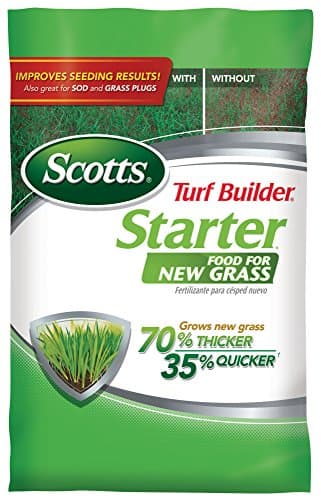
Scotts Turf Builder Starter Food for New Grass
A phosphorus rich starter fertilizer that lands close to the one pound of nitrogen target.

MySoil Soil Test Kit
A mail in soil test that tells you whether the phosphorus in a starter bag is needed.

Jonathan Green Black Beauty Ultra Grass Seed
A tall fescue, bluegrass and ryegrass blend for a full renovation seeding rate.
What Should You Skip in Fall?
The single biggest conflict is pre-emergent herbicide. Prodiamine, pendimethalin, and dithiopyr stop seeds from establishing, and they do not distinguish between a crabgrass seed and a bluegrass seed. If you put down a fall pre-emergent for annual bluegrass or winter annuals, you have chemically closed your seeding window for months.
So in a renovation year, you pick one. Renovate in fall and skip the fall pre-emergent, then resume the normal program the following season. The fall pre-emergent timing guide covers that normal program and the label wait times, so you can see what you are trading away.
Mesotrione is the exception worth knowing. It is labeled for application at seeding on most cool-season species, so it can give you some pre-emergent protection without blocking your grass seed. Two limits apply. It must go down at or before seeding, not after germination has started, and fine fescue tolerance is lower than bluegrass or tall fescue, so read the label for the species you are actually planting.
Skip these too:
- Broadleaf herbicide on the new stand. Most labels require two to three mowings before application.
- Heavy nitrogen beyond the 1 pound starter. It buys top growth at the expense of roots, which is the wrong trade in fall.
- Rolling with a heavy water-filled roller on clay. You want seed-to-soil contact, not compaction you spend next year aerating out.
- Mowing short. Let the new grass reach about 4 inches before the first cut, then take no more than a third.
The First Spring After a Fall Renovation
A fall renovation is not finished in November. What you do in the first spring decides whether it holds.
Go light on nitrogen in early spring. The stand is young, and a heavy spring feeding pushes leaf growth on a root system that is still shallow, which sets it up badly for its first summer. A modest feeding once the lawn is actively growing is enough.
Spring pre-emergent is a real decision, not an automatic one. Most labels want the new grass to have been through several mowings, and some want a full growing season. Read yours. If the renovation closed in well, you may have little crabgrass pressure to manage anyway, because dense turf is the best pre-emergent there is.
Expect to touch up. Even a good renovation leaves thin edges, spots the sprinkler missed, and areas where the dead thatch was thickest. Overseed those the following late summer at overseed rates, which is the half-rate column in the table above. Two consecutive fall seedings is a normal path to a fully closed stand, not a sign the first one failed.
Then put the rest of the fall calendar around it. Mowing height, leaf management, the last cut, and the timing of the final feeding all interact with a young stand, and the fall lawn care schedule and checklist sequences them month by month.
The short version: decide in early August, kill by late August, seed at full rates in the first half of September, and do not let a pre-emergent or a low seed rate undo six weeks of work. Cool-season grass gets one genuinely good window a year to start over, and this is it.
Top Picks
- Jonathan Green (10322) Black Beauty Ultra Grass Seed - Cool Season Lawn Seed (7 lb)Check price on Amazon
- Premium Lawn Top Dressing Coco Coir MixCheck price on Amazon
- Simple Lawn Solutions Ultimate 3-18-18 Liquid FertilizerCheck price on Amazon
As an Amazon Associate we earn from qualifying purchases.
Free Lawn Care Tools
Rutgers uses a 30 percent threshold. If less than 30 percent of the stand is desirable grass, kill and reseed. Above 30 percent, aeration plus overseeding will usually close the lawn in. Two findings override the percentage: perennial grassy weeds like quackgrass or nimblewill that cannot be removed selectively, and thatch over 1 inch.
Fall seedlings get two to three months of cool air, warm soil, and almost no weed competition before winter, so they harden off and root deeply. Spring seedlings get about six weeks before summer heat, arrive at July with shallow roots, and cannot be protected with a crabgrass pre-emergent because it would kill the seed too.
Allow 10 to 14 days. The herbicide needs that long to move into the roots, and disturbing the area early cuts the kill short. Rutgers advises retreating anything that is not fully dead at day 10. Do not mow, dethatch, or aerate during the wait, then scalp to three quarters of an inch once everything is brown.
Use new-seeding rates, not overseed rates. Penn State lists 6 to 8 pounds per 1,000 square feet for turf-type tall fescue, 2 to 3 for Kentucky bluegrass in a pure stand, 4 to 5 for perennial ryegrass, and 4 to 5 for fine fescue. Overseeding rates are roughly half those numbers.
Finish seeding at least 45 days before your first expected hard frost. In the upper Midwest and northern New England that lands around mid-August, in the lower Midwest and Mid-Atlantic around September 1 to 10, and in the transition zone around September 10 to 25. Nebraska Extension puts the general fall window at August 15 to September 15.
Not the common ones. Prodiamine, pendimethalin, and dithiopyr block grass seed just as effectively as crabgrass seed, so a fall pre-emergent closes your seeding window for months. Mesotrione is the exception, since it is labeled for application at seeding on most cool-season species. Apply it at or before seeding, never after germination starts.
Go light on nitrogen, because heavy spring feeding pushes leaf growth on roots that are still shallow. Check pre-emergent labels before applying, since most want several mowings first and some want a full growing season. Expect to overseed thin edges the following late summer at half rates. Two consecutive fall seedings is normal.

Beat weeds and brown spots from your phone
Snap a photo, get the fix, and follow a plan timed to your soil and weather. Free on iPhone.
Related Articles
 Seasonal Care
Dormant Seeding: How to Seed Your Lawn in Late Fall for Spring Germination
Jul 17, 2026•11 min read Seasonal Care
Fall Lawn Aeration: When and How to Aerate by Region
Sep 12, 2026•10 min read Seasonal Care
Fall Lawn Care Schedule and Checklist: Month-by-Month Maintenance
Jul 17, 2026•12 min read

