Scotts Turf Builder Lawn Food: When and How to Apply
 James ThorntonLawn Equipment & Maintenance Expert | 20 Years
As an Amazon Associate we earn from qualifying purchases.
You bought the green bag, you have a spreader in the garage, and now you are standing on the lawn wondering when the right time actually is and how much to throw down. That is the whole question with Scotts Turf Builder Lawn Food: the product works fine, but the timing and the technique are what separate a deep green lawn from a streaky, burned, or barely-changed one. Let me cut through the marketing and give you the straight answer on when to apply Scotts Turf Builder Lawn Food, how often to feed it, how to run your spreader, and how long it takes to see results.
Apply standard Scotts Turf Builder Lawn Food when your grass is actively growing and the soil has warmed past dormancy, then repeat roughly every 6 to 8 weeks through the growing season, which usually works out to about four feedings a year. For cool-season lawns (fescue, bluegrass, ryegrass) the two most important applications are early spring and early fall. For warm-season lawns (Bermuda, Zoysia, St. Augustine) you push the feedings into late spring and summer when that grass is at full speed.
Use a calibrated broadcast or drop spreader at the setting printed on your bag, apply to a dry lawn, then water it in with about a quarter inch of water within 24 hours. Most lawns show a visible color response within one to two weeks, and the slow-release nitrogen keeps feeding for roughly two to three months after that.
What standard Turf Builder Lawn Food actually is (and is not)
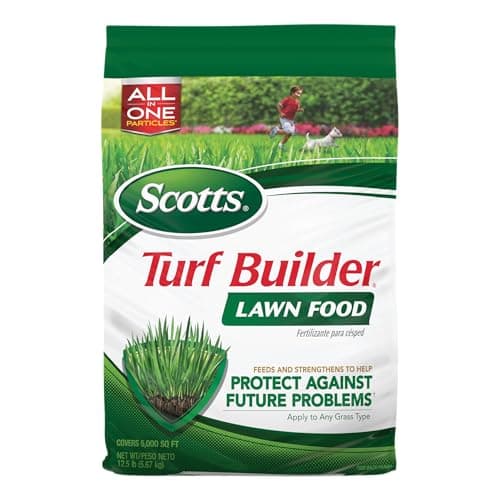
This guide is about the plain green-bag Scotts Turf Builder Lawn Food: the all-purpose, high-nitrogen feeding fertilizer with no herbicide and no insecticide in it. It is just food. That matters because Scotts sells a whole shelf of products with similar branding, and people grab the wrong one all the time.
If your bag says Triple Action, that one also prevents crabgrass and kills weeds, and it has its own timing rules. Read the dedicated Triple Action application guide instead of this one. If you are in the South and your bag says Southern Turf Builder, that formula is tuned for heat and warm-season grass, so follow the Southern Turf Builder instructions. Weed and Feed and Halts crabgrass preventer are also separate products with separate windows. This post stays in its lane: straight lawn food.
The headline on the bag is the nitrogen. Turf Builder leans heavily on nitrogen with a slow-release component, which is what gives you steady green-up over weeks instead of a quick flush and a crash. If you want to understand what the three numbers on the bag mean before you buy, the breakdown in how to read fertilizer numbers is worth five minutes. The short version: the first number (nitrogen) drives color and blade growth, and that is the one Turf Builder is built around.
When to apply Scotts Turf Builder Lawn Food: the season table
Timing is everything with a nitrogen fertilizer. Feed when the grass is growing and can use the nitrogen, and you get green. Feed when it is dormant or stressed, and you either waste the product or invite disease. Here is the schedule by grass type and season.
| Window | Cool-season lawns | Warm-season lawns | Why this timing |
|---|---|---|---|
| Early spring | First feeding once grass greens up and is actively growing | Hold off; grass is still waking up | Feeds new growth after dormancy without pushing tender warm-season grass too early |
| Late spring | Second feeding, about 6 to 8 weeks later | First feeding once soil is warm and grass is fully green | Warm-season grass hits its stride; cool-season grass needs a top-up before summer |
| Summer | Light or skip during heat and drought stress | Peak feeding window; repeat every 6 to 8 weeks | Cool-season grass is stressed by heat; warm-season grass is thriving |
| Early fall | Most important feeding of the year | Final feeding before slowdown | Cool-season roots recover and store energy; warm-season grass winds down |
| Late fall | Optional winterizer-style feeding before dormancy | Done for the season | Builds cool-season root reserves heading into winter |
The single rule that beats all the others: match the feeding to when your grass is actively growing. Cool-season grass grows hardest in spring and fall, so that is when it eats. Warm-season grass grows hardest in late spring and summer, so that is when it eats. If you do not know which type you have, that is exactly the kind of thing the free AI diagnosis sorts out from a photo, because feeding Bermuda on a fescue schedule (or vice versa) is one of the most common reasons a lawn underperforms.
How often to apply Scotts Turf Builder Lawn Food
Scotts' own feeding program is built around applications roughly every 6 to 8 weeks during the active growing season, which lands at about four feedings across the year for most lawns. That is the rhythm the slow-release nitrogen is designed for: by the time one application is tapering off, the next one picks up.
Do not try to shortcut that by doubling the rate and feeding half as often. Nitrogen does not bank that way. A double dose risks burning the lawn and surge-growing the top blades while the roots fall behind, and you will be mowing twice as much for nothing. Steady, moderate feedings on the label rate beat heavy occasional ones every time.
One more honest note: four feedings a year is the program Scotts sells, but plenty of healthy lawns do fine on two or three well-timed applications, especially if you mulch your clippings back into the turf (those clippings return a meaningful amount of nitrogen on their own). If you are unsure how much product your specific lawn actually needs per application, run your square footage through the fertilizer calculator so you are buying and spreading the right amount instead of guessing.
Scotts Fertilizer Schedule: A Simple Annual Calendar
If you just want the whole year sketched out in one place, here is the Scotts fertilizer schedule as a simple calendar, built from the same 6-to-8-week rhythm covered above. For a cool-season lawn it looks like this: feeding one in early spring once the grass greens up and is actively growing, feeding two in late spring about 6 to 8 weeks later, a light feeding or a skip through the summer heat, feeding three in early fall (the most important one of the year), and an optional winterizer-style feeding in late fall before dormancy.
For a warm-season lawn the calendar shifts later: hold off in early spring while the grass is still waking up, make your first feeding in late spring once the soil is warm and the lawn is fully green, keep feeding every 6 to 8 weeks through summer while the grass is at full speed, and put down your final feeding in early fall before growth winds down.
Either way you land at roughly four feedings across the year, spaced 6 to 8 weeks apart during your grass type's active growing season. Mark the first date, count forward in 6-to-8-week blocks, and skip any block where the lawn is dormant or heat-stressed. The dates themselves should flex with your local soil temperature and growing season, not the calendar page, and the exact rate always comes from the specific bag you bought, per the label.
Running the four-bag Scotts 4-Step Program instead of plain Turf Builder? Different bags, different windows. The step-by-step dates by region are in the Scotts 4-Step Program schedule.
How to apply it: spreader, rate, and pattern
The product only works if it lands evenly. Streaky application is the number one cause of that striped, light-and-dark lawn you see after someone fertilizes by hand or eyeballs the spreader.
Pick and set your spreader
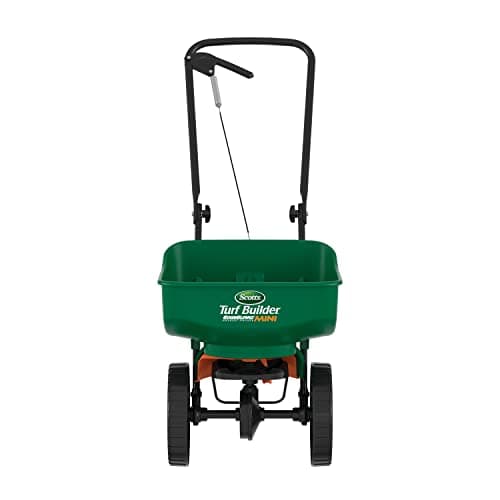
A broadcast (rotary) spreader is faster and gives a wider, more forgiving pattern for medium and large lawns. A drop spreader is more precise and better near beds, walkways, and tight edges, but it demands disciplined, slightly overlapping passes. Either works. The setting you dial in is printed right on the Turf Builder bag, listed by spreader type and often by specific Scotts model number. Use that number as your starting point.
If your spreader is old, off-brand, or you have lost faith in the dial, calibrate it rather than trusting the label blindly. The full walkthrough on dialing in a spreader and avoiding the classic mistakes is in how to apply granular fertilizer with the right spreader settings. The general principle: start a notch low, check your coverage, and bump up rather than starting high and burning a stripe.
Run the pattern
- Apply to a dry lawn so granules bounce and roll into place instead of sticking to wet blades.
- Fill the spreader on the driveway or a tarp, not over the grass, so a spill does not become a burn spot.
- Make two header passes across the ends of the lawn first, then fill the middle with back-and-forth rows.
- Slightly overlap each pass (especially with a drop spreader) and keep a steady walking pace; the rate is calibrated to your speed.
- Shut the hopper off at every turn and stop so you do not dump a pile where you pause.
Sweep any granules off hard surfaces like driveways and sidewalks back onto the lawn. Fertilizer left on concrete just washes into the storm drain, which is both a waste of your money and bad for local water.
Water it in
After spreading, water the lawn with about a quarter inch of water within 24 hours, or time the application just ahead of a predicted light rain. Watering moves the granules off the blades and down to the soil and root zone where the grass actually takes up the nitrogen. For standard Turf Builder Lawn Food (not a weed and feed), watering in promptly is what you want. Do not soak it to the point of runoff; you just need enough to dissolve and settle the granules in.
- Annual nitrogen needs are usually discussed as a range (commonly somewhere in the neighborhood of 2 to 4 pounds of nitrogen per 1,000 square feet per year for most lawns), but the right number for your grass, soil, and region is set locally. Confirm it with your county cooperative extension office rather than treating any single figure as universal.
- The best feeding dates are driven by soil temperature and your local growing season, not the calendar. Many regions key spring feeding to soil warming into roughly the mid-50s Fahrenheit and fall feeding to the weeks before dormancy. Your extension office publishes region-specific windows.
- If you have never tested your soil, do that before chasing color with more nitrogen. A simple soil test through your extension office tells you pH and whether phosphorus or potassium are the real limiting factors, which a nitrogen-heavy lawn food will not fix.
- Always defer to the exact rate and setting printed on the specific bag you bought; formulations and coverage are revised periodically.
How long until you see results
This is where people get impatient and make mistakes. With standard Turf Builder, most lawns show a visible color response within about one to two weeks, assuming the grass is growing and getting water. The slow-release nitrogen then keeps feeding for roughly two to three months, so the color holds rather than spiking and fading.
If two weeks pass with no change, resist the urge to throw down more. Slow or no green-up almost always means something else is the bottleneck: the lawn is too dry, the grass is dormant or heat-stressed, the soil pH is off, or the real problem is disease or pests rather than hunger. More nitrogen on a stressed or diseased lawn makes things worse, not better. That is the moment to stop and actually diagnose what you are looking at instead of feeding harder.
What other guides miss
Most Turf Builder articles read like a reworded version of the back of the bag: set your spreader, apply, water in, repeat four times a year. What they skip is the part that actually trips homeowners up, which is that fertilizer is a treatment, not a diagnosis. Turf Builder is a green-up tool for grass that is hungry and otherwise healthy. It is the wrong tool for a lawn that is actually fighting fungus, grubs, compaction, drought, or the wrong grass for the climate.
I see the same loop constantly: a lawn looks rough, the owner feeds it, nothing improves, so they feed it again, and now they have a thatchy, surge-grown, disease-prone lawn that is no greener than when they started. The nitrogen was never the missing piece. Brown patch disease, dollar spot, dull-mower-blade fray, and grub damage all look like a hungry lawn from the curb, and every one of them gets worse when you pour on nitrogen.
So the genuinely useful move that the bag will never tell you: before your first feeding of the season, take 30 seconds to confirm the lawn actually needs food and not a fix. A quick free AI diagnosis from a photo will flag whether you are looking at a nutrient issue or something like disease or pest pressure that fertilizer would make worse. If it is genuinely a feeding situation, Turf Builder is a fine choice and you can proceed with confidence. If it is not, you just saved yourself a bag of fertilizer and a month of frustration.
And if you want to stop guessing at timing entirely, that is exactly what the paid side of the site solves: a personalized 12-month care plan tells you the exact week to fertilize for your zip code and grass type, what product to put down each visit, and when to water it in, so you are not standing on the lawn in March wondering if it is too early. The free diagnosis is the on-ramp to that plan.
Your Turf Builder action plan
Here is the whole thing boiled down to an order of operations you can run this weekend.
- Confirm the lawn needs food, not a fix. Run a quick photo diagnosis first so you are not fertilizing a disease or pest problem.
- Know your grass type. Cool-season feeds hardest in spring and fall; warm-season feeds hardest in late spring and summer. Match the schedule to the grass.
- Buy the right bag. Standard green-bag Turf Builder Lawn Food, not Triple Action, Weed and Feed, or Halts unless you specifically want those.
- Size the job. Measure your square footage and check the rate with the fertilizer calculator so you spread the correct amount.
- Set the spreader to the bag's number and calibrate if you doubt the dial.
- Apply to a dry lawn using header passes plus overlapping rows, hopper off at every turn.
- Water in with about a quarter inch within 24 hours, or apply just before light rain.
- Wait one to two weeks for green-up. If nothing happens, diagnose before you feed again.
- Repeat every 6 to 8 weeks through your grass type's active growing season, about four feedings a year.
Do those nine things in order and Turf Builder does exactly what it is supposed to do: steady, even, lasting green without the burn stripes or the wasted bags. Get the timing and the diagnosis right first, and the product almost takes care of itself.
Top Picks
 Scotts Turf Builder Lawn FoodCheck price on Amazon
 Scotts Turf Builder EdgeGuard Mini Broadcast SpreaderCheck price on Amazon
As an Amazon Associate we earn from qualifying purchases.
Free Lawn Care Tools
Apply it when your grass is actively growing and past dormancy. For cool-season lawns like fescue and bluegrass, the key windows are early spring and early fall. For warm-season lawns like Bermuda and Zoysia, feed in late spring and through summer when that grass is growing hardest. The simplest rule is to feed only when the grass is actively growing so it can use the nitrogen.
Scotts' program is built around feeding roughly every 6 to 8 weeks during the active growing season, which works out to about four feedings a year. The exact interval varies by Turf Builder product, so check your bag's label; for standard Turf Builder Lawn Food it is typically 6 to 8 weeks, and once that window has passed and the grass is actively growing, you can feed again. Many lawns also do well on two or three well-timed applications, especially if you mulch your clippings back in. Avoid doubling the rate to feed less often, since heavy doses can burn the lawn and waste nitrogen.
For cool-season lawns: feed in early spring once the grass greens up, again in late spring about 6 to 8 weeks later, go light or skip during summer heat, make your most important feeding in early fall, and optionally add a late-fall winterizer-style feeding. For warm-season lawns: start in late spring once the soil is warm, feed every 6 to 8 weeks through summer, and finish in early fall. Either way it comes out to roughly four feedings a year, with exact rates per the label on your bag.
Most lawns show a visible color response within about one to two weeks, as long as the grass is growing and getting water. The slow-release nitrogen then continues feeding for roughly two to three months, so the color holds steady rather than spiking and fading. If you see no change after two weeks, the issue is usually drought, dormancy, soil pH, or disease rather than a need for more fertilizer.
Yes. After spreading standard Turf Builder Lawn Food, water the lawn with about a quarter inch of water within 24 hours, or apply just before a predicted light rain. Watering moves the granules off the blades and into the soil where the roots take up the nitrogen. Avoid soaking it to the point of runoff; you only need enough to settle the granules in.
It depends on your grass type. Warm-season lawns like Bermuda, Zoysia, and St. Augustine are in their peak growth in summer, so that is a prime feeding window. Cool-season lawns like fescue and bluegrass are heat-stressed in summer, so it is usually better to feed lightly or skip until early fall. Feeding stressed grass in peak heat can do more harm than good.
Use the setting printed on the bag, which is listed by spreader type and often by specific model number. If your spreader is old or off-brand, start a notch lower than the label suggests, check your coverage, and bump it up rather than starting high and risking a burn stripe. Calibrating the spreader to your walking pace gives the most even, accurate application.
Photos: Andrew Conboy / iNaturalist · CC BY 4.0

Your lawn plan, in your pocket all season
Grass ID, a season plan, soil-timed reminders, and a lawn journal that remembers what you did. Free on iPhone.
Related Articles
 Fertilizing
How to Apply Liquid Lawn Fertilizer With a Hose-End Sprayer (Rates and Timing)
Jun 27, 2026•2 min read Lawn Care Tips
Scotts DiseaseEx Instructions: Rates, Spreader Settings, and Timing
Sep 13, 2026•5 min read Fertilizing
Best Fertilizer for Bermuda Grass in Tennessee (2026)
Jul 18, 2026•8 min read