

How Much Does It Cost to Install Sod in 2026? Real Prices Per Square Foot

As an Amazon Associate we earn from qualifying purchases.
You looked at the patchy yard and thought: how bad can a pallet of grass really be? Then the first quote came back with a comma in it. That is when most people go looking for real numbers, and what they find is one national average with no explanation of why the guy down the street paid half that. Here is where the money actually goes.
Fast Answer: Installed sod runs roughly $0.85 to $1.75 per square foot according to Fixr's sod installation cost data, and our own sod calculator lands in the same place, averaging about $1.50 per square foot installed nationally and climbing past $1.75 in high cost regions. Sod alone is about $0.30 to $0.85 per square foot by species. Thumbtack reports most homeowners land between $1,051 and $3,052, averaging near $1,779, with large lawns past $6,500.
You will see higher numbers quoted elsewhere. Homewyse says its national average starts at $2.12 to $3.54 per square foot, but that is a unit-cost calculator built around a small job, roughly 534 square feet, with a two hour minimum labor charge and material waste baked in. Treat it as the ceiling on a small yard, not a rate to multiply across a half acre. Thumbtack's own per square foot figures run lower still, $0.63 to $0.96. The realistic center for a normal residential job is the $0.85 to $1.75 band, and that is what the tables below use.
Here is the other thing every cost guide skips. Sod pricing is intensely local. Freight, crew wages, which farm is within trucking distance, and whether a skid steer fits through your gate move your number more than any national average. The only real number is a written local quote. Treat the ranges below as what to expect on that quote.
Sod Cost Per Square Foot, Line By Line
The sod itself. Fixr's grade tiers run $0.20 to $0.85 per square foot: economy $0.20 to $0.40, mid-grade $0.45 to $0.60, premium $0.60 to $0.85. Fixr labels that table as installed cost, which cannot be right at the low end, so read it as material pricing. Our own calculator models sod material at $0.30 to $0.85 per square foot, which is the range to plan around. Grade is not marketing. Premium sod comes off the farm mature and dense with a thick webbed root mat, so it survives being cut and moved.
Delivery. Buy the sod yourself and freight becomes its own line. LawnStarter's 2024 Boise sod pricing guide puts delivery at $60 to $259 in that market, with some suppliers waiving it above a minimum order.
Labor. Fixr says labor starts near $0.55 per square foot, most companies around $0.95, or $40 to $80 an hour. On a 5,000 square foot lawn that alone is $2,850 to $4,650, which is Fixr's own published figure and prices labor at $0.57 to $0.93. Thumbtack's Xactware data on a 2,500 square foot job splits it roughly $1,293 material against $574 labor, so material dominates on small easy yards and labor climbs as the site gets harder.
Grading and prep. Fixr adds roughly another $1 per square foot for standard prep, and $1 to $2 per square foot if the yard needs resloping. This is where quotes diverge most.
Sod Installation Cost By Lawn Size
None of this is usable until you know your square footage. Our satellite lawn size calculator measures your actual lawn from aerial imagery in about a minute, which beats dragging a tape across a curved bed line. The table below runs the installed band across common lawn sizes. The spread inside each row is the difference between a flat, prepped, truck-accessible yard and one that needs real site work.
| Lawn size | Installed, at $0.85 to $1.75 per sq ft | Reality check |
|---|---|---|
| 500 sq ft | $425 to $875 | Expect $1,200 to $2,000. Job minimums rule at this size. |
| 1,000 sq ft | $850 to $1,750 | Contractor quotes cluster at $2,000 to $2,500. |
| 2,000 sq ft | $1,700 to $3,500 | Right in Thumbtack's $1,051 to $3,052 national range. |
| 5,000 sq ft | $4,250 to $8,750 | Labor alone is $2,850 to $4,650 here. |
| 10,000 sq ft | $8,500 to $17,500 | Volume pricing usually pulls this toward the low end. |
| Quarter acre (10,890 sq ft) | $9,040 to $19,170 | Fixr's own published acreage row. |
| Half acre (21,780 sq ft) | $18,075 to $38,335 | Fixr's own published acreage row. |
The two acreage rows are Fixr's own published figures rather than my arithmetic, which is why they do not equal the per square foot band times the area. The reality-check column comes from a contractor quoted by Thumbtack: $1,200 to $2,000 to lay 500 square feet, $2,000 to $2,500 for 1,000 square feet, and a practical job minimum near $1,200. Small lawns pay a premium per square foot and big lawns get volume pricing. Neither one matches a national average, which is the whole problem with national averages.
Sod Prices By Grass Type
Species is the second biggest lever after size. Fixr's per-pallet pricing assumes roughly 450 square feet per pallet, materials only.
| Grass type | Per pallet (about 450 sq ft) | Per sq ft |
|---|---|---|
| Kentucky Bluegrass | $130 to $260 | $0.30 to $0.60 |
| St. Augustine | $185 to $390 | $0.45 to $0.90 |
| Bermuda | $200 to $375 | $0.45 to $0.85 |
| Zoysia | $215 to $325 | $0.50 to $0.75 |
| Tall Fescue | $270 to $295 | $0.60 to $0.65 |
| Centipede | $350 to $385 | $0.80 to $0.85 |
Those are national aggregates, so read them with a grain of salt locally. Thumbtack's contributing pro notes the cheapest sod in the Southeast is Bermuda and St. Augustine while fescue and Zoysia are the expensive ones, and in northern markets it flips: fescue is cheap, Zoysia and Kentucky Bluegrass are premium. Price follows what the farms near you grow at volume. A species that is cheap in Georgia gets freight added in Ohio.
What A Pallet Of Sod Covers And What It Costs
Pallet size is not standardized, which trips up DIY math. Fixr reports pallets covering 450 to 650 square feet, with 450 most common, and Thumbtack's pro says pallets in his market run about 500 square feet at $250 to $750. Ask the farm for square feet per pallet before converting a price, because the same $300 pallet is either $0.67 or $0.46 per square foot depending which shows up.
Fixr's pallet counts: 2 to 3 pallets for 1,000 square feet, 3 to 4 for 2,000, 7 to 12 for 5,000, 16 to 23 for 10,000. Always round up. Our sod calculator handles the conversion, and Thumbtack's pro suggests adding 10 percent for cuts and waste.
The Site Prep Costs Most Quotes Bury
This is where a $2,000 job becomes a $4,000 job. Sod needs bare, graded, loosened soil, and nothing about getting there is free.
- Old lawn removal. Fixr adds about $1 per square foot including tilling and treating the soil. LawnStarter's Boise data puts a typical pro grass removal near $478.
- Tilling and soil depth. If the site lacks 3 to 4 inches of workable soil after tilling, more gets trucked in. Price it with our topsoil calculator before accepting a bid that says "add topsoil as needed."
- Soil test. A homeowner mail-in kit is a rounding error. Fixr's line is that "your contractor may need to test the soil" and prices it at $700 to $1,800, which is far too high for a test alone, so read that as a full evaluation and amendment scope and ask exactly what it covers. Run your own results through our soil test analyzer.
- Grading and resloping. Roughly $1 to $2 per square foot, and Fixr pegs a graded 1,000 square foot lawn at an extra $1,500 to $2,600 including topsoil and sod.
- Obstacles. Stump removal around $200 to $700 and tree removal around $400 to $900 per Fixr, both before sod goes down.
- Irrigation. Fixr prices sod plus a new sprinkler system together at $9,800 to $14,200. Our sprinkler system cost guide breaks that down by zone and yard size.
One more nobody puts in a brochure: a second pro quoted by Thumbtack says that if a skid steer, mini skid or tiller cannot reach the area, expect to pay three to five times the cost. Walk the gate and the side yard before you call anyone.
DIY Versus Hiring A Pro
The savings are real and they are labor. At $0.55 to $0.95 per square foot for professional labor, doing 2,000 square feet yourself keeps roughly $1,100 to $1,900. Against that you rent a rototiller and a walk-behind sod roller, plus a sod cutter if you are stripping the old lawn. Homewyse carries a daily equipment allowance for the tiller and roller inside professional bids, and prices lawn removal separately, so those are real lines either way.
The honest cost is time. Thumbtack's pro says set aside two to five days, with one to two of pure prep before a single roll goes down, and once sod is cut it has to be installed within 48 hours at the outside or you have composted a couple thousand dollars on your driveway. My rule: DIY if the yard is flat, under about 2,000 square feet and truck-accessible. Hire it out the moment grading is involved, because a bad grade is the one mistake you cannot fix after the sod knits.
Why Sod Costs Different Amounts In Different Regions
Regional gaps come down to which species the local farms grow at volume, how far the truck drives, and crew wages. In the South, warm season sod is a commodity crop, so Bermuda and St. Augustine are the value picks while cool season fescue carries a scarcity premium. In the Midwest and Northeast that reverses: fescue and bluegrass blends are affordable and Zoysia becomes a specialty order. LawnStarter's Boise numbers are a useful West snapshot, with sod alone at $0.33 to $0.83 per square foot across bluegrass and ryegrass blends, tall fescue and fine fescue.
The other regional cost is seasonal demand. Thumbtack's pro says extreme hot or cold weather adds 10 to 20 percent, because crews work slower and the risk of losing the sod rises. That premium lands in different months depending on where you live.
Sod Versus Seed: What The Premium Actually Buys
Seed is dramatically cheaper upfront. What the sod premium buys is time and certainty: a usable lawn in weeks instead of a season, erosion control on day one, and no weed-versus-seedling war. Thumbtack's pro frames the seeding side as four months of active care two to three times a week. That is the real comparison, not the receipt. Selling in six months? Sod is the cheaper decision. Have a year and a decent existing stand? Overseeding beats both. Our sod vs seed breakdown runs the full comparison, and hydroseeding sits between them on price and speed.
The Best Month To Lay Sod, And How Timing Moves The Price
Timing is a cost decision and an agronomic one. Warm season grasses like Bermuda, Zoysia, St. Augustine and Centipede go down in late spring through early summer, with a full growing season to root before winter. Cool season grasses like tall fescue and Kentucky Bluegrass do best in early fall, with late spring as backup. Thumbtack's guidance matches: early to mid fall, once the worst heat has passed.
Soil temperature is the real trigger, not the calendar, which is why our soil temperature guide is worth a read before booking a crew. The shoulder season also dodges that 10 to 20 percent weather surcharge.
- For establishment timing, soil preparation depth and the starter fertilizer program in your region, use your state turf program rather than a national average: Clemson HGIC lawn establishment, NC State Carolina Lawns, and University of Missouri Extension G6700.
- For sod-specific handling and installation practice, see Michigan State Extension on establishing a new lawn using sod and Purdue Turf on establishing a lawn from sod.
- For cool season establishment in the North and West, see Penn State Extension lawn establishment and UC IPM establishing turfgrass.
- Exact fertilizer analysis, application rates and pre-emergent timing for new sod are set locally by soil test results and state recommendations. Get the rate from your extension office or a soil test, not from a cost article.
How To Read And Compare Sod Installation Quotes
Three bids that all say "install sod, $3,400" tell you nothing. Ask every contractor to itemize these:
- Measured square footage, and how they got it. If two bids disagree on area, one is wrong.
- Species, cultivar and grade, plus the farm name. Economy versus premium is a real $0.40 per square foot swing.
- Delivery, included or billed separately.
- Old lawn removal and disposal, included or excluded. Haul-away is its own charge.
- Prep scope: tilling depth, topsoil in cubic yards, starter fertilizer, grading. "As needed" is not a scope.
- Labor as a rate or total, plus crew size and expected days.
- Warranty, and what voids it. Most sod warranties hinge on you watering correctly.
- General contractor markup. Homewyse notes that a GC supervising rather than a landscape crew working direct adds 13 to 22 percent.
What Your New Sod Costs After The Crew Leaves
The install is not the last check you write. New sod is thirsty in a way established lawn never is. Thumbtack's pro puts it bluntly: sod dies without frequent heavy watering through the first stretch, and manual watering is the cheap substitute for an irrigation system that costs thousands. Our watering schedule calculator builds the first-month schedule around your grass type and climate.
Then the first fertilizer application and the first mow. Fixr suggests waiting 14 to 21 days before mowing, once roots have gripped, and keeping traffic off at least 14 days. LawnStarter puts professional lawn fertilization at $103 to $343. Our guide to how long sod takes to root covers the establishment window, and the 2026 lawn care cost breakdown covers the annual number after that.
This is the exact point where a $3,000 lawn quietly gets starved. Month two arrives, the sod still looks fine, nobody feeds it, and the stand thins by fall. A premium personalized care plan on this site gives you the specific week to make that first fertilizer application for your zip code and the grass type you just laid, plus the follow-up schedule through the first year. It is the cheapest insurance on the most expensive thing in your yard.
What Other Guides Miss
Every sod cost guide prices the grass and stops. Here is what they leave out, and it decides whether your money gets wasted: the two inputs that determine the outcome are your measured square footage and whether the species matches your site. Get either wrong and the price per square foot stops mattering.
Take measurement. Most people pace the yard or eyeball a rectangle. Under-order by 8 percent on a 5,000 square foot job and you buy a short-order pallet at full retail plus a second delivery fee, arriving days later from a different harvest in a slightly different green you will see at every seam for two years. Over-order by two pallets and you threw away $500 in grass that is dead in 48 hours, because sod does not keep. Thumbtack's pro says add exactly 10 percent and no more, and you cannot add a precise 10 percent to a number you guessed. That is why satellite lawn size measurement is step one.
Now take matching, the expensive one. A homeowner in Atlanta wants the yard to look like the neighbor's, orders Bermuda because it is the local value pick, and lays it under mature oaks. Bermuda needs full sun. In two summers that lawn is thin, weedy and half gone, and the whole expense repeats. St. Augustine or a shade-tolerant Zoysia would have held. The cost of that mistake is not ten cents per square foot. It is the entire job, twice.
The fix costs nothing. Identify the grass already thriving in the good parts of your yard, and identify what the neighbor's lawn actually is before copying it. Both take a photo. Run a healthy patch of your lawn and the lawn you are matching through the free AI grass identification tool, then ask the sod farm whether that species fits your light conditions. Thirty seconds of identification in front of a several-thousand-dollar decision is the highest-return step here, and no cost guide mentions it.
The related trap is soil. Sod laid on compacted fill, or on the old dead lawn, does not root no matter how premium the grass was. Top dressing and soil amendment choices matter more here than the species on the invoice.
Your Sod Installation Action Plan
- Measure the actual lawn. Use the satellite lawn size calculator and write the number down. Every figure above is useless without it.
- Identify what is already growing. Photograph a healthy patch of your lawn, and the lawn you want to match, at the free grass ID tool. Confirm the species fits your sun and shade before you shop.
- Convert to pallets. Run the square footage through the sod calculator, add 10 percent, round up, and ask each farm how many square feet their pallet covers.
- Budget prep separately. Add roughly $1 per square foot for removal and prep, $1 to $2 if the yard needs grading, and get a soil test before anyone quotes amendments.
- Get three itemized quotes. Reject any bid that omits measured area, species and grade, prep scope, or disposal.
- Book the right season. Late spring to early summer for warm season grasses, early fall for cool season, and dodge the extreme weather surcharge.
- Price the year, not the day. Sanity check the total with the lawn cost estimator, and set the watering and fertilizer schedule before the truck arrives.
Sod is one of the few lawn projects where spending more upfront reliably saves money later, but only if the two free steps come first. Measure it, match it, then write the check.
Free Lawn Care Tools
Installed, 1,000 square feet of sod typically runs about $850 to $1,750 using the $0.85 to $1.75 per square foot installed band, which is also where our own sod calculator lands. In practice contractors quote higher at that size: a pro interviewed by Thumbtack puts real jobs around $2,000 to $2,500, because small lawns carry job minimums. Sod alone, without labor, is closer to $300 to $850 for that area depending on species. Your local quote is the only number that matters, because freight and crew wages swing it hard.
Bare soil is exactly what sod wants, but it has to be prepared dirt, not whatever is sitting there. That means the old lawn removed, the top few inches tilled and loosened, debris and stones out, at least three to four inches of workable soil, a starter fertilizer worked in, and the surface graded and lightly packed. What you cannot do is lay sod over existing grass. The contractor Thumbtack interviewed is blunt that it kills both the sod and the grass underneath.
At an installed rate of $0.85 to $1.75 per square foot, 400 square feet is only about $340 to $700 in materials and labor. In practice you will pay more, because most crews have a job minimum. One contractor quoted by Thumbtack charges a minimum near $1,200, since the margin on a few hundred square feet does not cover the day. Small areas are the strongest case for doing it yourself.
It depends on your grass type. Warm season sod such as Bermuda, Zoysia, St. Augustine and Centipede goes down best in late spring through early summer, when the soil is warm and the grass gets a full season to root before winter. Cool season sod such as tall fescue and Kentucky Bluegrass does best in early fall, with late spring as a backup. Avoid extreme heat and cold, which one contractor says adds 10 to 20 percent to the job. Check your state extension service for local dates.
Remove the old lawn, till the top few inches, and make sure there is at least three to four inches of loose workable soil. Add topsoil if there is not. A soil test tells you whether pH or nutrients need correcting first, and a starter fertilizer worked into the prepared soil before the sod arrives gives the new roots something to grow into. Get the specific product analysis and application rate from your local extension office or your soil test results.
Seed is far cheaper upfront. Sod buys you time and certainty: a usable lawn in weeks rather than a season, erosion control immediately, and no long fight between weeds and seedlings. One contractor quoted by Thumbtack frames seeding as four months of active care two to three times a week. If you are selling soon or the yard is bare and eroding, sod is usually the better value despite the higher invoice.

Your lawn plan, in your pocket all season
Grass ID, a season plan, soil-timed reminders, and a lawn journal that remembers what you did. Free on iPhone.
Related Articles
 Lawn Care Tips
Lawn Care Cost Estimates 2026: Average Prices by Region
Aug 1, 2026•7 min read Lawn Care Tips
How Much Does Lawn Care Actually Cost? A Realistic 2026 Breakdown
Mar 27, 2026•7 min read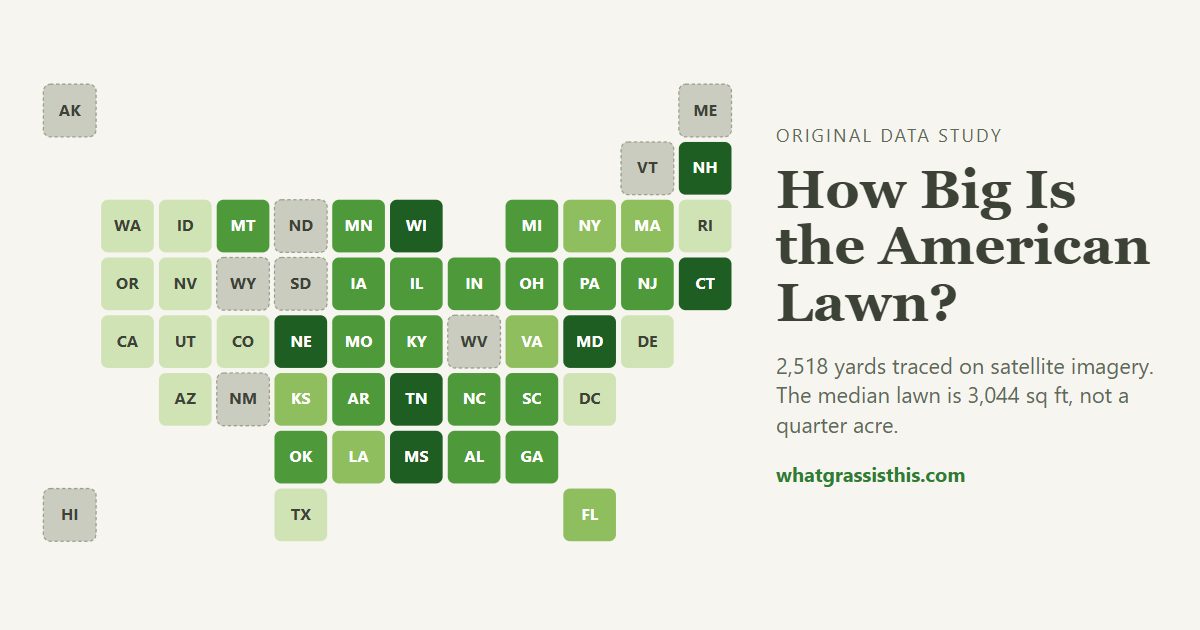 Lawn Care Tips
How Big Is the American Lawn? 2,518 Measured Yards Say 3,000 Square Feet, Not a Quarter Acre
Sep 15, 2026•6 min read

