

The State of the American Lawn 2026: What 7,618 Real Lawn Photos Reveal About America's Grass
 Anthony TrevisoFounder | What Grass Is This?
As an Amazon Associate we earn from qualifying purchases.
Ask ten neighbors what kind of grass they have and most will shrug. So we stopped asking and started counting. Between August 2025 and September 2026, homeowners uploaded thousands of lawn photos to our free grass identifier, and every confident identification became a data point. The result is something we have not seen published anywhere else: a state-by-state picture of what is actually growing in American lawns, built from real photos of real yards.
Updated September 14, 2026. The July 2026 edition of this study covered 3,566 identification attempts through July 18. This refresh runs through September 13, 2026 and more than doubles the sample to 7,618 attempts, with a full summer of peak-season lawns in it. Every chart, table and download on this page reflects the new window.
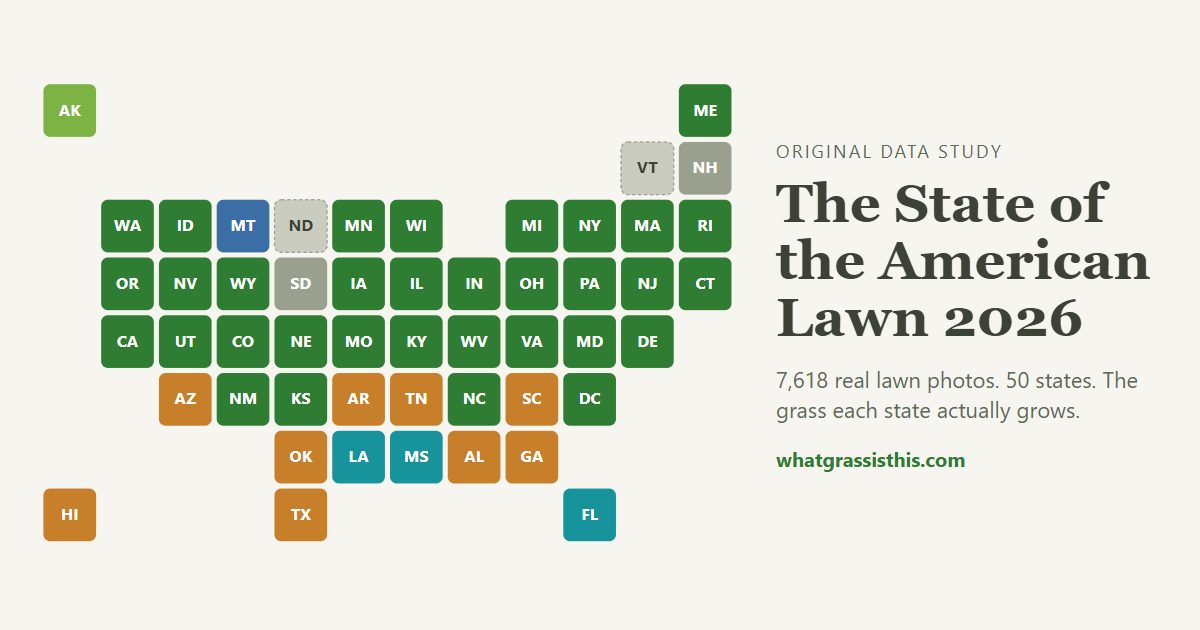
Tall fescue is America's most-identified lawn grass. Across 7,618 photos submitted to our free grass identifier between August 2025 and September 2026, it took 42.0% of the 5,859 confident identifications and led 34 of 50 states outright, plus Washington, DC.
Bermudagrass owns the South at 17.4% nationally, winning nine states including Texas at 48% and Oklahoma at 56%. St. Augustine takes 11.4% and the Gulf Coast, and Kentucky bluegrass 6.0%. Nearly 1 in 4 attempts, 23.1%, came back too mixed or patchy for a confident call.
Key findings
- Tall fescue is America's default lawn, at least in the yards people ask us about. It was the outright top identification in 34 of 50 states (32 of them with at least 8 identifications) plus Washington, DC, and accounts for 42.0% of all confident IDs.
- The South belongs to bermudagrass. It wins nine states from Arizona to South Carolina, including Oklahoma at 56% of IDs and Texas at 48%, and takes 17.4% nationally.
- South Carolina is the closest grass race among the big-sample states. Bermudagrass edges tall fescue 31% to 29%, a genuine transition-zone battleground. Wisconsin is the cool-season version: tall fescue 37%, Kentucky bluegrass 34%.
- Florida is closer than the conventional wisdom says. St. Augustine wins the state, but bahiagrass is right behind it, 43% to 34%. The conventional wisdom says Florida is St. Augustine country. Real lawns say it is a two-grass state.
- Nearly 1 in 4 identification attempts stumped the identifier. 23.1% came back too mixed, patchy, or ambiguous for a confident call, a reminder that many American lawns are blends and weeds doing their best impression of turf.
- Massachusetts sends us the most confusing lawn photos in America. 38.8% of Bay State attempts ended without a confident call, the highest rate of any state with 100 or more attempts.
- Kikuyugrass is a California story. It barely registers nationally at 0.7%, but 40 of its 43 identifications came from California, where it is 1 in 10 of everything we identified.
- St. Augustine is the grass our model is most sure about. Where we log confidence, it averages 81.0%, while Kentucky bluegrass is the toughest call at 74.3%.
The national ranking
Across 5,859 confident identifications in the study window, here is what the lawns people asked about actually are:
Tall fescue's lead is not close, and it makes sense. It is the most forgiving cool-season grass, it tolerates the transition zone's identity crisis, and decades of contractor seed mixes have spread it everywhere. If you are not sure what you have and you live anywhere between the Carolinas and California, the smart money says tall fescue.
One shift from the July edition is worth noting. Bermudagrass fell from 22.8% to 17.4% of confident identifications as the sample doubled, not because the South got less bermuda but because a full summer of northern and transition-zone lawns joined the data. The share of tall fescue, fine fescue and mixed cool-season lawns all rose for the same reason.
The map: every state's most-identified grass
Tall FescueBermudagrassSt. AugustinegrassKentucky BluegrassPerennial RyegrassTieLimited data (fewer than 8 IDs)
The pattern reads like a climate map, because it is one. Cool-season grasses hold the North and the mountain West, warm-season grasses own the Gulf, and the transition zone is where the two fight it out lawn by lawn.
Three grass nations
The fescue belt (most of the country)
From Maine to California, tall fescue is the plurality answer almost everywhere. California surprised us most: 57% of Golden State identifications came back tall fescue, more than triple bermudagrass at 16%. The other California surprise is kikuyugrass, a coastal warm-season grass that most of the country has never heard of. It took 10% of California's identifications and 40 of the 43 kikuyu calls nationwide.
The bermuda South
Bermudagrass wins Texas, Oklahoma, Arkansas, Tennessee, Alabama, Georgia, South Carolina, Arizona, and Hawaii. Oklahoma is the most bermuda-heavy state at 56% of IDs, with Texas and Arkansas at 48%. Georgia sits at 37%, where tall fescue, St. Augustine and centipede split most of the rest.
The Gulf Coast St. Augustine strip
Florida, Louisiana, and Mississippi go to St. Augustine, the shade-tolerant workhorse of humid coastal lawns. But note Florida's numbers: bahiagrass, the low-input pasture grass that homeowners either love or tolerate, is nine points behind it. No other state shows bahia pressure like that.
The bluegrass north
Kentucky bluegrass wins Montana outright and ties tall fescue in South Dakota, and that is the whole list. In July it also led Wisconsin, Idaho and South Dakota; a summer of new photos flipped Wisconsin to tall fescue by three points (37% to 34%) and Idaho by a wide margin (52% to 27%). Bluegrass is still the strongest second-place grass across the northern tier, but in the yards people photograph, tall fescue has crowded it out of first.
The transition-zone battlegrounds
The transition zone is the band where summers are too hot for cool-season grass and winters too cold for warm-season grass, so neither wins cleanly. Here is the tall fescue vs bermudagrass split in eight states in and around that band. South Carolina is a coin flip, Tennessee and Arizona show bermuda pulling away, North Carolina has opened up for tall fescue since July, and Virginia and California show how fast the race opens up once you leave the zone:
| State | Tall fescue | Bermudagrass | Winner | Lawns identified |
|---|---|---|---|---|
| North Carolina | 39% | 25% | Tall Fescue | 327 |
| Tennessee | 28% | 41% | Bermudagrass | 177 |
| South Carolina | 29% | 31% | Bermudagrass | 191 |
| Virginia | 65% | 16% | Tall Fescue | 192 |
| California | 57% | 16% | Tall Fescue | 390 |
| Arizona | 26% | 41% | Bermudagrass | 46 |
| Georgia | 19% | 37% | Bermudagrass | 400 |
| Oklahoma | 17% | 56% | Bermudagrass | 64 |
If you live in one of these states, your neighbor's lawn genuinely might be a different species than yours, which is why "just do what the neighbor does" fails here more than anywhere else. It is also why we built the identification guide in the first place.
City check: where the biggest cities land
State lines hide a lot. Here is how the highest-volume cities in our data break down:
| Metro | Most-identified grass | What the numbers show |
|---|---|---|
| Chicago, IL | Tall Fescue | Clear winner (68 of the city's 101 IDs) |
| Atlanta, GA | Bermudagrass | Bermuda 38, but tall fescue 25, centipede 14 and St. Augustine 14 all show up |
| Denver, CO | Tall Fescue | Clear winner at altitude (51 of 78) |
| Charlotte, NC | Tall Fescue | Street-level battleground: tall fescue 23, bermuda 20 |
| Houston, TX | St. Augustinegrass | Contested: St. Augustine 29, bermuda 23 |
| New York, NY | Tall Fescue | Clear winner (44 of 65) |
| Dallas, TX | Bermudagrass | Clear winner (32 of 64), St. Augustine second |
| Birmingham, AL | Bermudagrass | Bermuda 13, centipede 10, a genuine three-grass town |
| Jersey City, NJ | Kentucky Bluegrass | The strongest bluegrass city in our data: bluegrass 19, tall fescue 16 |
| Seattle, WA | Tall Fescue | Winner, with fine fescue and blends behind it |
| Portland, OR | Tall Fescue | Winner, with fine fescue and ryegrass country all around it |
Two details worth pulling out. Houston has flipped since July: bermuda led in the spring data, and a summer of photos put St. Augustine in front, which matches what Gulf Coast lawn pros will tell you about how contested that city is. And Jersey City is still the strongest Kentucky bluegrass pocket in our entire dataset, in a state that tall fescue wins overall.
The grasses our model is most sure about
Not all grasses are equally easy to call from a photo. Since July 2026 we have logged the model's confidence score on every identification, and a ranking emerges. One important framing note: this measures how confident the model is, not how accurate it is, so read it as directional:
St. Augustine tops the list, and anyone who has seen its thick, flat blades knows why: it looks like nothing else. At the bottom sit Kentucky bluegrass and perennial ryegrass, which at lawn height look a lot like each other and like the fescues around them. The spread is narrower than in the July edition, and one grass moved a long way: fine fescue was the toughest call on the old model and is now near the top of the list, which says as much about the model change in July (see the methodology) as it does about the grass.
Monocultures and melting pots
Some states barely need an identifier. Maryland went 77% tall fescue, Washington, DC 80%, and Kentucky, Kansas, Nebraska and Pennsylvania all came back tall fescue at least 73% of the time. Then there are the melting pots. Counting grasses with at least 3 identifications, among states with 50 or more total, the widest mix is Texas, with nine different grasses showing real presence, followed by North Carolina with eight. Texas is what happens when a state runs from the Gulf humidity of Houston to the high plains of Amarillo: bermuda, St. Augustine, zoysia, bahia, tall fescue and even a little bluegrass all turn up in the photos.
What lawn owners actually buy
Identification is step one; the follow-through shows up in what people order after reading. Here are the lawn products most often purchased through our links between April 20 and July 18, 2026, shown as a popularity index rather than raw counts. This section keeps the window from the July edition; the identification data above runs through September 13, 2026:
Two things stand out. The enthusiast favorite crushes the big-box names: The Andersons PGF Complete, a fertilizer you will rarely see on an end-cap, is ordered more than twice as often as the best-known national brand product on the list. And while fertilizer dominates the volume, weed-control products punch above their click counts: people browse fertilizer options for days, but when someone clicks a weed killer, they have usually already made the decision.
The 1 in 4 nobody talks about
Of 7,618 grass identification attempts, 1,759 (23.1%) came back without a confident call. Some were photo-quality issues, but many were likely lawns that are genuinely mixed: contractor blends gone feral, cool-season lawns being invaded by bermuda, or turf so weed-dominated that the "grass" was mostly crabgrass. And the no-call rate is not spread evenly:
Wyoming tops the chart, but on 43 attempts, so treat it as a small-sample warning rather than a verdict. Massachusetts is the real headline: 38.8% of its 116 identification attempts ended without a confident call, the highest rate of any state with 100 or more attempts, and it held that title in the July edition too. One plausible reading is a region of old, repeatedly overseeded yards where three or four cool-season grasses share every square foot, though our data cannot prove the cause. Much of the next tier (Iowa, Kentucky, Maryland, Missouri, Kansas) sits in or near the transition zone, exactly where you would expect lawns to be caught between grass identities. At the other end, Nevada, Oregon, Washington and California all came in at 17% or below. If your lawn has stumped you, it may have stumped the model too. You are in good company, nearly one attempt in four.
Methodology
Data comes from 7,618 lawn photo grass identification attempts submitted to whatgrassisthis.com's free AI grass identifier between August 1, 2025 and September 13, 2026 (end of day), by users in all 50 states plus Washington, DC; figures were extracted on September 14, 2026. (The tool also handles lawn problem diagnosis and weed identification; those submissions are separate flows and are excluded here.) Headline figures use the 5,859 attempts that produced a confident identification, which includes twelve named grasses plus a mixed cool-season blend category; the 23.1% no-confident-call rate is calculated against all 7,618 grass identification attempts. Location is derived from IP geolocation at the state level. Percentages are rounded to the nearest whole number at the state level, which is why some state splits do not sum to 100. Five honest limitations: (1) location reflects where the user was, which is nearly always but not guaranteed to be where the lawn is; (2) our users skew toward people unsure of their grass, which likely over-represents mixed and transition-zone lawns relative to a true census, so treat this as a study of identification demand, not a lawn census; (3) identifications are model-generated from photos, not lab-verified; (4) attempts are counted per submission, so a homeowner who scanned twice can appear twice; (5) the identification model was upgraded on July 10, 2026, and the no-confident-call rate ran about 16% in June and about 26% from July onward, so the national 23.1% blends two model generations and the July edition's 17.8% is not directly comparable. States with fewer than 8 identifications are marked as limited data on the map, and we flag every mention of them in the text as small-sample. The confidence ranking uses the 2,980 identifications from July 2026 onward that log a confidence score (logging started that month), charts the 2,972 from grasses with at least 10 logged, and measures the model's confidence, not its verified accuracy. State no-call rates include only the 38 states with at least 40 attempts. Metro figures rely on city-level IP geolocation, which is less accurate than state-level, and are labeled directional for that reason. The product popularity chart is based on items ordered through this site's Amazon affiliate links between April 20 and July 18, 2026, unchanged from the July edition; it is published as an index (most-ordered product = 100) because absolute order counts and program financials are not disclosed, orders attribute through Amazon's 24-hour referral window, occasional non-lawn items that window produces are excluded, and duplicate listings of the same product are combined. Product popularity reflects what our readers buy, not national sales.
One comparison is worth flagging here, because it reaches a different answer. Our state-by-state grass synthesis aggregates the grass lists from 40 university-extension-backed state guides instead of counting photos, and on that basis Kentucky bluegrass leads in 17 states, with tall fescue and bermudagrass at nine each. That page reports what extension programs recommend for a state. This one reports what people photographed in their own yards, which is why tall fescue looks far more dominant in this dataset.
Quick stats, free to quote
Writers and researchers: every line below is free to quote with a link to this page.
- Tall fescue is the most commonly identified lawn grass in America, leading 34 of 50 states outright and taking 42.0% of all confident identifications.
- Bermudagrass is the grass of the American South, winning nine states and 17.4% of identifications nationally.
- South Carolina has the closest big-state grass race in the country: bermudagrass 31%, tall fescue 29%.
- Wisconsin is the closest cool-season race: tall fescue 37%, Kentucky bluegrass 34%.
- Florida is a two-grass state: St. Augustine 43%, bahiagrass 34%.
- Kikuyugrass is 1 in 10 of California's identified lawns and almost nonexistent everywhere else (40 of 43 national IDs).
- Massachusetts sends in the most confusing lawn photos in America: 38.8% of identification attempts there ended without a confident call, versus 23.1% nationally.
- Nearly 1 in 4 lawn photo identification attempts cannot be confidently called as a single grass, consistent with how many American lawns are mixes.
- St. Augustine is the grass the identification model is most confident about (81.0% average). Kentucky bluegrass is the toughest call (74.3%).
- Texas is the most diverse lawn state, with nine different grasses showing real presence in its photos.
"The most surprising thing in the data is how contested the middle of the country is. In a state like South Carolina, the lawn next door genuinely might be a different grass than yours. And nearly one in four identification attempts nationwide came back too mixed for a single confident call, which tells you how many American lawns are really blends rather than one grass."
Anthony Treviso, founder, whatgrassisthis.com
Appendix: all 50 states + DC
| State | Most-identified grass | Runner-up | IDs |
|---|---|---|---|
| Alaska | Perennial Ryegrass (63%) | Fine Fescue (13%) | 8 |
| Maine | Tall Fescue (56%) | Fine Fescue (22%) | 18 |
| Vermont * | Tall Fescue (100%) | 2 | |
| New Hampshire | Tie: Fine Fescue and Tall Fescue | 10 | |
| Washington | Tall Fescue (49%) | Fine Fescue (17%) | 148 |
| Idaho | Tall Fescue (52%) | Kentucky Bluegrass (27%) | 52 |
| Montana | Kentucky Bluegrass (53%) | Fine Fescue (29%) | 17 |
| North Dakota * | Tall Fescue (50%) | Kentucky Bluegrass (33%) | 6 |
| Minnesota | Tall Fescue (44%) | Fine Fescue (24%) | 119 |
| Wisconsin | Tall Fescue (37%) | Kentucky Bluegrass (34%) | 123 |
| Michigan | Tall Fescue (51%) | Fine Fescue (17%) | 168 |
| New York | Tall Fescue (64%) | Mixed Cool-Season Blend (10%) | 205 |
| Massachusetts | Tall Fescue (58%) | Fine Fescue (15%) | 71 |
| Rhode Island | Tall Fescue (52%) | Fine Fescue (28%) | 25 |
| Oregon | Tall Fescue (57%) | Perennial Ryegrass (17%) | 81 |
| Nevada | Tall Fescue (57%) | Bermudagrass (13%) | 40 |
| Wyoming | Tall Fescue (57%) | Fine Fescue (24%) | 21 |
| South Dakota | Tie: Kentucky Bluegrass and Tall Fescue | 14 | |
| Iowa | Tall Fescue (70%) | Mixed Cool-Season Blend (11%) | 47 |
| Illinois | Tall Fescue (68%) | Kentucky Bluegrass (9%) | 215 |
| Indiana | Tall Fescue (67%) | Fine Fescue (10%) | 129 |
| Ohio | Tall Fescue (58%) | Kentucky Bluegrass (10%) | 157 |
| Pennsylvania | Tall Fescue (73%) | Perennial Ryegrass (7%) | 131 |
| New Jersey | Tall Fescue (62%) | Kentucky Bluegrass (15%) | 186 |
| Connecticut | Tall Fescue (48%) | Fine Fescue (14%) | 44 |
| California | Tall Fescue (57%) | Bermudagrass (16%) | 390 |
| Utah | Tall Fescue (64%) | Kentucky Bluegrass (22%) | 92 |
| Colorado | Tall Fescue (60%) | Kentucky Bluegrass (19%) | 182 |
| Nebraska | Tall Fescue (74%) | Fine Fescue (8%) | 76 |
| Missouri | Tall Fescue (68%) | Bermudagrass (10%) | 132 |
| Kentucky | Tall Fescue (76%) | Bermudagrass (8%) | 66 |
| West Virginia | Tall Fescue (56%) | Fine Fescue (22%) | 9 |
| Virginia | Tall Fescue (65%) | Bermudagrass (16%) | 192 |
| Maryland | Tall Fescue (77%) | Mixed Cool-Season Blend (7%) | 56 |
| Delaware | Tall Fescue (54%) | Kentucky Bluegrass (19%) | 26 |
| Arizona | Bermudagrass (41%) | Tall Fescue (26%) | 46 |
| New Mexico | Tall Fescue (45%) | Bermudagrass (18%) | 22 |
| Kansas | Tall Fescue (75%) | Bermudagrass (20%) | 55 |
| Arkansas | Bermudagrass (48%) | St. Augustinegrass (27%) | 66 |
| Tennessee | Bermudagrass (41%) | Tall Fescue (28%) | 177 |
| North Carolina | Tall Fescue (39%) | Bermudagrass (25%) | 327 |
| South Carolina | Bermudagrass (31%) | Tall Fescue (29%) | 191 |
| Washington, DC | Tall Fescue (80%) | Kentucky Bluegrass (8%) | 25 |
| Oklahoma | Bermudagrass (56%) | Tall Fescue (17%) | 64 |
| Louisiana | St. Augustinegrass (47%) | Bermudagrass (23%) | 73 |
| Mississippi | St. Augustinegrass (40%) | Centipede (21%) | 57 |
| Alabama | Bermudagrass (35%) | Centipede (19%) | 197 |
| Georgia | Bermudagrass (37%) | Tall Fescue (19%) | 400 |
| Hawaii | Bermudagrass (60%) | St. Augustinegrass (13%) | 15 |
| Texas | Bermudagrass (48%) | St. Augustinegrass (31%) | 455 |
| Florida | St. Augustinegrass (43%) | Bahiagrass (34%) | 331 |
Frequently asked questions
What is the most common lawn grass in America?
In our 2026 identification data, tall fescue, at 42.0% of confident identifications and the outright top spot in 34 of 50 states. Bermudagrass is second nationally at 17.4%.
What is the most common grass in the South?
Bermudagrass, which wins Texas, Oklahoma, Arkansas, Tennessee, Alabama, Georgia, South Carolina, Arizona, and Hawaii in our data. Along the Gulf Coast, St. Augustine takes over, winning Florida, Louisiana, and Mississippi.
How do I find out what grass I have?
Upload a photo to our free grass identifier and you will get an answer in about ten seconds, or work through the visual identification guide if you prefer to check by eye.
Where does this data come from?
From 7,618 real lawn photo identification attempts submitted to our free AI grass identifier between August 2025 and September 13, 2026, across all 50 states. Full details are in the methodology section above.
For media and bloggers
You are welcome to republish the state map, the charts, the appendix table, and the founder quote in your coverage, with attribution and a link to this page as the source (CC BY 4.0). Writing about one state? Every appendix row has a direct anchor, so you can link straight to it: this page's address plus #texas, #south-carolina, #massachusetts, and so on.
The raw data behind the study is downloadable: per-state grass counts, the national totals, and no-confident-call rates for the 38 states with at least 40 attempts. Columns are named plainly; counts are per identification attempt as described in the methodology. One reconciliation note so the files tie out: the per-state file sums to 5,759, because 100 of the 5,859 confident identifications lacked a US state-level location and appear only in the national file. Need a cut we did not publish, or a comment for a story? Contact us through the site and we will turn it around quickly. We publish this study annually and refresh it in season, so this page is the permanent home of the series.
Cite this data
This study is free to reference. Cite it as: "The State of the American Lawn 2026," whatgrassisthis.com, based on 7,618 AI lawn identification attempts, August 2025 to September 2026, with a link to this page. We plan to publish this annually, so bookmark this page for the 2027 edition.
Not sure which side of the map your own lawn falls on? Upload a photo and find out in about ten seconds. Next year, your lawn will be a data point too.
Top Picks
- American Lawn Mower Company 1204-14 14-Inch 4-Blade Push Reel Lawn MowerCheck price on Amazon
- Scotts Turf Builder Thick R Lawn Sun and ShadeCheck price on Amazon
- Jonathan Green (10322) Black Beauty Ultra Grass Seed - Cool Season Lawn Seed (7 lb)Check price on Amazon
As an Amazon Associate we earn from qualifying purchases.
Free Lawn Care Tools

Beat weeds and brown spots from your phone
Snap a photo, get the fix, and follow a plan timed to your soil and weather. Free on iPhone.
Related Articles
 Grass Types
Carpetgrass: How to Identify It and Decide What Your Lawn Needs
Sep 21, 2026•6 min read Grass Types
Perennial Ryegrass vs Tall Fescue: Which Cool-Season Grass Wins for Your Lawn?
Jun 21, 2026•6 min read Grass Types
Sod vs Seed: Cost, Timing, and Which Is Right for Your Lawn
Jun 19, 2026•11 min read

