Johnson Grass in Your Lawn: How to Identify It and Kill It for Good

As an Amazon Associate we earn from qualifying purchases.
Every course I worked had a fence line or a ditch bank where the mowers didn't reach, and every August something tall and coarse would stand up out of it, taller than the crew. The stalks carried loose purple seed heads, and the leaves had a white stripe down the middle you could see from the cart path. That was Johnson grass, and on every course it came in from the edges.
Fast Answer: Johnson grass (Sorghum halepense) is a perennial warm-season grass, per Mississippi State Extension, that spreads by underground stems called rhizomes and by seed. Its tell is a broad leaf with a white midrib. In bermuda, zoysia, St. Augustine, or centipede, spray it with sulfosulfuron (Certainty). In tall fescue or bluegrass, spot-spray glyphosate and patch the hole.
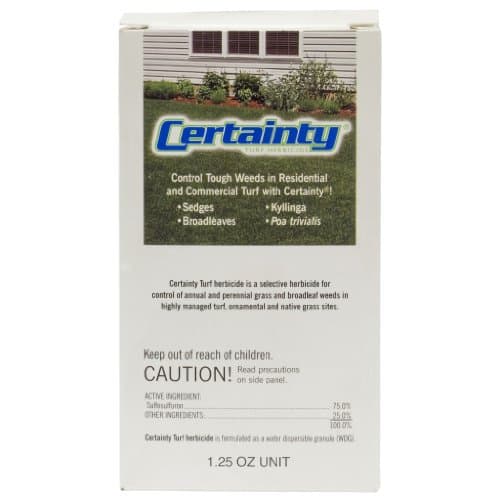
The Certainty label lists Johnsongrass on those warm-season grasses at 1.25 to 2.0 ounces of product per acre and says to test St. Augustine on a small area first. Glyphosate kills any grass it touches, so it stays on the clump, and Illinois Extension times it for plants at least 18 inches tall, before they flower.
What Does Johnson Grass Look Like?
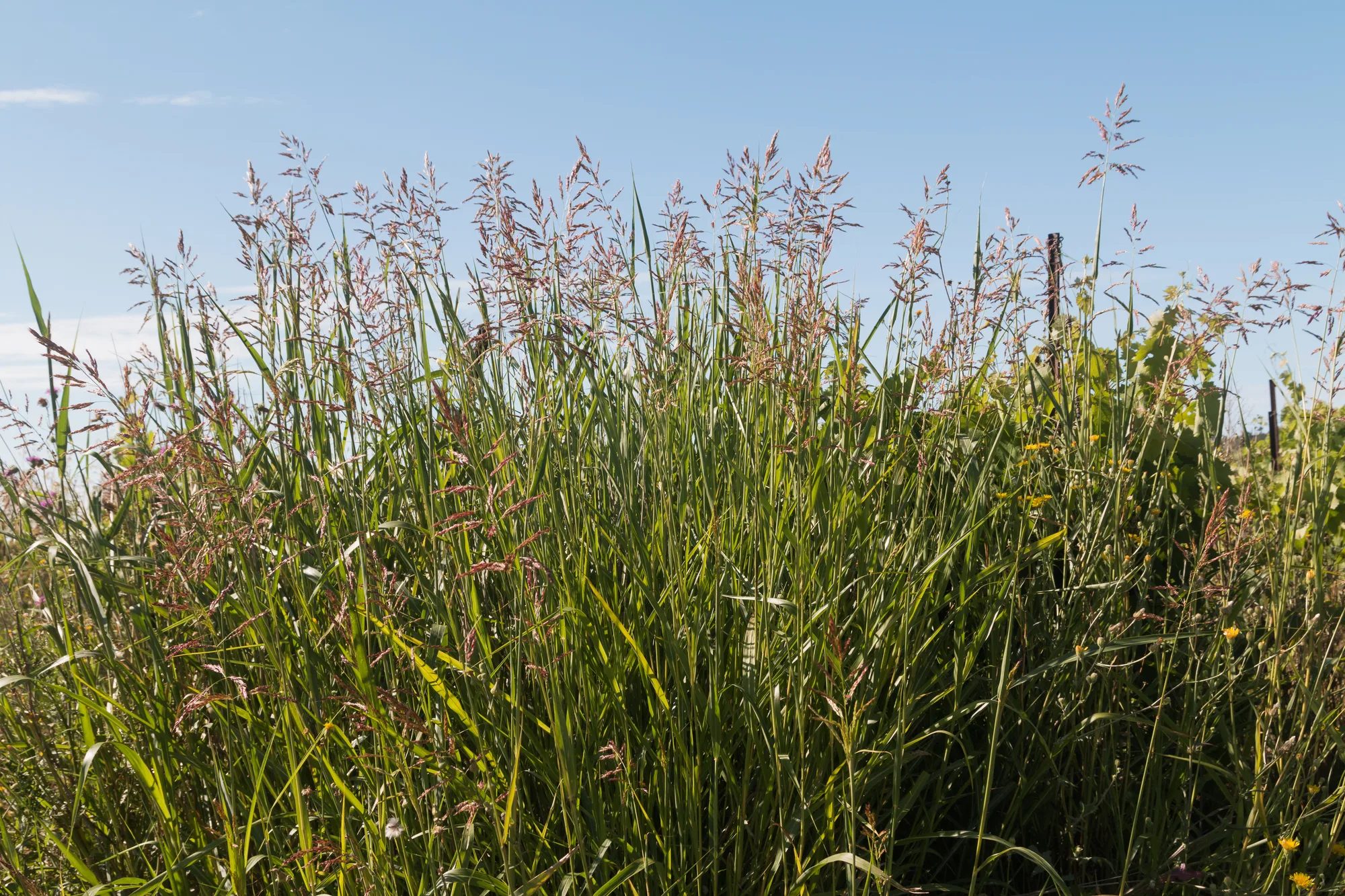
Johnson grass starts out looking like a corn seedling and grows into a tall, coarse clump. NC State describes rough leaf blades 0.4 to 1.2 inches wide with a prominent white, raised midvein running the full length, stems that can reach 6 feet, and a purple seed head. Dig one up and you'll find thick, fleshy rhizomes.
Young Johnson Grass
Seedlings are the hard part. UC IPM says a Johnson grass seedling resembles a young corn seedling, and the giveaway is the seed itself: football- to egg-shaped, dark reddish-brown to black, and still attached when you carefully lift the seedling out of the soil. The first leaf lies parallel to the ground, and the midvein is whitish at the base. Pull one gently and look for that seed.
The Mature Plant, the Rhizomes, and the Seed Head
A mature plant grows in spreading, leafy tufts, and UC IPM puts the upright stems at 6 to 7 feet. The Washington State Noxious Weed Control Board gives leaves 12 to 30 inches long. UC IPM adds that the whitish midvein snaps readily when you fold the leaf over, and that the ligule, the small collar of tissue where blade meets stem, is membranous with a fringe of hairs and no auricles. Illinois Extension notes the leaves are sharp enough to give you paper cuts, so wear gloves.
Below ground, UC IPM describes the rhizomes as thick, fleshy, and segmented, and roots and shoots can sprout from those segments. Above ground, the flower head is large, open, and pyramid-shaped, green or greenish violet at first and dark reddish or purplish brown at maturity. It blooms from May through October, per UC IPM and Mississippi State.
Johnson Grass vs Crabgrass, Dallisgrass, and Quackgrass
These four get mixed up in lawns all the time, and each one needs its own fix. Johnson grass and quackgrass run on rhizomes, dallisgrass is a clumping perennial, and crabgrass is a summer annual.
| Trait | Johnson grass | Large crabgrass | Dallisgrass | Quackgrass |
|---|---|---|---|---|
| Leaf blade | 0.4 to 1.2 inches wide, prominent white raised midvein (NC State) | 0.2 to 0.6 inches wide, short hairs on both surfaces (NC State) | 0.28 to 0.6 inches wide, flat and sharply creased (NC State) | About 0.08 to 0.55 inches wide, often narrowed at the tip (UC IPM) |
| Ligule | Membranous with a fringe of hairs (UC IPM) | Membranous, 1 to 2 mm, toothed, often reddish (NC State) | Membranous, up to 0.2 inches, pointed to blunt (NC State) | Membranous with a fine fringe (UC IPM) |
| Auricles | None (UC IPM) | None (NC State) | None (NC State) | Narrow and clasping the stem (UC IPM) |
| Spreads by | Rhizomes and seed (UC IPM) | Seed; stems root at the lower nodes, no rhizomes (NC State) | Seed; rhizomes occasional and very short (NC State) | Rhizomes and seed; rhizomes mostly in the top 6 inches of soil (UC IPM) |
| Habit | Upright, stems up to 6 feet (NC State) | Low and spreading (NC State) | Loose bunches, 1 to 5 feet (UC IPM) | Erect, can form clumps, almost 4 feet (UC IPM) |
| Seed head | Large, open, purplish panicle (UC IPM) | 2 to 9 finger-like spikes near the top of the stem (NC State) | 3 to 8 branches with hairy spikelets in 4 rows (NC State) | A single spike 2 to 8 inches long (UC IPM) |
| Life cycle | Perennial (NC State) | Summer annual (NC State) | Perennial (NC State) | Perennial (UC IPM) |
A broad leaf with a white stripe down the middle, on a plant that comes back from thick, fleshy rhizomes, is Johnson grass. Narrow auricles clasping the stem mean quackgrass. A low, sprawling plant that sprouted this spring is crabgrass, and a tough clump with a few seed-head branches lined with hairy spikelets is dallisgrass.
If it turns out to be dallisgrass, the dallisgrass removal guide covers it, and the dallisgrass vs crabgrass comparison splits those two side by side. For crabgrass, the crabgrass profile has the pre-emergent timing. For quackgrass, see how to identify quackgrass.
Does Johnson Grass Come Back Every Year?
Yes. Johnson grass is a perennial, per NC State and the USDA PLANTS database, so the same plant regrows from its rhizomes each season. The Washington State Noxious Weed Control Board adds that its seeds stay dormant in the soil for several years, so new plants can keep coming up from seed even after the old clumps die.
The rhizomes are why it's so stubborn. The Washington board says herbicides control the upper part of the plant, but dormant buds on the rhizome may still sprout. Illinois Extension says one tool and one treatment won't eradicate Johnson grass, and repeated treatments are part of the job. Plan on more than one round, whichever product you use.
What Kills Johnson Grass but Not the Lawn?
On bermuda, zoysia, St. Augustine, and centipede, sulfosulfuron, sold as Certainty Turf Herbicide, kills Johnson grass without killing the lawn. Its EPA label allows residential turf, calls it generally safe on those grasses, and lists Johnsongrass at 1.25 to 2.0 ounces of product per acre. Tall fescue and Kentucky bluegrass lawns get a glyphosate spot spray.
| Your lawn | What to spray | Label notes |
|---|---|---|
| Bermuda | Sulfosulfuron (Certainty) | Listed as generally safe; 1.25 to 2.0 oz of product per acre |
| Zoysia | Sulfosulfuron (Certainty) | Listed as generally safe; 1.25 to 2.0 oz of product per acre |
| St. Augustine | Sulfosulfuron (Certainty) | May be more sensitive; test a small area before wide-scale use |
| Centipede | Sulfosulfuron (Certainty) | Listed as generally safe; 1.25 to 2.0 oz of product per acre |
| Tall fescue or Kentucky bluegrass | Glyphosate, on the clump only | Certainty's cool-season recommendations exclude residential turf; reseed or sod the dead spot |
Certainty on a Warm-Season Lawn
Certainty's label converts the per-acre rate for hand-held sprayers, which go on at 2 gallons of spray per 1,000 square feet. One large scoop (the 0.8-gram scoop in the package) in 2.0 gallons of water gives the 1.25-ounce rate. Two large scoops in 2.5 gallons give the 2.0-ounce rate, which the label says to use on established, dense infestations. Add 2 teaspoons (1/3 fluid ounce) of nonionic surfactant per gallon.
Spray Johnson grass while it's actively growing, and hold the mower off for at least 2 days before and 2 days after. The label gives no height for Johnsongrass, so on a warm-season lawn you keep mowing on your normal schedule outside that window. Expect the weed to yellow or brown within 2 to 3 weeks. If you started at 1.25 ounces, a second 1.25-ounce application can go on 4 or more weeks later if needed, with no more than 2 applications a year.
The label also warns of temporary yellowing and delayed green-up in the lawn itself, and says drought-stressed weeds are less susceptible. Heavy rain or irrigation within 2 hours can wash it off the leaves.
Glyphosate on Tall Fescue or Bluegrass
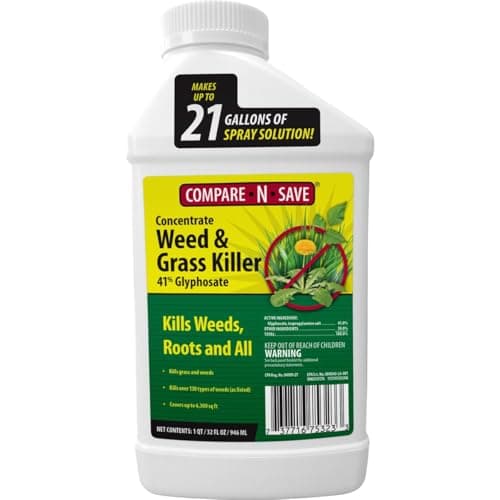
On a cool-season lawn, Illinois Extension's timing applies: it sprays glyphosate from June to August, when the plant is at least 18 inches tall and until it starts to flower, at a 2% solution by volume in water. Mississippi State adds that the plant should be actively growing and free of adverse environmental conditions. In a mowed lawn, I'd mow around the clump for a few weeks so there's enough leaf to take the spray, then reseed or sod the dead spot with your lawn grass.
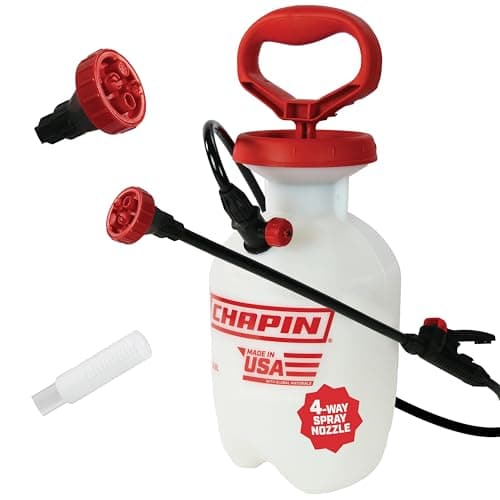
Work with a hand-pump sprayer on a calm morning, and shield the turf around the clump with a piece of cardboard. The tank mix calculator turns a percentage like 2% into ounces for a one-gallon sprayer. Mississippi State's table lists 32 herbicides and premixes that control Johnson grass across many application sites, sulfosulfuron among them, and it sends you to each label for sites and rates. On bermuda, the guide to bermuda-safe weed control covers what else you can spray without losing the lawn.
- The label is the law. Mix at the rate printed on the product you bought, and stay within Certainty's limit of 2 applications a year.
- Illinois Extension's rates (2% glyphosate, or sulfosulfuron at 1 to 1.5 ounces per 100 gallons with 0.25% nonionic surfactant) come from its invasive species page. Your county extension office can confirm timing and rates for your region.
- Mississippi State reports glyphosate-resistant Johnson grass in that state. If a clump survives two rounds, get a local recommendation.
- Check the glyphosate label's waiting period before you reseed or sod.
Should You Pull Johnson Grass?
Pull seedlings, dig small clumps, and spray established patches. Mississippi State says hand removal is difficult because Johnson grass has long rhizomes, though it may be feasible for small patches in a landscape or vegetable garden. Leave a rhizome piece behind and it can sprout.
A seedling with the seed still attached comes out clean if the soil is moist. A clump that has been there a season needs a spade. Get the blade under it, lift the whole root mass, and sift the soil with your fingers for white rhizome pieces. Bag them; don't compost them.
Mowing alone won't finish it either. Illinois Extension says mowing can keep the plant from flowering and spreading seed but won't eradicate it, and Mississippi State agrees that mowing does not generally eradicate Johnson grass. Keep the mower on it to stop the seed while you work on the roots.
Where Johnson Grass Gets Into a Lawn
NC State notes that Johnson grass is uncommon in turf and doesn't grow well under frequent, close mowing. It lives on roadsides, pastures, and disturbed fields. So when a homeowner calls me about it, I don't start in the middle of the yard. I walk the edges: the back fence, the ditch, the corner behind the shed the mower skips, and the low spot somebody filled last spring.
A homeowner trucks in a load of fill to level a wet corner, seeds it, and by midsummer there's a clump of broad, white-striped grass standing above everything around it. Mississippi State says Johnson grass spreads through rhizomes in soil, seed on equipment, and contaminated seed or hay, and that moving contaminated soil spreads it too. Ask where your soil came from before it's dumped in the yard.
A strip along the fence that the mower never touches is where plants get tall enough to flower and drop seed. Illinois Extension warns that tilling an infested spot can move rhizome pieces into clean ground, and the Washington board says repeated tillage, preferably monthly, is effective, while a single pass lets rhizomes re-sprout and the patch spread. Mow the edges as often as the lawn, and if you till a patch, keep at it.
How to Keep Johnson Grass From Coming Back
NC State's prevention advice for perennial grass weeds in turf comes down to three habits. Mow at the recommended height for your grass and remove clippings when grassy weeds have seed heads. Fertilize with the right amount of nitrogen at the right time for your grass type. Use a soil test to set nutrients and lime.
Two more habits help. Mississippi State notes that Johnson grass generally doesn't tolerate deep shade, and a thick, well-fed lawn gives it less open ground to take. Walk the edges every few weeks through summer and deal with each new sprout while it's small. The mowing height calculator gives you the height for your grass.
Put a Name on It Before You Mix Anything
Crabgrass, dallisgrass, and young Johnson grass look alike when they're small. Spraying glyphosate on a patch of crabgrass costs you a lawn patch to kill an annual that a pre-emergent would have stopped. Snap the leaf, the collar, and the seed head with the free photo diagnosis, or run a picture through the weed identifier.
Once you know what you're dealing with, WGIS Premium adds seasonal reminders timed to your ZIP code and grass for the mowing and feeding that keep the edges thick, and you can set your own reminder for the follow-up spray.
Your Johnson Grass Action Plan
- Confirm the ID: a white midrib, thick rhizomes, and a purplish panicle. Use the comparison table or a free photo diagnosis.
- Pull seedlings with the seed attached, and dig small clumps with every rhizome piece.
- Bermuda, zoysia, St. Augustine, or centipede: spray actively growing Johnson grass with Certainty and nonionic surfactant at the label rate, with no mowing for at least 2 days on either side. Test St. Augustine on a small area first.
- Tall fescue or bluegrass: let the clump reach at least 18 inches between June and August, spot-spray glyphosate before it flowers, then reseed or sod the dead spot.
- Check back in 4 weeks and re-treat regrowth within the label's limits.
- Mow the edges, bag clippings when seed heads show, and check where fill soil came from.
Free Lawn Care Tools
Johnsongrass has limited value as livestock forage, and that use carries a real risk. Mississippi State says it was introduced as a forage grass in the early 1800s but can cause cyanide poisoning in livestock, especially after stress such as cutting, frost, or chemical application that causes wilting. In a lawn it has no use, so remove it.
Its main disadvantages are aggressive spread, livestock poisoning risk, and sheer size. Mississippi State says it forms dense stands that replace surrounding vegetation, can poison livestock with cyanide, and grows tall enough to block visibility on roadsides. Illinois Extension adds that its sharp leaves can cut skin, so wear gloves when you handle it.
Yes, Johnsongrass is invasive. Illinois Extension lists it as an invasive species and noxious weed in Illinois and as invasive in 23 other states, and Washington State lists it as a Class A noxious weed. The USDA PLANTS database records it as an introduced species in the lower 48 states.
Johnsongrass spreads quickly, and UC IPM says it rapidly produces colonies from both rhizomes and seed. Mississippi State adds that seed travels on equipment and in contaminated hay, and rhizomes travel in soil, so one clump can start a new patch somewhere else. No fact sheet gives a speed, so check your lawn edges every few weeks in summer.
Johnson grass roots form an extensive system of long, thick rhizomes, per the Washington State Noxious Weed Control Board and Mississippi State, which is why hand removal is difficult. UC IPM describes them as fleshy and segmented, and each segment can sprout. None of these fact sheets gives a depth figure, so dig out the whole root mass.
Control Johnsongrass in a warm-season lawn with sulfosulfuron (Certainty), whose label lists Johnsongrass on bermuda, zoysia, St. Augustine, and centipede at 1.25 to 2.0 ounces of product per acre. In tall fescue or bluegrass, spot-spray glyphosate once plants reach 18 inches, per Illinois Extension. Dig small clumps and mow to stop seeding.
Sources (12)
- Certainty Turf Herbicide (sulfosulfuron) EPA-accepted label, EPA Reg. No. 59639-226
- NC State Extension TurfFiles: Johnsongrass
- UC IPM: Johnsongrass
- Mississippi State University Extension: Johnsongrass
- Illinois Extension: Johnsongrass (Illinois Grasses)
- Illinois Extension: Invasive Johnsongrass
- Washington State Noxious Weed Control Board: Johnsongrass
- USDA PLANTS Database: Sorghum halepense
- NC State Extension TurfFiles: Large Crabgrass
- NC State Extension TurfFiles: Dallisgrass
- UC IPM: Dallisgrass
- UC IPM: Quackgrass

Your lawn plan, in your pocket all season
Grass ID, a season plan, soil-timed reminders, and a lawn journal that remembers what you did. Free on iPhone.
Related Articles
 Problem Solving
How to Get Rid of Stickers in Your Yard (Burweed, Sandburs and Goatheads)
Sep 17, 2026•5 min read Problem Solving
Weeds in St. Augustine Grass: How to Identify the Lookalikes and Kill Them Safely
Sep 16, 2026•5 min read Problem Solving
Weeds With Purple Flowers: Identify What's Blooming in Your Lawn
Aug 12, 2026•6 min read